Follow eufisica

Follow eufisica

Showing posts with label earth. Show all posts

Saturday, October 3, 2015

Escape Velocity

In physics, escape velocity is the minimum speed needed for an object to "break free" from the gravitational attraction of a massive body. More particularly, escape velocity is the velocity (speed traveled away from the starting point) at which the sum of an object's kinetic energy and its gravitational potential energy is equal to zero. At escape velocity the object will move away forever from the massive body, without additional acceleration applied to the object. As the object moves away from the massive body, the object will continually slow and asymptotically approach zero speed as the object's distance approaches infinity.
For a spherically symmetric massive body such as a (non-rotating) star or planet, the escape velocity at a given distance is calculated by the formula
v_e = \sqrt{\frac{2GM}{r}},
where G is the universal gravitational constant (G = 6.67×10⁻¹¹ m3 kg−1 s−2), M the mass of the body to be escaped, and r the distance from the center of mass of the mass M to the object. Notice that the relation is independent of the mass of the object escaping the mass body M. Conversely, a body that falls under the force of gravitational attraction of mass M from infinity, starting with zero velocity, will strike the mass with a velocity equal to its escape velocity.
In this equation atmospheric friction (air drag) is not taken into account.
Source: Wikipedia

In hyperPhysics website you can input some data and it gives the escape velocity: http://hyperphysics.phy-astr.gsu.edu/hbase/vesc.html

See the escape velocity of Earth and Mars here: http://bit.ly/1iThICI

full computaion here http://wolfr.am/7ijFlEcl

Listen about escaping probes in this Astronomy Cast:


Saturday, September 19, 2015

Eratosthenes experiment


Source: wikipedia
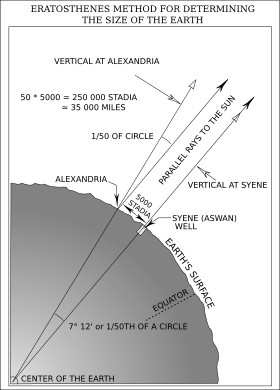
On Wednesday, at local noon, each school in different countries will conduct the Eratosthenes experiment.

Eratosthenes  of  Cyrene (276 aC – 195/194 aC) was a Greek mathematician, geographer, poet, astronomer, and music theorist. He was a man of learning, becoming the chief librarian at the Library of Alexandria. He invented the discipline of Geography, including the terminology used today. He is best known for being the first person to calculate the circumference of the Earth, which he did by applying a measuring system using stadia, a standard unit of measure during that time period. His calculation was remarkably accurate. He was also the first to calculate the tilt of the Earth's axis (again with remarkable accuracy).

To conduct the experiment and exchange data with other schools please go to this website: eratosthenes.ea.gr

You can also participate in the photo contest.

Be part of the Galileo Teacher Program (connecting teachers in all countries).

Monday, April 23, 2012

First Earthrise over Moon recreated


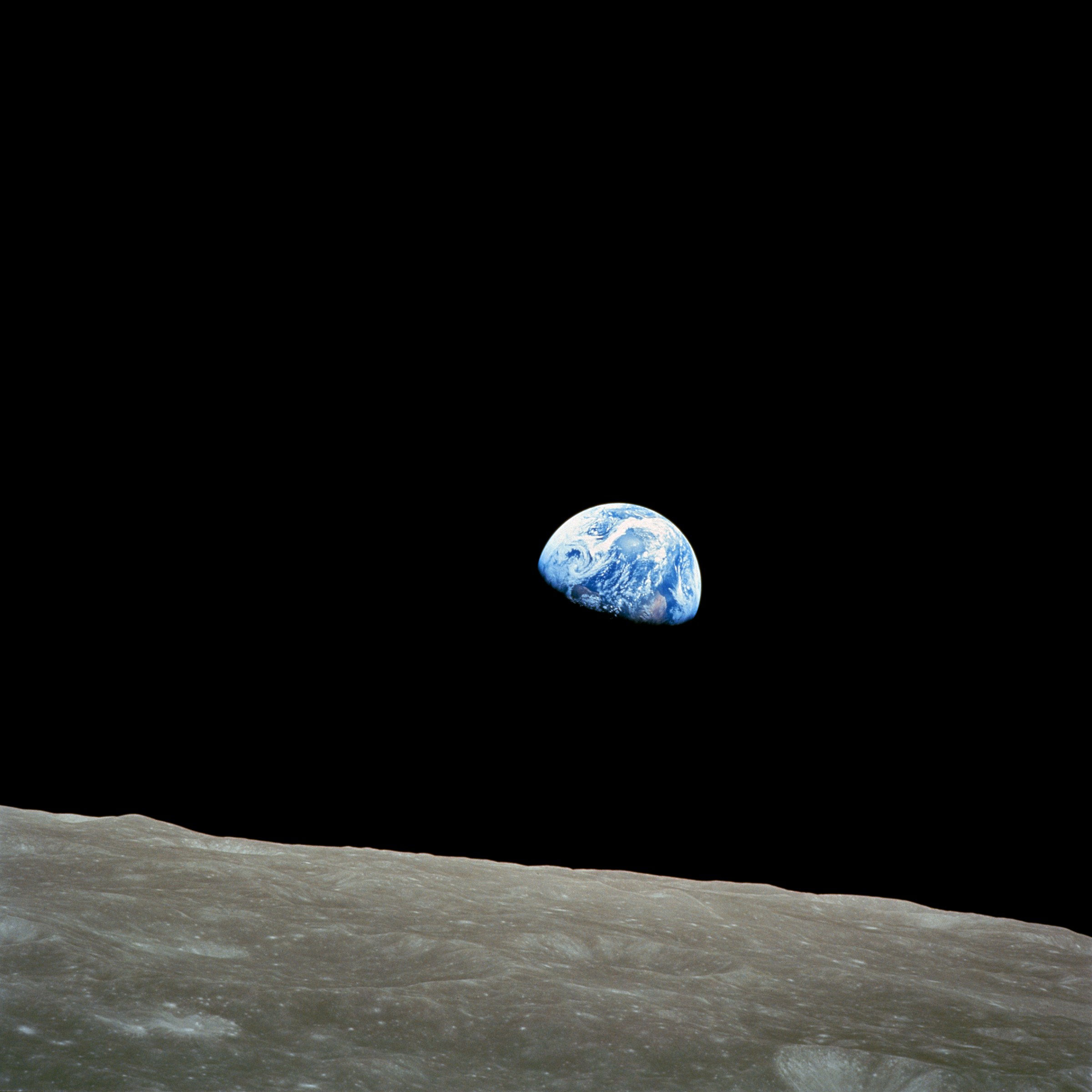
In 1968, the crew of Apollo 8 became the first humans to witness and photograph the Earth appearing to rise over the horizon of the moon. 
In 2012, NASA has used data from the Lunar Reconnaissance Orbiter to show the experience in stunning detail. 

Watch the video and click here to get an image in full resolution.


Monday, March 26, 2012

more questions about the origin of the moon

Moon. Photo courtesy of NASA 
(PhysOrg.com) -- It’s beguiled watchers since before records were kept, and today still, it fills poets with pensive musings, and scientists with enchanting questions. Where did the moon come from, and how did it get there? The prevailing view is that a planet named Theia entered out solar system and banged into our planet with sufficient force to push some of the molten material from our planet into orbit. Over time, that material coalesced to form the moon. Now, new research from geophysical scientist Junjun Zhang and colleagues, suggests that such thinking might be wrong. In their paper published in Nature Geoscience, they find that in comparing titanium isotopes from both the moon and the Earth, that the match is too close to support the theory that the moon could have been made partly of material from another planet. 
Video credit and more information in Space.com

Tuesday, January 31, 2012

Human activity, solar activity and global warming

A graph of the sun's total solar irradiance shows that in recent years irradiance dipped to the lowest levels recorded during the satellite era. The resulting reduction in the amount of solar energy available to affect Earth's climate was about .25 watts per square meter, less than half of Earth's total energy imbalance. Credit: NASA/James Hansen
A new NASA study underscores the fact that greenhouse gases generated by human activity -- not changes in solar activity -- are the primary force driving global warming.


A new NASA study underscores the fact that greenhouse gases generated by human activity -- not changes in solar activity -- are the primary force driving global warming.

"The fact that we still see a positive imbalance despite the prolonged solar minimum isn't a surprise given what we've learned about the climate system, but it's worth noting because this provides unequivocal evidence that the sun is not the dominant driver of ," Hansen said.

Hansen's team concluded that Earth has absorbed more than half a watt more solar energy per square meter than it let off throughout the six year study period. The calculated value of the imbalance (0.58 watts of excess energy per square meter) is more than twice as much as the reduction in the amount of solar energy supplied to the planet between maximum and minimum solar activity (0.25 watts per square meter).

According to calculations conducted by Hansen and his colleagues, the 0.58 watts per square meter imbalance implies that carbon dioxide levels need to be reduced to about 350 parts per million to restore the energy budget to equilibrium. The most recent measurements show that carbon dioxide levels are currently 392 parts per million and scientists expect that concentration to continue to rise in the future.
in NASA

Monday, January 9, 2012

The Tides

The Tidal Force
The tidal force is a secondary effect of the force of gravity and is responsible for the tides. It arises because the gravitational force per unit mass exerted on one body by a second body is not constant across its diameter, the side nearest to the second being more attracted by it than the side farther away. Stated differently, the tidal force is a differential force. Consider three things being pulled by the moon: the oceans nearest the moon, the solid earth, and the oceans farthest from the moon. The moon pulls on the solid earth, but it pulls harder on the near oceans, so they approach the moon more causing a high tide; and the moon pulls least of all on the far oceans (on the other side of the planet), so they stay behind more, causing another high tide at the same time. If we imagine looking at the Earth from space, we see that the whole Earth was pulled, but the near oceans more and the far oceans less; the far oceans stayed behind since they are pulled less (since they are farther away).
in Wikipedia


More information in How Stuff Works


Tuesday, December 20, 2011

NASA Discovers First Earth-size Planets Beyond Our Solar System

An artist's concept of Kepler-20e
This artist's conception illustrates Kepler-20e.
Image credit: NASA/Ames/JPL-Caltech
The discovery marks the next important milestone in the ultimate search for planets like Earth. The new planets are thought to be rocky. Kepler-20e is slightly smaller than Venus, measuring 0.87 times the radius of Earth. Kepler-20f is a bit larger than Earth, measuring 1.03 times its radius. Both planets reside in a five-planet system called Kepler-20, approximately 1,000 light-years away in the constellation Lyra.

An artist's concept of Kepler-20f
This artist's conception illustrates Kepler-20f.
Image credit: NASA/Ames/JPL-Caltech


Kepler-20e orbits its parent star every 6.1 days and Kepler-20f every 19.6 days. These short orbital periods mean very hot, inhospitable worlds. Kepler-20f, at 800 degrees Fahrenheit, is similar to an average day on the planet Mercury. The surface temperature of Kepler-20e, at more than 1,400 degrees Fahrenheit, would melt glass.

from NASA


Saturday, November 12, 2011

Research by Assistant Professor Aleksey Smirnov and colleagues from University of Rochester indicates that the earth's inner core is much older than we thought.

"Aleksey Smirnov, assistant professor of geophysics, with colleagues from the University of Rochester and Yale University, has discovered that the earth’s inner core could actually be at least 1.2 billion years older than previously thought."
in PhysOrg.com 

Tuesday, August 9, 2011

Anel de Antipartículas da Terra


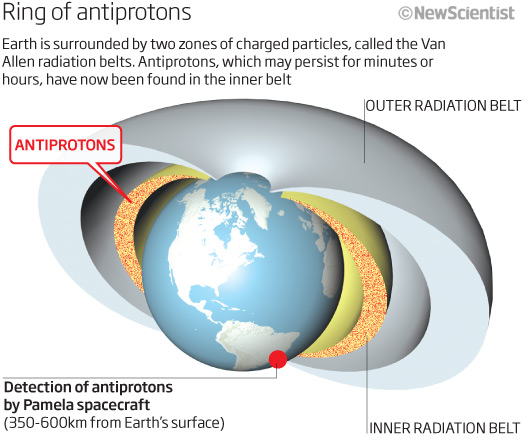
Um artigo publicado pela New Scientist, no dia 04 de Agosto, revela que a Terra tem um anel de antiprotões confinado pelo campo magnético terrestre. A antimatéria poderia, em teoria, ser usado para abastecer foguetes ultra-eficientes do futuro (ler aqui e aqui).
Trajectória dos antiprotões nas linhas de  
campo magnético.
Estas linhas fazem parte da cintura de
radiação interna.
Os satélites já tinham descoberto positrões - os parceiros de antimatéria dos elétrões - na cintura de radiação. Agora, uma sonda detectou antiprotões, que são cerca de 2000 vezes mais massivos. Para o efeito, foi usado o PAMELA, um detector de raios cósmicos ligado a um satélite de observação russo. A nave voa através do interior da cintura interna de radiação da Terra sobre o Atlântico sul.
Entre julho de 2006 e dezembro de 2008, o PAMELA detectou antiprotões presos em órbitas espirais em torno das linhas do campo magnético que brotam do pólo sul da Terra. As amostras do PAMELA são apenas uma pequena parte da cintura de radiação interna, mas os antiprotões deverão, provavelmente, estar presos ao longo dessa cintura.


Fonte:  
New Scientist
Artigo para publicação em arXiv.org

Artigo completo publicado na astropt.org

Friday, July 15, 2011

Measuring the Earth-Sun distance during a lunar eclipse

Lunar Eclipse. Credit: Fred Espenak


The classical method for measure the Earth-Sun distance is due to Aristarchus and it is based upon the measure of the angle Moon-Earth-Sun when the Moon is exactly in quadrature. [...]
Comments:3 pages, 2 figures. Proc. of "Einstein 120" conference, Kyrgyz State University, 12 September 1999, Bishkek, Kyrghizsthan
Subjects:Instrumentation and Methods for Astrophysics (astro-ph.IM); History and Philosophy of Physics (physics.hist-ph)
Journal reference:"Einstein 120" conference,V. Gurovich ed., Kyrgyz State University, Bishkek, Kyrghizsthan, 2000
Cite as:arXiv:1107.0836v1 [astro-ph.IM]

Monday, March 7, 2011

The lost carbon...

An international team of scientists begins a ten year survey of the 'most important element'

Deep beneath the surface of the Earth, a vast and unseen community of strange, microscopic lifeforms quietly subsists on the heat rising from our planet's interior.

Sunday, January 23, 2011

NASA scientist tremor claim - Chile quake has shifted the Earths axis - News - Bild.de

NASA scientist tremor claim - Chile quake has shifted the Earths axis - News - Bild.de (full reading)
The catastrophic earthquake in Chile has shifted the axis of the earth and shortened the length of a day, according to NASA scientists.
“Any worldly event that involves the movement of mass affects the Earth's rotation,” explained NASA scientist Benjamin Fong Chao from the Goddard Space Center in Greenbelt to CNN.
"The resulting vibrations can influence the distribution of mass on the planet and can have an effect on the speed of the Earth’s rotation and the gradient of the axis of the earth. The days will become shorter through this.”
NASA research scientist Richard Gross confirmed the movement of the Earth’s axis. He used a computer model to discover that it has shifted by around eight centimetres.

Thursday, August 26, 2010

What's Left?

What's Left?

A graphical accounting of the limits to what one planet can provide


We have to worry with Global Warming, but also with another problem: We are running out on resources.
The info-graphics produced by Michael Moyer, shows us a world that's almost without resources and running for its extinction. 
Is the planet overpopulated?
Image: www.pixmac.com

The exponential growth of human population peaked in 1987. That year 87.01 million more people were added to the Earth. Since 1987, the population has declined on average by 2.1 million less people added per year. In this year of 2000 the population will increase by 60.1 million people. If we maintain this 13 year average of 2.1 million less people added per year, we will peak in population reaching zero population growth in 2029 with 6.90 billion people.

The decline of human population has been even more dramatic over the last 6 years. In 1994 we added 78.5 million more people, this year we will add 60.1 million. This is a decline of 3 million less people added per year. If we maintain this 6 year average of 3 million less people added per year, we will peak in population reaching zero population growth in 2020 with 6.64 billion people.

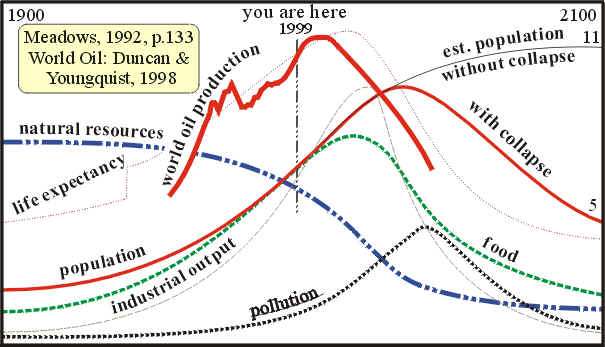
United Nations expects that we'll have ten billions of people in 2050 and we rich the limit of 11 billions in 2100.
In the following graph we denote that resources are falling and the population will stop growing in a near future.
Image from: http://www.oilempire.us/oil-jpg/Yourhere.jpg
Are we lost or have a salvation?

Time Lapse from Space - Earth

Thursday, July 15, 2010

Solar Eclipse

A total solar eclipse arced across the southern Pacific Ocean Sunday, blotting out the sun and offering stunning views to skywatchers, some of whom ventured to remote islands or rode cruise ships just to see the event. in space.com

As seen from the Earth, a solar eclipse occurs when the Moon passes between the Sun and the Earth, and the Moon fully or partially covers the Sun as viewed from a location on Earth. This can only happen during a new moon, when the Sun and Moon are in conjunction as seen from Earth. font wikipedia

300px-Geometry_of_a_Total_Solar_Eclipse.svg[1]

Image represents a schematic representation of solar system (from wikipedia)

Featured Post

IBSE about Light Pollution

Here is my presentation that happened in the Discover the Cosmos Conference (Volos, Greece - 2013). The presentation was an Inquiry Base...

Popular Posts