Follow eufisica

Follow eufisica

Showing posts with label forces. Show all posts

Friday, December 7, 2018

The Physics of Spiderman 3


Spiderman 3. Credit: Sony Pictures

There is an article in Popular Science related with the Physics of Spiderman 3, specially when Spiderman fall several times without breaking a bone.
The calculus are demonstrated in the webpage and the force is something about 400000 Newtons!!! 
And an acceleration around 6000 m/s2 (~600 x gravity acceleration), 2 times higher than some insects acceleration.

If you considered the mass of ISS (~450 000 kg), the weight will be 4,5 MN. Comparing the Force applied by gravity on the ISS and the force of the ground in Spiderman's feet (0,4 MN), we will have: 

F(ISS) = 11 F(Spiderman) 

Comparing with a person with mass equal to 75 kg (750N), the force due to gravity in the ISS compared with person's weight will be:

F(ISS) = 6 000 F(person)

So, the force of the ground in Spideman's feet is 533 times greater than the person's weight.

Saturday, March 1, 2014

The Physics of Skiing

Image from: uk.eurosport.yahoo.com Credit: Reuters
I was watching TV last night about skiing in The Sochi 2014 Winter Olympics (just try Sochi in Google) and I found myself thinking the Physics behind it.
It was evident that we have energy transformation (from potential to kinetics): 
"As the skier begins the descent down the hill, potential energy is lost and kinetic energy (i.e., energy of motion) is gained. As the skier loses height (and thus loses potential energy), she gains speed (and thus gains kinetic energy). Once the skier reaches the bottom of the hill, her height reaches a value of 0 meters, indicating a total depletion of her potential energy. At this point, her speed and kinetic energy have reached a maximum. This energy state is maintained until the skier meets a section of unpacked snow and skids to a stop under the force of friction. The friction force, sometimes known as a dissipative force, does work upon the skier in order to decrease her total mechanical energy. Thus, as the force of friction acts over an increasing distance, the quantity of work increases and the mechanical energy of the skier is gradually dissipated. Ultimately, the skier runs out of energy and comes to a rest position. Work done by an external force (friction) has served to change the total mechanical energy of the skier." (in Physics Classroom)
 The NSF has a great video about this topic:


I found that all the materials must be design to support bumps and torsion:
"Ski materials have received an equally extensive makeover. Engineers are continually working to make skis lighter and more flexible to absorb bumps in the snow, while keeping them rigid enough to hold their shape during turns. For that reason, metal skis were introduced in the 1950s. Today’s skis, because of their broader tips and tails, have to endure torsional forces that skis of the past could not have withstood. Most skis are now made of sandwiches of fiberglass, wood, aluminum alloys, glue, and polymers." (in Discover Magazine)
They running with a crouch position to reduce drag force:
"A skier maximizes his speed by minimizing resistance to motion, both from air resistance and snow resistance. A skier minimizes his air resistance (drag) by reducing his projected frontal area. He does this by going into a crouch position, which (along with improving his ability to hold balance) results in a lower drag force, which acts in a direction opposite his velocity, slowing him down. The picture below shows a downhill skier in a crouch position." (in Real World Physics Problems)
 And they have curved skies to prevent slipping on snow:
force applied to ski on sloped snow surface to avoid slipping

"To prevent slipping, the angle ψ must be greater than or equal to 90° . This means that the component of FR parallel to the plane of the ski, will either be zero (for ψ = 90°), or it will point directly into the snow, towards the right (for ψ > 90°), and the "wall" of snow will prevent it from slipping." (in Real World Physics Problems)


What a great sport!


Thursday, July 25, 2013

Black-Body Radiation and Gravity

Blackbody radiation induces attractive force stronger than gravity
Artistic visualization of the interaction between an atom and a Black-Body. Due to the atractive force of the Black-Body, the atom is pulled to the direction of this body. Credit: M. Sonnleitner, et al. ©2013 American Physical Society
The black-body objects are perfect not-reflectors that produce constant radiation when they are at a uniform temperature. Thus, the properties of a black-body depends on its temperature, thinking that this radiation would have a repulsive effect. Now a new, scientists have demonstrated theoretically that black-body radiation induces a second force in atoms and molecules that are near its surface which is attractive and stronger than the repulsive radiation pressure. Consequently, the atoms and molecules are pulled to the surface of the black-body by a force which may be greater than gravity. The new attractive force - what scientists describe as "black-body force" - suggests that a variety of astrophysical scenarios need to be revisited.
blackbody_radn_curves_Swinburne University of Technology
À medida que a temperatura diminui, o pico da curva da radiação de um corpo negro se desloca para menores intensidades e maiores comprimentos de onda.
Scientist identify a few interesting results in their formulation. First, this force decays with the third power of the distance to the black-body (F ∝ 1/r3). Second, it is more stronger for small objects. Third, the force is more stronger for warmer objects. Above a few thousand degrees Kelvin, the force of attraction changes to repulsion.
In their study, scientists demonstrated that the strength of the black-body in a grain of dust, at a temperature of 100 K, is much stronger than the gravitational force in this grain. However, for a massive star at a temperature of 6000 K black-body force is much weaker than the gravitational force.
Scientific Article: M. Sonnleitner, et al. “Attractive Optical Forces from Blackbody Radiation.” PRL 111, 023601 (2013). DOI: 10.1103/PhysRevLett.111.023601

Tuesday, March 13, 2012

Angry Birds Space: NASA announcement

Angry Birds is a good way to teach Physics. Topics like kinematics (motion, velocity, acceleration), dynamics (force, collisions), and energy are great to learn with that game.
Techradar website explores velocity and distance (post 1) and stretching and collisions (post 2);
wired website explores the elastic force, acceleration and analysis.http://www.wired.com/wiredscience/2011/11/physics-of-the-yellow-angry-bird/


Angry Birds Space is coming and NASA made "the announcement":

Tuesday, February 7, 2012

Sunday, January 29, 2012

Newton's Laws Summary

Isaac Newton (1642-1727). Credit: Wikipedia
Newton's Laws:
I. Every object in a state of uniform motion or at rest (FR = 0) tends to remain in that state of motion unless an external force is applied to it (FR≠0).

II. The relationship between an object's mass m, its acceleration a, and the applied force F is F = m a. Acceleration and force are vectors (as indicated by their symbols being displayed in slant bold font); in this law the direction of the force vector is the same as the direction of the acceleration vector. The expression brings the relation between dynamics and kinematics.
III. For every action there is an equal and opposite reaction.


Thursday, January 26, 2012

Airflow across a wing

Credit: Wikipedia
"It is often said that the lift on a wing is generated because the flow moving over the top surface has a longer distance to travel and therefore needs to go faster. This common explanation is actually wrong." Here, aerodynamics expert Professor Holger Babinsky from the University of Cambridge's Department of Engineering debunks a popular, yet misleading, explanation of how wings lift.


Monday, January 9, 2012

The Tides

The Tidal Force
The tidal force is a secondary effect of the force of gravity and is responsible for the tides. It arises because the gravitational force per unit mass exerted on one body by a second body is not constant across its diameter, the side nearest to the second being more attracted by it than the side farther away. Stated differently, the tidal force is a differential force. Consider three things being pulled by the moon: the oceans nearest the moon, the solid earth, and the oceans farthest from the moon. The moon pulls on the solid earth, but it pulls harder on the near oceans, so they approach the moon more causing a high tide; and the moon pulls least of all on the far oceans (on the other side of the planet), so they stay behind more, causing another high tide at the same time. If we imagine looking at the Earth from space, we see that the whole Earth was pulled, but the near oceans more and the far oceans less; the far oceans stayed behind since they are pulled less (since they are farther away).
in Wikipedia


More information in How Stuff Works


Tuesday, November 29, 2011

The Magnus Force


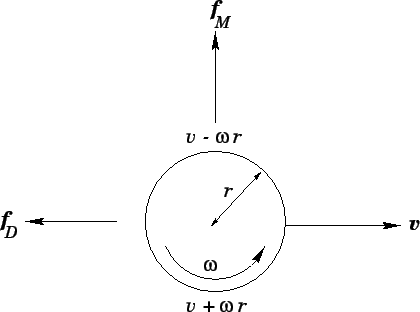
The Magnus effect, demonstrated on a ball. v represents the wind velocity, the arrow F the resulting force towards the side of lower pressure. (from: wikipedia)


The Magnus effect is the phenomenon whereby a spinning object flying in a fluid creates a whirlpool of fluid around itself, and experiences a force perpendicular to the line of motion.
In fluid dynamics, Bernoulli's principle states that for an inviscid flow, an increase in the speed of the fluid occurs simultaneously with a decrease in pressure or a decrease in the fluid's potential energy. But it doesn't mention the effect when an object is spinning through a fluid (that's what happened in Magnus effect), that has an incremental energy due to the spinning object.


Principle

When a body (such as a sphere or circular cylinder) is spinning in a viscous fluid, it creates a boundary layer around itself, and the boundary layer induces a more widespread circular motion of the fluid. One explanation of the Magnus effect is since there is more (forward) acceleration of air on the forward-moving side than the backward-moving side, there is more pressure on the forward-moving side, resulting in a perpendicular component of force from the air towards the backward-moving side (watch the video bellow).

\begin{figure}
\epsfysize =2.75in
\centerline{\epsffile{magnus.eps}}
\end{figure}

Calculation of Magnus force

Given the angular velocity vector \vec{\omega} and velocity \vec{v} of the object, the resulting force \vec{F_M} can be calculated using the following formula:

\vec{F_M} = S (\vec{\omega}\times\vec{v})
where S is dependent on the average of the air resistance coefficient across the surface of the object.[8] The \times denotes the vector cross product.


An example of spin ball in the air

The following equation demonstrates the lift force induced on a ball that is spinning along an axis of rotation perpendicular to the direction of its translational motion:
{F}=\frac{1}{2} \rho  v^2 A C_L
F = lift force
ρ = density of the fluid
r = radius of the ball
v = velocity of the ball
A = cross-sectional area of ball
CL = lift coefficient
The lift coefficient CL may be determined from graphs of experimental data using Reynolds numbers and spin ratios.[9] For a smooth ball with spin ratio of 0.5 to 4.5, typical lift coefficients range from 0.2 to 0.6.


Saturday, April 30, 2011

Tension between droplets and solids


In PhysicsToday.org we found this paper about the tension of a droplet in a solid surface:


"(...) researchers at Yale University and at consumer products manufacturer Unilever have experimentally and theoretically resolved the out-of-plane contributions. Using a confocal fluorescence microscope, the researchers, led by Yale’sEric Dufresne, laced a 20-micron-thick film of silicone gel with fluorescent beads and measured the deformation due to a water droplet. At equilibrium, a one-micron-high ridge, illustrated in the inset, formed in the gel at the contact line. When the researchers factored the gel’s surface tension and thickness into a linear elastic model, they arrived at a nonsingular theoretical solution for stress that closely fit their experimental data. Their model, however, underestimates the deformations in the solid-liquid contact plane, which they believe are caused by pinning or viscous drag. (E. Jerison et al., Phys. Rev. Lett., in press.)—Jermey N. A. Matthews"


in PhysicsToday

Featured Post

IBSE about Light Pollution

Here is my presentation that happened in the Discover the Cosmos Conference (Volos, Greece - 2013). The presentation was an Inquiry Base...

Popular Posts