

Showing posts with label NASA. Show all posts
Showing posts with label NASA. Show all posts
Monday, February 22, 2021

Saturday, February 20, 2021
Rover Perseverance and Jezero's Crater
 |
| Perseverance first photography of landed site. Credit: NASA/JPL |
The Mars' rover, Perseverance, landed and it started to photograph the landscape of Jezero's crater site.
You can check an interactive map of the site here: https://www.esa.int/Science_Exploration/Space_Science/Mars_Express/An_interactive_map_to_explore_Jezero_crater
Or check this video made by ESA/DLR/FU Berlin:
Thursday, February 4, 2021
Rover Perseverance
 |
| Mission Patch. Credits: NASA |
The Rover Perseverance will be landing on Mars in February 18.
In the mean while, you can check information in this flyer or download the PDF
Credits: NASA
Friday, September 16, 2016
Solar prominence
 |
| Image credit: NASA |
Do you want to know what is a solar prominence?
Check this video from NASA.
Sunday, December 22, 2013
The Sun's Magnetic Field is About to Flip.
The sun's magnetic field changes polarity approximately every 11 years. It happens at the peak of each solar cycle as the sun's inner magnetic dynamo re-organizes itself.
A reversal of the sun's magnetic field is, literally, a big event. The domain of the sun's magnetic influence (also known as the "heliosphere") extends billions of kilometers beyond Pluto. Changes to the field's polarity ripple all the way out to the Voyager probes, on the doorstep of interstellar space.

An artist's concept of the heliospheric current sheet, which becomes more wavy when the sun's magnetic field flips.
When solar physicists talk about solar field reversals, their conversation often centers on the "current sheet." The current sheet is a sprawling surface jutting outward from the sun's equator where the sun's slowly rotating magnetic field induces an electrical current. The current itself is small, only one ten-billionth of an amp per square meter (0.0000000001 amps/m2), but there’s a lot of it: the amperage flows through a region 10,000 km thick and billions of kilometers wide. Electrically speaking, the entire heliosphere is organized around this enormous sheet.
During field reversals, the current sheet becomes very wavy.
Cosmic rays are also affected. These are high-energy particles accelerated to nearly light speed by supernova explosions and other violent events in the galaxy.
"The sun's north pole has already changed sign, while the south pole is racing to catch up," Scherrer said. "Soon, however, both poles will be reversed, and the second half of solar max will be underway."
Source: NASA
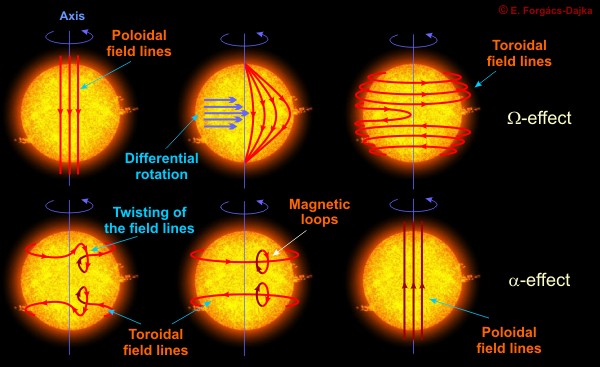
"The changing magnetic field is described by dynamo models: the rotation takes effect on the convective envelope and the result is the surface differential rotation, when the angular rotation has an equator-to-pole gradient. Differential rotation acts on the primordial poloidal field, and starts to build up a toroidal one (see the figure). Under the surface, somewhere at the bottom of the convective zone, this spin up effect streches, thus reinforces the toroidal field until it becomes an unstable state, when the buoyant force begins to act on them. Thus, the toroidal magnetic field arranged in vast flux tubes begins to emerge and reaches the solar surface. At this time, a typical magnetic feature appears: a magnetic loop, with a cool bipolar spot pair at the footpoints. The large scale meridional convection works just the opposite: somehow (that we do not understand clearly) it regenerates the poloidal field, transporting the emerging flux towards the poles. Finally, this process results in a poloidal field, similar to that we had at the beginning, but the polarity is now the opposite in sign."Source: http://www.konkoly.hu/solstart/stellar_activity.html
Tuesday, August 20, 2013
NASA Spinoff 2012

Tuesday, June 18, 2013
Flames in the ISS

Candle Flames in Microgravity
Microgravity experiments using drop towers and Space Shuttle Orbiters have provided scientists valuable insights on how things burn. In the typical experiment, a flammable material, such as a candle, is ignited by a hot wire.
The picture illustrate a combustion experiment conducted at the NASA Lewis Research Center 132 Meter Drop Tower. These pictures of a candle Candle Flames in Microgravity flame. As the picture illustrate, the flame stabilized, and its shape appears to be constant throughout the remainder of the drop. Instead of the typical teardrop shape seen on Earth, the microgravity flames becomes spherical. On Earth, the flame is drawn into a tip by the rising hot gases. However, convection currents are greatly reduced in microgravity. Fresh oxygen is not being delivered to the candle by these currents. Instead, oxygen works it way slowly to the flame by the process of diffusion. Soon, the flame temperature begins to drop because the combustion is less vigorous. The lower temperature slows down the melting and vaporization of the candle wax. Candles onboard the first United States Microgravity Laboratory, launched in June 1992, burned from 45 seconds to about 1 minute before being extinguished because of the dropping temperature and reduction of wax vapor.
From: NASA
Combustion, Complex Fluids, and Fluid Physics Experiments on the ISS
Motil, Brian; Urban, David
(NASA Glenn Research Center; Cleveland, OH, United States)
Abstract
From the very first days of human spaceflight, NASA has been conducting experiments in space to understand the effect of weightlessness on physical and chemically reacting systems. NASA Glenn Research Center (GRC) in Cleveland, Ohio has been at the forefront of this research looking at both fundamental studies in microgravity as well as experiments targeted at reducing the risks to long duration human missions to the moon, Mars, and beyond. In the current International Space Station (ISS) era, we now have an orbiting laboratory that provides the highly desired condition of long-duration microgravity. This allows continuous and interactive research similar to Earth-based laboratories. Because of these capabilities, the ISS is an indispensible laboratory for low gravity research. NASA GRC has been actively involved in developing and operating facilities and experiments on the ISS since the beginning of a permanent human presence on November 2, 2000. As the lead Center both Combustion, Fluid Physics, and Acceleration Measurement GRC has led the successful implementation of an Acceleration Measurement systems, the Combustion Integrated Rack (CIR), the Fluids Integrated Rack (FIR) as well as the continued use of other facilities on the ISS. These facilities have supported combustion experiments in fundamental droplet combustion fire detection fire extinguishment soot phenomena flame liftoff and stability and material flammability. The fluids experiments have studied capillary flow magneto-rheological fluids colloidal systems extensional rheology pool and nucleate boiling phenomena. In this paper, we provide an overview of the experiments conducted on the ISS over the past 12 years. We also provide a look to the future development. Experiments presented in combustion include areas such as droplet combustion, gaseous diffusion flames, solid fuels, premixed flame studies, fire safety, and super critical oxidation processes. In fluid physics, experiments are discussed in multiphase flows, capillary phenomena, and heat pipes. Finally in complex fluids, experiments in rheology and soft condensed materials will be presented.
Read the paper here [pdf].
You can conduct a classroom activity:
1) Candle flame in microgravity;
2) Educator guide.
You can conduct a classroom activity:
1) Candle flame in microgravity;
2) Educator guide.
Wednesday, April 24, 2013
NASA | SDO: Three Years of Sun in Three Minutes
Three years of Sun in three minutes
In the three years since it first provided images of the sun in the spring of 2010, NASA's Solar Dynamics Observatory (SDO) has had virtually unbroken coverage of the sun's rise toward solar maximum, the peak of solar activity in its regular 11-year cycle. This video shows those three years of the sun at a pace of two images per day.
SDO's Atmospheric Imaging Assembly (AIA) captures a shot of the sun every 12 seconds in 10 different wavelengths. The images shown here are based on a wavelength of 171 Angstroms, which is in the extreme ultraviolet range and shows solar material at around 600,000 Kelvin. In this wavelength it is easy to see the sun's 25-day rotation as well as how solar activity has increased over three years.
During the course of the video, the sun subtly increases and decreases in apparent size. This is because the distance between the SDO spacecraft and the sun varies over time. The image is, however, remarkably consistent and stable despite the fact that SDO orbits the Earth at 6,876 miles per hour and the Earth orbits the sun at 67,062 miles per hour.
Such stability is crucial for scientists, who use SDO to learn more about our closest star. These images have regularly caught solar flares and coronal mass ejections in the act, types of space weather that can send radiation and solar material toward Earth and interfere with satellites in space. SDO's glimpses into the violent dance on the sun help scientists understand what causes these giant explosions -- with the hopes of some day improving our ability to predict this space weather.
There are several noteworthy events that appear briefly in this video. They include the two partial eclipses of the sun by the moon, two roll maneuvers, the largest flare of this solar cycle, comet Lovejoy, and the transit of Venus. The specific time for each event is listed below, but a sharp-eyed observer may see some while the video is playing.
00:30;24 Partial eclipse by the moon
00:31;16 Roll maneuver
01:11;02 August 9, 2011 X6.9 Flare, currently the largest of this solar cycle
01:28;07 Comet Lovejoy, December 15, 2011
01:42;29 Roll Maneuver
01:51;07 Transit of Venus, June 5, 2012
02:28;13 Partial eclipse by the moon
More information about this video, as well as full HD version of all four wavelengths and print-resolution stills are public domain and can be viewed and downloaded at: http://svs.gsfc.nasa.gov/vis/a010000/...
This video is public domain and can be downloaded.
CREDIT: NASAexplorer channel in Youtube
Friday, April 19, 2013
A whole new view of the Horsehead Nebula

In this episode of the Hubblecast celebrates 23 years of the NASA/ESA Hubble Space Telescope, by unveiling a beautiful and striking new image of the Horsehead nebula.
Dr Joe Liske (aka Dr J) explains the secrets of nebulae, cosmic clouds of gas and dust that have been the subjects of some of Hubble's most striking astronomical images. The Horsehead nebula is one of the most distinctive, and is now shown in a whole new light thanks to a stunning new infrared image — revealing the delicate wisps of gas that are normally hidden by the thick dust that makes up the Horsehead's famous and familiar shape.
More information and download-options:
Credit: ESA/Hubble
Sunday, December 16, 2012
Friday, December 7, 2012
Why Are So Many Sun Grazing Comets Being Discovered? | NASA Space Science
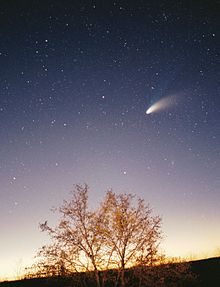
A comet is an icy small Solar System body (SSSB) that, when close enough to the Sun, displays a visible coma (a thin, fuzzy, temporary atmosphere) and sometimes also a tail. These phenomena are both due to the effects of solar radiation and the solar wind upon the nucleus of the comet. Comet nuclei range from a few hundred meters to tens of kilometers across and are composed of loose collections of ice, dust, and small rocky particles. Comets have been observed since ancient times and have traditionally been considered bad omens.
font: wikipedia
Thursday, December 6, 2012
GRAIL's Gravity Tour of the Moon
 |
| This image shows the variations in the lunar gravity field as measured by NASA's Gravity Recovery and Interior Laboratory (GRAIL) during the primary mapping mission from March to May 2012. Credit: NASA/JPL-Caltech/MIT/GSFC |
The gravitational field of the Moon has been determined by the tracking of radio signals emitted by orbiting spacecraft. The principle used depends on the Doppler effect, whereby the line-of-sight spacecraft acceleration can be measured by small shifts in frequency of the radio signal, and the measurement of the distance from the spacecraft to a station on Earth. Since the gravitational field of the Moon affects the orbit of a spacecraft, it is possible to use these tracking data to invert for gravity anomalies. However, because of the Moon's synchronous rotation it is not possible to track spacecraft much over the limbs of the Moon, and the far-side gravity field is thus only poorly characterized. The gravitational acceleration on the surface of the Moon is 1.6249 m/s2, about 16.7% that on Earth's surface (it means 1/6 of Earth gravity). Over the entire surface, the gravity variation is about is ~0.0253 m/s2 (1.6% of the gravity acceleration). Because weight is directly dependent upon gravitational acceleration, things on the Moon will weigh only 16.7% of what they weigh on the Earth.

The major characteristic of the Moon's gravitational field is the presence of mascons, which are large positive gravity anomalies associated with some of the giant impact basins. These anomalies greatly influence the orbit of spacecraft about the Moon, and an accurate gravitational model is necessary in the planning of both manned and unmanned missions. They were initially discovered by the analysis of Lunar Orbiter tracking data, since navigation tests prior to the Apollo program experienced positioning errors much larger than mission specifications.
The origin of mascons are in part due to the presence of dense mare basaltic lava flows that fill some of the impact basins. However, lava flows by themselves cannot explain the entirety of the gravitational variations, and uplift of the crust-mantle interface is required as well. Based on Lunar Prospector gravitational models, it has been suggested that some mascons exist that do not show evidence for mare basaltic volcanism. The huge expanse of mare basaltic volcanism associated with Oceanus Procellarum does not possess a positive gravity anomaly.
font: Wikipedia
font: Wikipedia
This movie shows the variations in the lunar gravity field as measured by NASA's Gravity Recovery and Interior Laboratory (GRAIL) during the primary mapping mission from March to May 2012. Very precise microwave measurements between two spacecraft, named Ebb and Flow, were used to map gravity with high precision and high spatial resolution. The field shown resolves blocks on the surface of about 12 miles (20 kilometers) and measurements are three to five orders of magnitude improved over previous data. Red corresponds to mass excesses and blue corresponds to mass deficiencies. The map shows more small-scale detail on the far side of the moon compared to the nearside because the far side has many more small craters. Image credit: NASA/JPL-Caltech/MIT/GSFC
Monday, December 3, 2012
NASA's Voyager 1 spacecraft has entered a new region
 |
| Credit: NASA/JPL-Caltech/The Johns Hopkins University Applied Physics Laboratory |
Read more at: http://phys.org/news/2012-12-voyager-encounters-region-deep-space.html#jCp
Friday, September 28, 2012
Old streambed on martian surface

(Phys.org)—NASA's Curiosity rover mission has found evidence a stream once ran vigorously across the area on Mars where the rover is driving. There is earlier evidence for the presence of water on Mars, but this evidence—images of rocks containing ancient streambed gravels—is the first of its kind.
NASA's Mars rover Curiosity has discovered what appears to be an ancient streambed, suggesting that water once flowed in large volumes — perhaps hip-deep in places — across the Martian surface. (space.com)
PASADENA, Calif. -- NASA's Curiosity rover mission has found evidence a stream once ran vigorously across the area on Mars where the rover is driving. There is earlier evidence for the presence of water on Mars, but this evidence -- images of rocks containing ancient streambed gravels -- is the first of its kind.
Scientists are studying the images of stones cemented into a layer of conglomerate rock. The sizes and shapes of stones offer clues to the speed and distance of a long-ago stream's flow. (NASA)
Sunday, August 26, 2012
Neil Amstrong
Neil A. Armstrong, the first man to walk on the moon, was born in Wapakoneta, Ohio, on August 5, 1930.
As a research pilot at NASA’s Flight Research Center, Edwards, Calif., he was a project pilot on many pioneering high speed aircraft, including the well known, 4000-mph X-15. He has flown over 200 different models of aircraft, including jets, rockets, helicopters and gliders.Armstrong transferred to astronaut status in 1962. He was assigned as command pilot for the Gemini 8 mission. Gemini 8 was launched on March 16, 1966, and Armstrong performed the first successful docking of two vehicles in space.As spacecraft commander for Apollo 11, the first manned lunar landing mission, Armstrong gained the distinction of being the first man to land a craft on the moon and first to step on its surface.Armstrong has been decorated by 17 countries.
Neil Alden Armstrong (August 5, 1930 – August 25, 2012) was an American astronaut, test pilot, aerospace engineer, university professor and United States Naval Aviator. He was the first person to walk on the Moon. Before becoming an astronaut, Armstrong was a United States Navy officer and had served in the Korean War. After the war, he served as a test pilot at the National Advisory Committee for Aeronautics High-Speed Flight Station, now known as the Dryden Flight Research Center, where he logged over 900 flights. He graduated from Purdue University and the University of Southern California.

A participant in the U.S. Air Force's Man In Space Soonest and X-20 Dyna-Soar human spaceflight programs, Armstrong joined the NASA Astronaut Corps in 1962. His first spaceflight was the NASA Gemini 8 mission in 1966, for which he was the command pilot, becoming one of the first U.S. civilians in space. On this mission, he performed the first manned docking of two spacecraft with pilot David Scott.
Armstrong's second and last spaceflight was as mission commander of the Apollo 11 moon landing in July 1969. On this mission, Armstrong and Buzz Aldrin descended to the lunar surface and spent 2½ hours exploring, while Michael Collins remained in orbit in the Command Module. Armstrong was awarded the Presidential Medal of Freedom by President Richard Nixon along with Collins and Aldrin, the Congressional Space Medal of Honor by President Jimmy Carter in 1978, and the Congressional Gold Medal in 2009.
On August 25, 2012, Armstrong died in Cincinnati, Ohio, at the age of 82 due to complications from blocked coronary arteries.
Monday, August 6, 2012
First images from Mars Curiosity Rover
Curiosity Mars Rover has landed. Here is the first image from Mars Science Lab:

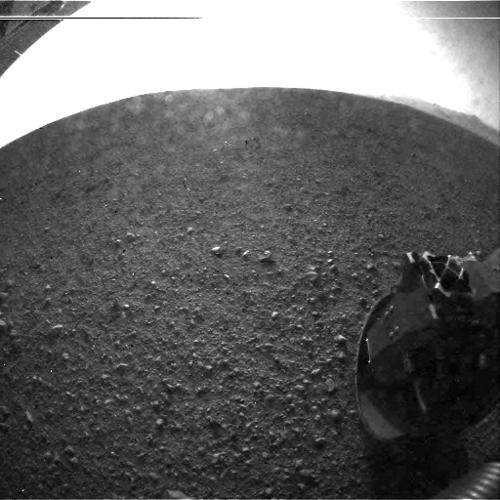
Credit: JPL/NASA
Curiosity's Surroundings
|
Sunday, August 5, 2012
Curiosity Mars Rover Landing (Live)
Watch Curiosity's Landing!
Aug 5, 2012 10:31 p.m. PacificAug 6, 2012 1:31 a.m. Eastern
Aug 6, 2012 5:31 a.m. Universal
Challenges of Getting to Mars: Curiosity's Seven Minutes of Terror
"Team members at NASA's Jet Propulsion Laboratory share the challenges of the Curiosity Mars rover's final minutes to landing on the surface of Mars." (JPL youtube page)
Here is an image of the landing operation (credit: JPL/NASA):

Follow the Curiosity Mars Rover landing here (LIVE).
Aug 5, 2012 10:31 p.m. Pacific
Aug 6, 2012 1:31 a.m. Eastern
Aug 6, 2012 5:31 a.m. Universal
Here is an image of the landing operation (credit: JPL/NASA):
Follow the Curiosity Mars Rover landing here (LIVE).
Aug 5, 2012 10:31 p.m. Pacific
Aug 6, 2012 1:31 a.m. Eastern
Aug 6, 2012 5:31 a.m. Universal
 |
| Credit: JPL/NASA |
The science instruments in this rover are tools for acquiring information about the geology, atmosphere, environmental conditions, and potential biosignatures on Mars.
The instruments that carry Mars Science Laboratory are:
- Cameras
- Spectrometers
- Radiation Detectors
- Environmental Sensors
- Atmospheric Sensors
Saturday, July 28, 2012
Tuesday, June 19, 2012
Supernova won't explode. Why?
 |
| Computer Simulation of a spinning collapse supernova. Credit: NASA |
Read entire article here and watch this video:
At least that's what supercomputers have been telling astrophysicists for decades. Many of the best computer models of supernovas fail to produce an explosion. At the end of the simulation, gravity wins the day and the star simply collapses.Clearly, physicists are missing something." (science.NASA)
Subscribe to:
Posts (Atom)
Popular Posts
-
Today we made a Cloud Chamber or Wilson Chamber. Credit: scifun.ed Basically consists of a closed environment which has insi...
-
The Moon is the only natural satellite of the Earth , and the fifth largest satellite in the Solar System . It is the largest na...
-
 X-radiation (composed of X-rays ) is a form of electromagnetic radiation . X-rays have a wavelength in the range of 10 to 0.01 nanomet...
-
There is an article in Popular Science related with the Physics of Spiderman 3, specially when Spiderman fall several times without brea...
-
The Solar Dynamics Observatory has been witnessing the last days of the slow movement of a large coronal hole above th...


