Follow eufisica

Follow eufisica

Showing posts with label simulation. Show all posts

Sunday, December 12, 2021

Build your thermo scale


Do you want to know more about thermometers?
Well check this website, choose your scale and see how it's the formula (see the image below).
Update (12-12-2021): You need to download the file (right click with your mouse and select "save link as...") and you can run in your computer (you need Adobe Flash Player installed in your computer).


Thermometers
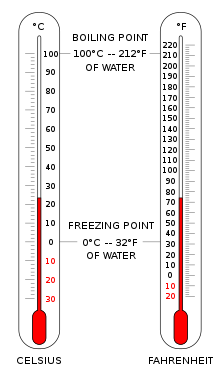
Developed during the 16th and 17th centuries, a thermometer (from the Greek θερμός (thermos) meaning "warm" and meter, "to measure") is a device that measures temperature or temperature gradient using a variety of different principles. A thermometer has two important elements: the temperature sensor (e.g. the bulb on a mercury thermometer) in which some physical change occurs with temperature, plus some means of converting this physical change into a numerical value (e.g. the scale on a mercury thermometer).
Read more in Wikipedia.


Farenheit Scale
Fahrenheit is the temperature scale proposed in 1724 by, and named after, the German physicist Daniel Gabriel Fahrenheit (1686–1736). Within this scale, the freezing of water into ice is defined at 32 degrees, while the boiling point of water is defined to be 212 degrees. The temperature scale was replaced by the Celsius scale in most countries during the mid to late 20th century, but it remains the official scale of the United StatesCayman Islands and Belize.
Read more in Wikipedia.

Celsius Scale
Celsius is a scale and unit of measurement for temperature. It is named after the Swedish astronomer Anders Celsius (1701–1744), who developed a similar temperature scale two years before his death. The degree Celsius (°C) can refer to a specific temperature on the Celsius scale as well as a unit to indicate a temperature interval, a difference between two temperatures or an uncertainty. The unit was known until 1948 as "centigrade" from the Latin "centum" translated as 100 and "gradus" translated as "steps".
Credit: uoregon.edu
From 1744 until 1954, 0 °C was defined as the freezing point of water and 100 °C was defined as the boiling point of water, both at a pressure of one standard atmosphere with mercury being the working material. Although these defining correlations are commonly taught in schools today, by international agreement the unit "degree Celsius" and the Celsius scale are currently defined by two different temperatures: absolute zero, and the triple point of VSMOW (specially-purified water). This definition also precisely relates the Celsius scale to the Kelvin scale, which defines the SI base unit of thermodynamic temperature with symbol K. Absolute zero, the lowest temperature possible at which matter reaches minimum entropy, is defined as being precisely 0 K and −273.15 °C. The temperature of the triple point of water is defined as precisely 273.16 K and 0.01 °C.
This definition fixes the magnitude of both the degree Celsius and the kelvin as precisely 1 part in 273.16 (approximately 0.00366) of the difference between absolute zero and the triple point of water. Thus, it sets the magnitude of one degree Celsius and that of one kelvin as exactly the same. Additionally, it establishes the difference between the two scales' null points as being precisely 273.15 degrees Celsius (−273.15 °C = 0 K and 0 °C = 273.15 K).
Read more in Wikipedia.


Rankine Scale
Rankine is a thermodynamic (absolute) temperature scale named after the Glasgow University engineer and physicistWilliam John Macquorn Rankine, who proposed it in 1859. (The Kelvin scale was first proposed in 1848.)
The symbol for degrees Rankine is R[1] (or Ra if necessary to distinguish it from the Rømer and Réaumur scales). Zero on both the Kelvin and Rankine scales is absolute zero, but the Rankine degree is defined as equal to one degreeFahrenheit, rather than the one degree Celsius used by the Kelvin scale. A temperature of −459.67 °F is exactly equal to 0 R.
Some engineering fields in the U.S. measure thermodynamic temperature using the Rankine scale.[2] However, throughout the entire scientific world thermodynamic temperature is measured in Kelvin.[2] The US National Institute of Standards and Technology does not recommend using degrees Rankine in NIST publications.
Read more in Wikipedia.


Another temperature scales:
The Delisle Scale, the Newton Scale, the Réaumur Scale, the Rømer Scale.
And here is the conversion formulae:


Tuesday, May 13, 2014

Refraction of Light

Here is some photos taken at class to teach light's refraction.


To learn more about this topic try to find refraction in the search option.
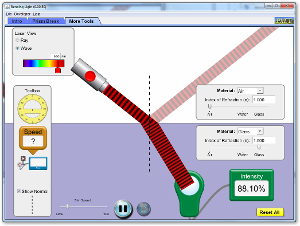
You can also play with this PhET simulation:

Bending Light
Click to Run

Thursday, January 9, 2014

Build Electric Circuits

"An electrical network is an interconnection of electrical elements such as resistorsinductorscapacitorsvoltage sourcescurrent sources and switches. An electrical circuit is a network consisting of a closed loop, giving a return path for the current." in Wikipedia
The two simplest of these circuits are called series and parallel and occur very frequently.
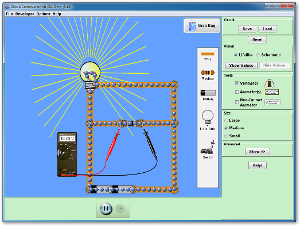
In the image (above) we can see the schemes of two simple electric circuits. The first circuit (fig. 1) the lamps are connecting in a series circuit. The second circuit (fig. 2) we have the lamps are connecting in a parallel circuit.
You can try to build both circuits by using a PhET simulation. Try to do it by clicking the image bellow.

Circuit Construction Kit (DC Only)
Click to Run

Monday, March 26, 2012

Projectile Motion with Angry Birds


Projectile Motion with Angry Birds
written by Anne Cox
The Projectile Motion with Angry Birds lab uses the Tracker video analysis tool to measure and analyze the motion an angry bird projected from a slingshot to hit a pig.  
Item PictureThe zip file contains the lab handout, a video, and the Tracker file. 

You can download the file from Open Source Physics. To read other posts about Angry Birds go here.


Now Angry Birds Space is available here.

Wednesday, February 15, 2012

Mathematical Model Computes Snow Flake Shapes

John Barrett at Imperial College London and a couple of pals reveal their approach to snowflake modelling. The result is that they have been able to compute various snow flake shapes that appear in nature for the first time. These include solid plates, solid prisms, hollow columns, needles, dendrites, capped columns and scrolls on plates. 
Entire article here.
Preprint paper here.
Triangular snowflakes here.


Monday, November 14, 2011

Wednesday, April 13, 2011

When Neutron Stars Collide


EN: A team of scientist made the most concise simulation about the collision of two neutron's stars. 
ES: Un equipo de científicos hizo la simulación más concisa sobre la colisión de dos estrellas de neutrones. 
PT: Uma equipa de cientistas realizou a mais precisa simulação da colisão de duas estrelas de neutrões até à data.  Saber mais em astroPT.

Thursday, March 31, 2011

Solar System 3D model

Interactive 3D model of Solar System, Planets and Night Sky:


"Welcome to Solar System Scope space traveller,

SSS means Astronomy for Everybody. Whether you are a student, astronomy fan or an accidental browser, you are most welcome to play with our user-friendly application. It's full of space-art graphics, has easy-to-use interface with various settings and offers interesting information.


SSS will illustrate you real-time celestial positions with planets and constellations moving over the night sky.

But I can see you're not just a passive spectator - and that's good, because you can actively change parameters for a better understanding of happenings in our Solar System and the Universe." in www.solarsystemscope.com


Friday, October 15, 2010

Nuclear Fission Simulation

Great simulation from PhET

Amplify’d from phet.colorado.edu
PhET Logo

Nuclear Fission

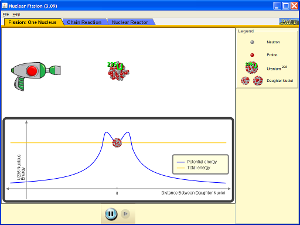
Nuclear Fission Screenshot Download Run Now! Version: 3.22 (change log) 3,787 kB

Start a chain reaction, or introduce non-radioactive isotopes to prevent one. Control energy production in a nuclear reactor! (Previously part of the Nuclear Physics simulation - now there are separate Alpha Decay and Nuclear Fission sims.)
Read more at phet.colorado.edu

Posted via email from eufisica's posterous

Featured Post

IBSE about Light Pollution

Here is my presentation that happened in the Discover the Cosmos Conference (Volos, Greece - 2013). The presentation was an Inquiry Base...

Popular Posts