Follow eufisica

Follow eufisica

Showing posts with label 2011. Show all posts

Sunday, December 12, 2021

Build your thermo scale


Do you want to know more about thermometers?
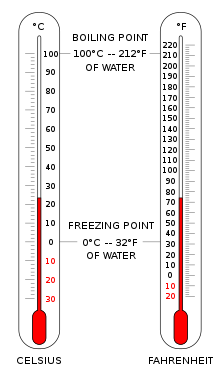
Well check this website, choose your scale and see how it's the formula (see the image below).
Update (12-12-2021): You need to download the file (right click with your mouse and select "save link as...") and you can run in your computer (you need Adobe Flash Player installed in your computer).


Thermometers
Developed during the 16th and 17th centuries, a thermometer (from the Greek θερμός (thermos) meaning "warm" and meter, "to measure") is a device that measures temperature or temperature gradient using a variety of different principles. A thermometer has two important elements: the temperature sensor (e.g. the bulb on a mercury thermometer) in which some physical change occurs with temperature, plus some means of converting this physical change into a numerical value (e.g. the scale on a mercury thermometer).
Read more in Wikipedia.


Farenheit Scale
Fahrenheit is the temperature scale proposed in 1724 by, and named after, the German physicist Daniel Gabriel Fahrenheit (1686–1736). Within this scale, the freezing of water into ice is defined at 32 degrees, while the boiling point of water is defined to be 212 degrees. The temperature scale was replaced by the Celsius scale in most countries during the mid to late 20th century, but it remains the official scale of the United StatesCayman Islands and Belize.
Read more in Wikipedia.

Celsius Scale
Celsius is a scale and unit of measurement for temperature. It is named after the Swedish astronomer Anders Celsius (1701–1744), who developed a similar temperature scale two years before his death. The degree Celsius (°C) can refer to a specific temperature on the Celsius scale as well as a unit to indicate a temperature interval, a difference between two temperatures or an uncertainty. The unit was known until 1948 as "centigrade" from the Latin "centum" translated as 100 and "gradus" translated as "steps".
Credit: uoregon.edu
From 1744 until 1954, 0 °C was defined as the freezing point of water and 100 °C was defined as the boiling point of water, both at a pressure of one standard atmosphere with mercury being the working material. Although these defining correlations are commonly taught in schools today, by international agreement the unit "degree Celsius" and the Celsius scale are currently defined by two different temperatures: absolute zero, and the triple point of VSMOW (specially-purified water). This definition also precisely relates the Celsius scale to the Kelvin scale, which defines the SI base unit of thermodynamic temperature with symbol K. Absolute zero, the lowest temperature possible at which matter reaches minimum entropy, is defined as being precisely 0 K and −273.15 °C. The temperature of the triple point of water is defined as precisely 273.16 K and 0.01 °C.
This definition fixes the magnitude of both the degree Celsius and the kelvin as precisely 1 part in 273.16 (approximately 0.00366) of the difference between absolute zero and the triple point of water. Thus, it sets the magnitude of one degree Celsius and that of one kelvin as exactly the same. Additionally, it establishes the difference between the two scales' null points as being precisely 273.15 degrees Celsius (−273.15 °C = 0 K and 0 °C = 273.15 K).
Read more in Wikipedia.


Rankine Scale
Rankine is a thermodynamic (absolute) temperature scale named after the Glasgow University engineer and physicistWilliam John Macquorn Rankine, who proposed it in 1859. (The Kelvin scale was first proposed in 1848.)
The symbol for degrees Rankine is R[1] (or Ra if necessary to distinguish it from the Rømer and Réaumur scales). Zero on both the Kelvin and Rankine scales is absolute zero, but the Rankine degree is defined as equal to one degreeFahrenheit, rather than the one degree Celsius used by the Kelvin scale. A temperature of −459.67 °F is exactly equal to 0 R.
Some engineering fields in the U.S. measure thermodynamic temperature using the Rankine scale.[2] However, throughout the entire scientific world thermodynamic temperature is measured in Kelvin.[2] The US National Institute of Standards and Technology does not recommend using degrees Rankine in NIST publications.
Read more in Wikipedia.


Another temperature scales:
The Delisle Scale, the Newton Scale, the Réaumur Scale, the Rømer Scale.
And here is the conversion formulae:


Tuesday, January 14, 2014

Dark energy interacting with dark matter

Notes on dark energy interacting with dark matter and unparticle in loop quantum cosmology

We investigate the behavior of dark energy interacting with dark matter and unparticle in the framework of loop quantum cosmology. In four toy models, we study the interaction between the cosmic components by choosing different coupling functions representing the interaction. We found that there are only two attractor solutions namely dark energy dominated and dark matter dominated Universe. The other two models are unstable, as they predict either a dark energy filled Universe or one completely devoid of it.
Notes on dark energy interacting with dark matter and unparticle in loop quantum cosmology. (arXiv:1107.1558v1 [physics.gen-ph])

Friday, December 30, 2011

Electromagnetic momentum density in matter solved

Optical Force Measurement. Credit: eecs.northwestern.edu

"(PhysOrg.com) -- Researchers from the NIST Center for Nanoscale Science and Technology and the University of British Columbia have shown that the interaction between a light pulse and a light-absorbing object, including the momentum transfer and resulting movement of the object, can be calculated for any positive index of refraction using a few, well-established physical principles combined with a new model for mass transfer from light to matter."

Electromagnetic radiation, like light, carries momentum and can transfer its momentum to matter via radiation pressure. In the past century, there has been a controversy over the correct form of the electromagnetic momentum density in matter.
There was two forms:

  •  In the “Minkowski formulation,” the momentum density is proportional to the index of refraction;
  • in direct contrast, the “Abraham formulation” finds it to be inversely proportional. 
And the two equations for the momentum in a dielectric with refractive index n are:
  • The Minkowski version:
p=\frac {n h \nu}{c}
  • The Abraham version:
p=\frac {h \nu}{n c}
where h is the Planck constantν is the frequency of the light and c is the speed of light in vacuum.
In 2011, an optical experiment was performed to study this problem based on first principles. It tested the velocity-addition formula of light in a reversed Fizeau experiment. The result was that the light speed c= 299,792,458m/s in vacuum of Lorentz transformation should be replaced by c/n to describe electrodynamic phenomena in a dielectric medium[1] Consequently, the momentum of a photon in vacuum is p=E/c and the value should be p=E/(c/n)=nE/c in media, although it is not measured directly.[2] It is asserted, that this confirms Minkowski's formulation.
[1] Wang Zhong-Yue, Wang Pin-Yu, Xu Yan-Rong (2011). "Crucial experiment to resolve Abraham-Minkowski Controversy". Optik 122 (22): 1994–1996. doi:10.1016/j.ijleo.2010.12.018
[2] Wang, Zhong-Yue. Graphene, neutrino mass and oscillationarXiv:/0909.1856


The recently published in Applied Physics support the Abraham formulation: Revisiting the Balazs thought experiment in the presence of loss: electromagnetic-pulse-induced displacement of a positive-index slab having arbitrary complex permittivity and permeability, K. J. Chau and H. J. Lezec, Applied Physics A 105, 267-281 (2011).
"The researchers propose a set of postulates for light-matter interaction that encompass: a) the Maxwell equations, which govern classical electromagnetic behavior; b) a generalized Lorentz force law, which describes the force felt by matter in the presence of an electromagnetic field; c) a model for electromagnetic mass density transfer to an absorbing medium; and d) the Abraham formulation of momentum density. Using both closed-form calculations and numerical simulations of the interaction between an electromagnetic pulse and a test slab, the researchers demonstrated that their postulates yield results that are consistent with conservation of energy, mass, momentum, and center-of-mass velocity at all times." ( PhysOrg)
Read entire article in PhysOrg


Astronomy mobile applications - catalog


Andrew Fraknoi made a catalog with Astronomy applications for your mobile and you can found it here (most applications is for iPhone).
Now I going to leave here my modest list of Android applications:
The Google SkyMap let you observe the sky at night. To do that you must install the free application from Android Market. Open the application and point your mobile to the night sky, then you'll see in the mobile screen all the information about the star or other sky object that you are observing.
The Zenit Mobile Telescope is an application that isn't free and made almost the same task as Google SkyMap, it seems that has more information and best image resolution.
The eufisica is a free application with news about Physics and Astronomy. Is still at an early stage, but already has some downloads.
The NASA App is my favorite one. It's the official application from NASA and has news, APOD and other important information about Astronomy, Technology, Physics, etc. It's free. By doing a search in the Android Market you will find many NASA applications (some are official and free, others are not).
The Solar System Explorer Lite is a interactive 3D journey in the Solar System. It has planets, moons, asteroids and space probes.
The Exoplanet Explorer Lite is a journey to the deep space. It is based on latest available data. Explore 3D recreations in more than 500 known planets and systems.

A trip to faster than light neutrinos

Happy Holidays


I forgot to publish my postal card this year. :(
But, here it is. :)
Best wishes to all.
JG

How Differential Steering Works


"Steering is the term applied to the collection of components, linkages, etc. which will allow a vessel (shipboat) or vehicle (carmotorcycle,bicycle) to follow the desired course. An exception is the case of rail transport by which rail tracks combined together with railroad switches (and also known as 'points' in British English) provide the steering function."
in wikipedia


G. W. Lucas has the equations for an elementary trajectory model for the differential steering system of robot wheel actuators. Check his website for equations and this one for the java applet.


Tuesday, December 27, 2011

Kepler's Birthday

Johannes Kepler (December 27, 1571 – November 15, 1630) is not a name that most people recognize, but if you are aware of the recent discoveries of new planets, will recognize that many new planets bear his name.  Perhaps the best birthday gift we can give to this scientist is Kepler 22b, the first planet discovered in the habitable zone of a star, an earth possible planet like ours.
Kepler is best known for revealing the secrets of planetary motions. His three laws of planetary motion still apply today, and enabled Newton to give us the law of universal gravitation.
In 1596, Kepler published Mysterium Cosmographicum, where he set out arguments for the heliocentric hypothesis.
In 1609 published Astronomia Nova ... From Motibus Stellae Martis, where he presented his three laws of planetary motion that now bear his name:
  • The planets describe elliptical orbits with the sun at one focus.
  • The radius vector connecting the planet to the sun describes equal areas in equal times. (law of areas)
  • The squares of the periods of revolution (T) are proportional to the cubes of mean distances (a) from the Sun to the planets. T2 = k a3, where k is a proportionality constant.
Probably most of us will never use this information in our life, but it does well to remember that those was important intellectual achievements of Western civilization. We could even think to remember Kepler itself and its laws would be enough, but Kepler had more projects, for example, projects of the first glasses for myopia and hyperopia.

Thursday, December 22, 2011

The Universe in 3D: Planet & Star Size Comparison - Final Version [1080p]

Watch this video with a simulation of Planet and Star size comparison:


The video from Discovery:

Breaking the speed of light?

Let's break the speed of light in your backyard :)

Higgs boson still missing, but we have new particle


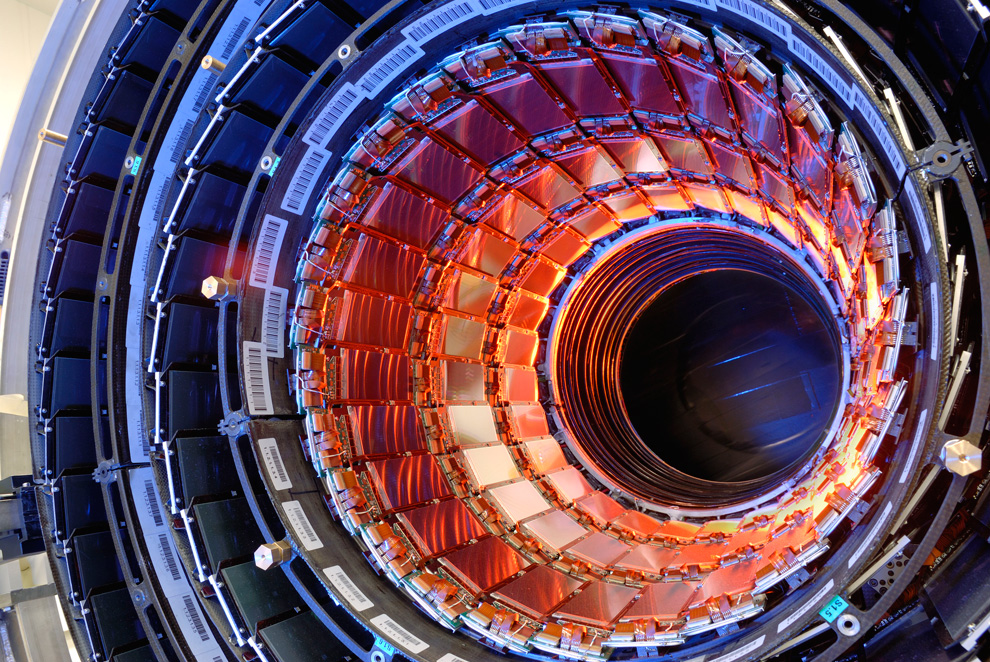
Credit: CERN

Scientists still looking for the Higgs Boson, and they have just found the LHC's first new particle: Chi-b 3P.
It's actually another type of boson — an excited version of the Chi particles already seen in other collision experiments. This particles are made up of a 'beauty quark' and a 'beauty anti-quark', which are bound together. The way that the two quarks are held together reveals more information about the strong nuclear force — and that should help in identifying the Higgs boson. Prof. Roger Jones, who works on the Atlas detector at the LHC, told to BBC:
"The better we understand the strong force, the more we understand a large part of the data that we see, which is quite often the background to the more exciting things we are looking for, like the Higgs. So, it's helping put together that basic understanding that we have and need to do the new physics."
More in arXivBBC, The Verge, Gizmodo.


Want to know more about Higgs boson? Watch this video:

Featured Post

IBSE about Light Pollution

Here is my presentation that happened in the Discover the Cosmos Conference (Volos, Greece - 2013). The presentation was an Inquiry Base...

Popular Posts