Follow eufisica

Follow eufisica

Showing posts with label science. Show all posts

Wednesday, January 2, 2019

We are star dust


This is not new, but I love this song:

Thursday, June 27, 2013

WIRE Magazine - issue 2


WIRE magazine is create by the Science Panorama fellows, with the spread science mission in their minds.

The magazine passing by all the scientific topics and easy to read for all public. 
Here is the issue number 2! It's FREE, so don't hesitate to download and share it. Now let the magazine speak for itself. 
http://bit.ly/wireissue2

Tuesday, April 16, 2013

Science School, Issue 26

Science School

Issue 26

Cover 26
Download Issue 26 as PDF [5.3 MB]
Editorial
  • Welcome to the twenty-sixth issue of Science in School
News from the EIROs
  • Science in space, society and synchrotrons
    EIROforum, the publisher of Science in School, reports on the latest news from its eight European inter-governmental research organisations.
Events
  • Meeting the next generation of scientists: the European Union Contest for Young Scientists
    As young scientists from across Europe gathered in Bratislava to exhibit their projects, find out what impressed the jury most.

  • Forthcoming events
Feature article
  • Propping up the wall: how to rescue a leaning tower
    Civil engineer John Burland talks about the perils and practicalities of supporting some of the world’s most iconic buildings.
Cutting-edge science
  • Cracking the mystery of how our planet formed
    Studying the chemical composition of some of the planet’s oldest rocks has revolutionised our understanding of how our continents formed.

  • Laying bare our genetic blueprint
    What does the majority of our DNA do? Hundreds of scientists have spent years examining these ‘junk’ sequences, which may hold the key to serious diseases – and much more.

Teaching activity
  • The genetics of obesity: a lab activity
    Around 1.5 billion people worldwide are overweight or obese. Are we just eating too much or can we blame our genes? Here’s how to investigate the genetics of obesity in the classroom.

Science education project
  • Casting light on solar wind: simulating aurorae at school
    The aurorae are one of the wonders of the natural world. Using some simple apparatus, they and related phenomena can easily be reproduced in the classroom.

Science topics
  • Spinal cord injury: do stem cells have the answer?
    Spinal cord injury typically causes permanent paralysis and is currently a condition without a cure. Could stem cell therapy provide hope?

  • A thermometer that goes to 200 million degrees
    Measuring the temperature inside a fusion reactor is no easy task. Find out how it’s done – and even simulate it in the classroom.

  • Life without the Moon: a scientific speculation
    Soaring temperatures, a flooded landscape, violent winds…. What would our planet be like without the Moon?


Monday, August 6, 2012

First images from Mars Curiosity Rover

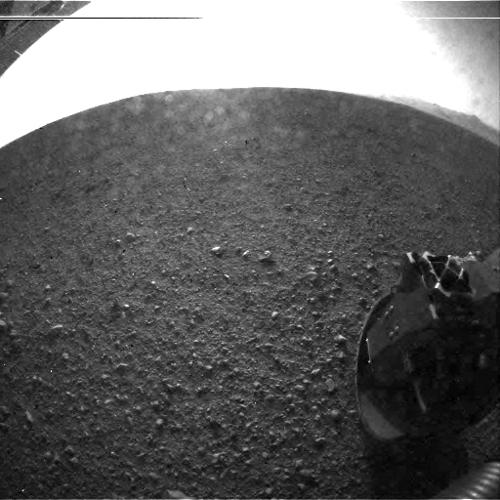
Curiosity Mars Rover has landed. Here is the first image from Mars Science Lab:
Credit: JPL/NASA

Curiosity's Surroundings

This is one of the first images taken by NASA's Curiosity rover, which landed on Mars the evening of Aug. 5 PDT (morning of Aug. 6 EDT).
"This is one of the first images taken by NASA's Curiosity rover, which landed on Mars the evening of Aug. 5 PDT (morning of Aug. 6 EDT). It was taken through a "fisheye" wide-angle lens on the left "eye" [...]. The clear dust cover that protected the camera during landing has been sprung open. Part of the spring that released the dust cover can be seen at the bottom right, near the rover's wheel.
On the top left, part of the rover's power supply is visible.
Some dust appears on the lens even with the dust cover off.
The cameras are looking directly into the sun, so the top of the image is saturated. Looking straight into the sun does not harm the cameras. The lines across the top are an artifact called "blooming" that occurs in the camera's detector because of the saturation. 
As planned, the rover's early engineering images are lower resolution. Larger color images from other cameras are expected later in the week [...]."

Image Credit: NASA/JPL-Caltech
Text credit: NASA/JPL

Saturday, July 28, 2012

Sport Science - Jessica Lopez

The Olympic Games have started. Now, it's time for some science and sport:


Monday, January 23, 2012

Thursday, March 31, 2011

Solar System 3D model

Interactive 3D model of Solar System, Planets and Night Sky:


"Welcome to Solar System Scope space traveller,

SSS means Astronomy for Everybody. Whether you are a student, astronomy fan or an accidental browser, you are most welcome to play with our user-friendly application. It's full of space-art graphics, has easy-to-use interface with various settings and offers interesting information.


SSS will illustrate you real-time celestial positions with planets and constellations moving over the night sky.

But I can see you're not just a passive spectator - and that's good, because you can actively change parameters for a better understanding of happenings in our Solar System and the Universe." in www.solarsystemscope.com


Radiation Dosage Chart

A natural radiation in the Human Body is about 0.4 microsievert. A lethal dosage is about 100 000 milisievert (100 sievert).


Sunday, January 23, 2011

NASA scientist tremor claim - Chile quake has shifted the Earths axis - News - Bild.de

NASA scientist tremor claim - Chile quake has shifted the Earths axis - News - Bild.de (full reading)
The catastrophic earthquake in Chile has shifted the axis of the earth and shortened the length of a day, according to NASA scientists.
“Any worldly event that involves the movement of mass affects the Earth's rotation,” explained NASA scientist Benjamin Fong Chao from the Goddard Space Center in Greenbelt to CNN.
"The resulting vibrations can influence the distribution of mass on the planet and can have an effect on the speed of the Earth’s rotation and the gradient of the axis of the earth. The days will become shorter through this.”
NASA research scientist Richard Gross confirmed the movement of the Earth’s axis. He used a computer model to discover that it has shifted by around eight centimetres.

Saturday, February 27, 2010

Iceberg with the size of Luxembourg created

English version:

New Iceberg...

"iceberg the size of Luxembourg has been created in the seas off the Antarctic - the break caused by a collision with another massive block of ice." in SkyNews


Versão portuguesa:

Correio da Manha - Icebergue do tamanho do Luxemburgo desprende-se

"Um icebergue do tamanho do Luxemburgo desprendeu-se do glaciar Mertz, na Antártida, após colidir com outro bloco de gelo gigante, chamado B2B. Esta ocorrência poderá causar grandes alterações climáticas." in Correio da Manhã

Monday, January 18, 2010

Active Science - Interactive Periodic Table

"Active Science - Interactive Periodic Table: "
Glaxo Smith Kline's Active Science offers fifteen interactive games covering a range of science topics.


The Interactive Periodic Table is a game designed to help chemistry students practice identification of the elements. To play the game students are given some clues about an element's properties. Using those clues the student has to place the element in the correct place on the table.




------------- x ------------- 
The Ptable is another interesting tools: put the mouse over the element and visualize all the information about it.


Nottingham University project has videos about the properties of the lements.


Wednesday, April 8, 2009

Artigos da SciAm

Some articles to read:
Aqui vai alguns artigos que valem a pena ler:
Aqui ván algunos articulos para lectura:


Monday, January 26, 2009

Congratulations Mr. President


image from: http://www.dmiblog.com

A new era of scientists will bring us a hope for climate change and technology. 
I hope President Obama can make a difference. 
The scientific community trust this man. 
Yes We Can.


Featured Post

IBSE about Light Pollution

Here is my presentation that happened in the Discover the Cosmos Conference (Volos, Greece - 2013). The presentation was an Inquiry Base...

Popular Posts