Follow eufisica

Follow eufisica

Showing posts with label temperature. Show all posts

Sunday, December 12, 2021

Build your thermo scale


Do you want to know more about thermometers?
Well check this website, choose your scale and see how it's the formula (see the image below).
Update (12-12-2021): You need to download the file (right click with your mouse and select "save link as...") and you can run in your computer (you need Adobe Flash Player installed in your computer).


Thermometers
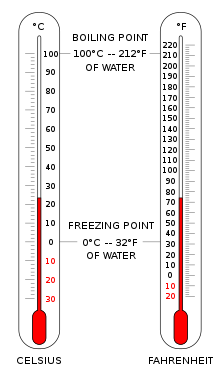
Developed during the 16th and 17th centuries, a thermometer (from the Greek θερμός (thermos) meaning "warm" and meter, "to measure") is a device that measures temperature or temperature gradient using a variety of different principles. A thermometer has two important elements: the temperature sensor (e.g. the bulb on a mercury thermometer) in which some physical change occurs with temperature, plus some means of converting this physical change into a numerical value (e.g. the scale on a mercury thermometer).
Read more in Wikipedia.


Farenheit Scale
Fahrenheit is the temperature scale proposed in 1724 by, and named after, the German physicist Daniel Gabriel Fahrenheit (1686–1736). Within this scale, the freezing of water into ice is defined at 32 degrees, while the boiling point of water is defined to be 212 degrees. The temperature scale was replaced by the Celsius scale in most countries during the mid to late 20th century, but it remains the official scale of the United StatesCayman Islands and Belize.
Read more in Wikipedia.

Celsius Scale
Celsius is a scale and unit of measurement for temperature. It is named after the Swedish astronomer Anders Celsius (1701–1744), who developed a similar temperature scale two years before his death. The degree Celsius (°C) can refer to a specific temperature on the Celsius scale as well as a unit to indicate a temperature interval, a difference between two temperatures or an uncertainty. The unit was known until 1948 as "centigrade" from the Latin "centum" translated as 100 and "gradus" translated as "steps".
Credit: uoregon.edu
From 1744 until 1954, 0 °C was defined as the freezing point of water and 100 °C was defined as the boiling point of water, both at a pressure of one standard atmosphere with mercury being the working material. Although these defining correlations are commonly taught in schools today, by international agreement the unit "degree Celsius" and the Celsius scale are currently defined by two different temperatures: absolute zero, and the triple point of VSMOW (specially-purified water). This definition also precisely relates the Celsius scale to the Kelvin scale, which defines the SI base unit of thermodynamic temperature with symbol K. Absolute zero, the lowest temperature possible at which matter reaches minimum entropy, is defined as being precisely 0 K and −273.15 °C. The temperature of the triple point of water is defined as precisely 273.16 K and 0.01 °C.
This definition fixes the magnitude of both the degree Celsius and the kelvin as precisely 1 part in 273.16 (approximately 0.00366) of the difference between absolute zero and the triple point of water. Thus, it sets the magnitude of one degree Celsius and that of one kelvin as exactly the same. Additionally, it establishes the difference between the two scales' null points as being precisely 273.15 degrees Celsius (−273.15 °C = 0 K and 0 °C = 273.15 K).
Read more in Wikipedia.


Rankine Scale
Rankine is a thermodynamic (absolute) temperature scale named after the Glasgow University engineer and physicistWilliam John Macquorn Rankine, who proposed it in 1859. (The Kelvin scale was first proposed in 1848.)
The symbol for degrees Rankine is R[1] (or Ra if necessary to distinguish it from the Rømer and Réaumur scales). Zero on both the Kelvin and Rankine scales is absolute zero, but the Rankine degree is defined as equal to one degreeFahrenheit, rather than the one degree Celsius used by the Kelvin scale. A temperature of −459.67 °F is exactly equal to 0 R.
Some engineering fields in the U.S. measure thermodynamic temperature using the Rankine scale.[2] However, throughout the entire scientific world thermodynamic temperature is measured in Kelvin.[2] The US National Institute of Standards and Technology does not recommend using degrees Rankine in NIST publications.
Read more in Wikipedia.


Another temperature scales:
The Delisle Scale, the Newton Scale, the Réaumur Scale, the Rømer Scale.
And here is the conversion formulae:


Thursday, October 6, 2016

Boiling in a syringe

Decreasing the pressure can make water boiling.
Video from Flinn Scientific

Monday, January 7, 2013

Down of absolute zero!


My friend Andrew Jones wrote a great article about the recent publication of going down absolute zero:
"Temperature has long been understood as a measurement of the average energy of a set of atoms, with the absolute zero temperature representing a system in which the particles no longer have any kinetic energy at all, having ceased all movement. For this reason, while we frequently talk about negative temperatures in the Celsius and Fahrenheit scales, the idea of a negative temperature on the Kelvin temperature scale was believed to be a nonsensical concept. After all, you can't have less motion than none, can you?
Well, new research may have found a way around that."
Read entire article and papers here.
According with the NewScientist:
Credit: NewScientist
"Negative-temperature systems have the opposite behaviour. Adding energy reduces their disorder. But they are not cold in the conventional sense that heat will flow into them from systems at positive temperatures. In fact, systems with negative absolute temperatures contain more atoms in high-energy states than is possible even at the hottest positive temperatures, so heat should always flow from them to systems above zero kelvin."
and
"This has already been done in experiments in which atomic nuclei were placed in a magnetic field, where they act like tiny bar magnets and line up with the field. The field was then suddenly reversed, leaving the nuclei briefly aligned opposite to the direction in which they would have the lowest energy. While they were in this state they fleetingly behaved in a way consistent with them having negative absolute temperatures, before they too flipped over to line up with the field."
Read entire article here.
It seems a new rise for technology:
"Moving into the sub-absolute zero realm, matter begins to display odd properties. Clouds of atoms drift upwards instead of down, while the atomic matrix’s ability to resist collapsing in on itself echoes the forces causing the universe to expand outwards rather than contracting under the influence of gravity.
The ability to produce a relatively stable substance at several billionths of a Kelvin below absolute zero will allow physicists to better study and understand this curious state, possibly leading to other innovations."
Read entire article here.

Friday, January 20, 2012

Degradation of the Ozone in the Artic

March 2011: This shows strongly reduced ozone values (left, dark blue) and significantly increased concentration of chlorine monoxide (right, red) that is directly involved in ozone degradation. Credit: Figure: IMK-ASF, KIT
"Extraordinarily cold temperatures in the winter of 2010/2011 caused the most massive destruction of the ozone layer above the Arctic so far: The mechanisms leading to the first ozone hole above the North Pole were studied by scientists of the KIT Institute of Meteorology and Climate Research (IMK). According to these studies, further cooling of the ozone layer may enhance the influence of ozone-destroying substances, e.g. chlorofluorocarbons (CFC), such that repeated occurrence of an ozone hole above the Arctic has to be expected."

All the pollutants are making a really damage to the ozone concentration in the Artic. What happen next? Well, the concentration of ozone will be decrease and raise up the ultraviolet rays in the Artic. Let's face it, we have a problem.

Thursday, June 30, 2011

water

Water can flow below -130 C When water is cooled below zero degrees, it usually crystallizes directly into ice. Ove Andersson, a physicist at Umea University, has now managed to produce sluggishly flowing water at 130 degree below zero under high pressure – 10,000 times higher than normal pressure. It is possible that this sluggishly fluid and cold water exists on other heavenly bodies.

Featured Post

IBSE about Light Pollution

Here is my presentation that happened in the Discover the Cosmos Conference (Volos, Greece - 2013). The presentation was an Inquiry Base...

Popular Posts