Follow eufisica

Follow eufisica

Showing posts with label exoplanets. Show all posts

Tuesday, January 14, 2014

Exoplanet detection: Transit Method

Credit: ESA
How to find an Extrasolar planet
There are three main detection techniques that can be used to find extrasolar planets. All of them rely on detecting a planet's effect on its parent star, to infer the planet's existence.
The three techniques are simple in principle but difficult in practice because extreme precision is needed to register the planet's effect on the much larger star. This is also difficult from Earth because the atmosphere distorts our view of the stars, limiting the accuracy of the observations. Space missions can overcome this problem. The methods in question are:
  • the radial velocity method
  • the astrometry method
  • the transit method
These methods are all referred to as 'indirect' methods.
from ESA website (click to read complete article)
When a planet crosses in front of its star as viewed by an observer, the event is called a transit. Transits by terrestrial planets produce a small change in a star's brightness of about 1/10,000 (100 parts per million, ppm), lasting for 2 to 16 hours. 
from NASA website

Exoplanet Detection: Transit Method (simulation)

The Exoplanet Detection: Transit Method model simulates the detection of exoplanets by using the transit method. In this method, the light curve from a star, and how it changes over time due to exoplanet transits, is observed and then analyzed. In this simulation the exoplanet orbits the star (sun-sized) in circular motion via Kepler's third law.  When the exoplanet passes in front of the star (transits), it blocks part of the starlight. This decrease in starlight is shown on the graph.  If the exoplanet is close enough to the central star, and has sufficient reflectivity, or albedo, it can reflect enough of the starlight to be seen on the light curve. In the simulation the star-exoplanet system is shown as seen from Earth (edge on view) but magnified greatly, and with the star and planet sizes not shown to the scale of the orbit. The radius of the central star (relative to the radius of Sun),semi-major axis of the exoplanet (in AU), radius of the exoplanet (relative to the radius of Jupiter), the exoplanet's albedo (reflectivity), and the inclination of the system relative to Earth can be changed.
from COMPADRE


Saturday, July 20, 2013

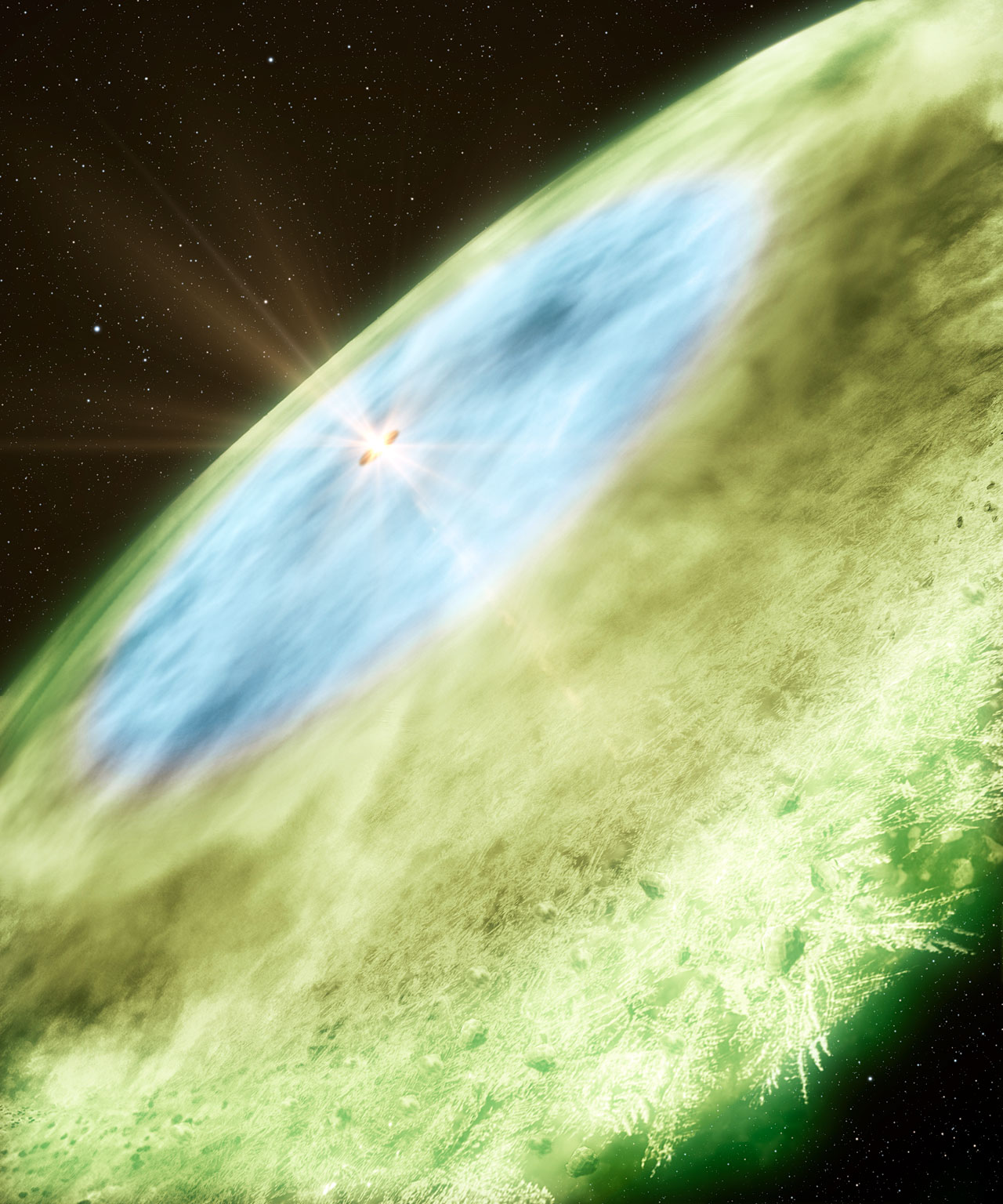
Snow in a baby planetary system


Concepção artística da linha de neve na TW Hydrae, que mostra gelo de água a cobrir grãos de poeira no disco interior (4,5 a 30 unidades astronómicas, a azul) e gelo de monóxido de carbono a cobrir grãos no disco exterior (a mais de 30 unidades astronómicas, a verde). A transição de azul para verde marca a linha de neve do monóxido de carbono. As linhas de neve ajudam os grãos de poeira a aderirem uns aos outros, ao darem-lhes uma cobertura pegajosa, o que é essencial à formação de planetas e cometas. Pelo facto dos diferentes compostos químicos terem diferentes pontos de congelação, as respectivas linhas de neve encontram-se a distâncias diferentes da estrela. Créditos: B. Saxton & A. Angelich/NRAO/AUI/NSF/ALMA (ESO/NAOJ/NRAO)

An international team of astronomers was able to obtain first the image of a snow line in a distant planetary system newborn.
The snow line, located in the disk surrounding the star TW Hydrae, like solar, promises to teach us more about the formation of planets and comets, including the factors that determine their composition and, consequently, of the history of our System solar.

The findings are published in the journal Science Express.
ESO article here.

Wednesday, April 4, 2012

Goldilocks Planet

Getting to Know the Goldilocks Planet

NASA's Kepler spacecraft is discovering a veritable avalanche of alien worlds. As the numbers mount, it seems to be just a matter of time before Kepler finds what astronomers are really looking for: an Earth-like planet orbiting its star in the "Goldilocks zone".
Credit NASA

Tuesday, December 20, 2011

NASA Discovers First Earth-size Planets Beyond Our Solar System

An artist's concept of Kepler-20e
This artist's conception illustrates Kepler-20e.
Image credit: NASA/Ames/JPL-Caltech
The discovery marks the next important milestone in the ultimate search for planets like Earth. The new planets are thought to be rocky. Kepler-20e is slightly smaller than Venus, measuring 0.87 times the radius of Earth. Kepler-20f is a bit larger than Earth, measuring 1.03 times its radius. Both planets reside in a five-planet system called Kepler-20, approximately 1,000 light-years away in the constellation Lyra.

An artist's concept of Kepler-20f
This artist's conception illustrates Kepler-20f.
Image credit: NASA/Ames/JPL-Caltech


Kepler-20e orbits its parent star every 6.1 days and Kepler-20f every 19.6 days. These short orbital periods mean very hot, inhospitable worlds. Kepler-20f, at 800 degrees Fahrenheit, is similar to an average day on the planet Mercury. The surface temperature of Kepler-20e, at more than 1,400 degrees Fahrenheit, would melt glass.

from NASA


Thursday, June 2, 2011

AstroPT magazine - May Edition

The AstroPT magazine is online and ready for download.
The magazine is in portuguese but there's articles in english language.
In this issue you can find:
1. Doomsday (p. 8-9);
2. two interviews with Gregory Laughlin (discovery and characterization of extrasolar planets and planetary systems)(p. 32-38) and Geoff Marcy (first measurement of the Zeeman effect in the spectrum of solar-type stars, the discovery of "brown dwarfdesert" , the development of methods to measure the radial velocity to an accuracy of 3 m/s, the discovery of 70 of the first 100 known exoplanets, discovered the first multiple system (Upsilon Andromedae), discovered the first transiting planet (HD209458b), discovery of first planet orbiting beyond 5 AU (55 Cancri d) and discovery of the first Neptune-sizedplanets (55 Cancri and GJ 436B e).)(p. 39-42).


Friday, May 20, 2011

Orphan Planets

Massey scientist's software finds 'orphan' planets
Software developed by a Massey University computer scientist and astrophysicist has led to the discovery of free-floating ‘orphan’ planets – once the subject of science fiction.

Versão portuguesa.

Featured Post

IBSE about Light Pollution

Here is my presentation that happened in the Discover the Cosmos Conference (Volos, Greece - 2013). The presentation was an Inquiry Base...

Popular Posts