Follow eufisica

Follow eufisica

Showing posts with label radiation. Show all posts

Monday, February 1, 2021

understanding colors


In this video Neil deGrasse Tyson explains the Physics behind colors.


You can check this lesson, and create a copy from here (if you like it).

Here is another lesson as well (about light pollution):


Friday, April 4, 2014

Crookes' work

A Crookes Tube. Credit: Wikipedia
Crookes made a career of being a meteorologist and lecturer at multiple places. Crookes worked in both the fields of chemistry and physics. The salient characteristic of his work was the originality of the conception of his experiments, and his skill in their execution.
His work on electricity in high vacuum, leads us to cathode rays tubes (the technology behind the creation of television).The Crookes tube is an early experimental electrical discharge tube, with partial vacuum, in which cathode rays, streams of electrons, were discovered. The Crookes tube consists of a partially evacuated glass container of various shapes, with two metal electrodes, the cathode and the anode, one at either end. When a high voltage is applied between the electrodes, cathode rays (electrons) are projected in straight lines from the cathode. It was used by Crookes, Johann Hittorf, Julius Plücker, Eugen Goldstein, Heinrich Hertz, Philipp Lenard and others to discover the properties of cathode rays, culminating in J.J. Thomson's 1897 identification of cathode rays as negatively charged particles, which were later named electrons. 
Crookes tubes are now used only for demonstrating cathode rays.

Crookes radiometer in action. Credit: wikipedia
Another interesting apparatus is the Crookes radiometer, consists of an airtight glass bulb, containing a partial vacuum. Inside are a set of vanes which are mounted on a spindle. The vanes rotate when exposed to light, with faster rotation for more intense light, providing a quantitative measurement of electromagnetic radiation intensity. Today the device is mainly used in physics education as a demonstration of a heat engine run by light energy. 


It is still manufactured and sold as an educational aid or curiosity.
The radiometer is made from a glass bulb from which much of the air has been removed to form a partial vacuum. Inside the bulb, on a low friction spindle, is a rotor with several (usually four) vertical lightweight metal vanes spaced equally around the axis.
The vanes are:
  • polished or white on one side,
  • black on the other.
When exposed to sunlight, artificial light, or infrared radiation (even the heat of a hand nearby can be enough), the vanes turn with no apparent motive power, the dark sides retreating from the radiation source and the light sides advancing.
Cooling the radiometer causes rotation in the opposite direction.
To know more see radiation pressure.
Fonts:
Videos about radiation pressure:

Thursday, July 25, 2013

Black-Body Radiation and Gravity

Blackbody radiation induces attractive force stronger than gravity
Artistic visualization of the interaction between an atom and a Black-Body. Due to the atractive force of the Black-Body, the atom is pulled to the direction of this body. Credit: M. Sonnleitner, et al. ©2013 American Physical Society
The black-body objects are perfect not-reflectors that produce constant radiation when they are at a uniform temperature. Thus, the properties of a black-body depends on its temperature, thinking that this radiation would have a repulsive effect. Now a new, scientists have demonstrated theoretically that black-body radiation induces a second force in atoms and molecules that are near its surface which is attractive and stronger than the repulsive radiation pressure. Consequently, the atoms and molecules are pulled to the surface of the black-body by a force which may be greater than gravity. The new attractive force - what scientists describe as "black-body force" - suggests that a variety of astrophysical scenarios need to be revisited.
blackbody_radn_curves_Swinburne University of Technology
À medida que a temperatura diminui, o pico da curva da radiação de um corpo negro se desloca para menores intensidades e maiores comprimentos de onda.
Scientist identify a few interesting results in their formulation. First, this force decays with the third power of the distance to the black-body (F ∝ 1/r3). Second, it is more stronger for small objects. Third, the force is more stronger for warmer objects. Above a few thousand degrees Kelvin, the force of attraction changes to repulsion.
In their study, scientists demonstrated that the strength of the black-body in a grain of dust, at a temperature of 100 K, is much stronger than the gravitational force in this grain. However, for a massive star at a temperature of 6000 K black-body force is much weaker than the gravitational force.
Scientific Article: M. Sonnleitner, et al. “Attractive Optical Forces from Blackbody Radiation.” PRL 111, 023601 (2013). DOI: 10.1103/PhysRevLett.111.023601

Tuesday, April 23, 2013

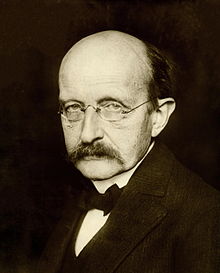
Max Planck - Born in April 23, 1858


Max Karl Ernst Ludwig Planck, (April 23, 1858 – October 4, 1947) was a German theoretical physicist who originated quantum theory, which won him the Nobel Prize in Physics in 1918.
Max Planck 1933.jpg
Max Planck. Credit: Wikipedia
Planck made many contributions to theoretical physics, but his fame rests primarily on his role as originator of the quantum theory. This theory revolutionized human understanding of atomic and subatomic processes, just as Albert Einstein’s theory of relativity revolutionized the understanding of space and time. Together they constitute the fundamental theories of 20th-century physics. Both have led humanity to revise some of its most cherished philosophical beliefs, and have brought about industrial and military applications that affect many aspects of modern life.
His work on Black Body Radiation was the begging of Quantum Mechanics.

The Planck constant (denoted h, also called Planck's constant) is a physical constant that is the quantum of action in quantum mechanics. The Planck constant was first described as the proportionality constant between the energy (E) of a photon and the frequency (f) of its associated electromagnetic wave. This relation between the energy and frequency is called the Planck relation: E = h f.


"Blackbody radiation" or "cavity radiation" refers to an object or system which absorbs all radiation incident upon it and re-radiates energy which is characteristic of this radiating system only, not dependent upon the type of radiation which is incident upon it. The radiated energy can be considered to be produced by standing wave or resonant modes of the cavity which is radiating. 
From the assumption that the electromagnetic modes in a cavity were quantized in energy with the quantum energy equal to Planck's constant times the frequency, Planck derived a radiation formula. The average energy per "mode" or "quantum" is the energy of the quantum times the probability that it will be occupied:

This average energy times the density of such states, expressed in terms of either frequency or wavelength
gives the energy density , the Planck radiation formula.
Font: HyperPhysics, Wikipedia

Here is a simulation of the Blacbody radiation (PhET)


You can also try this cool simulation from Open Source Physics.

Finally watch this video with a brief History of Quantum Mechanics:


Thursday, November 8, 2012

Discover of X-Rays


Today we celebrate the discover of the X-Ray an important part of the electromagnetic spectrum.
I posted in this blog a several posts about radiation, with focus in the X-Rays. Now, Let's find out who discovered this radiation and how.

Wilhelm Conrad Röntgen (27 March 1845 – 10 February 1923) was a German physicist, who, on 8 November 1895, produced and detected electromagnetic radiation in a wavelength range today known as X-rays or Röntgen rays, an achievement that earned him the first Nobel Prize in Physics in 1901. His experiments involved the passing of electric current through gases at extremely low pressure. On November 8, 1895 while he was experimenting, he observed that certain rays were emitted during the passing of the current through discharge tube. His experiment that involved working in a totally dark room with a well covered discharge tube resulted in the emission of rays which illuminated a barium platinocyanide covered screen. The screen became fluorescent even though it was placed in the path of the rays, two meters away from discharge tube.


earlier x-rays

He continued his experiments using photographic plate to capture the image of various objects of random thickness placed in the path of the rays. He generated the very first “roentgenogram” by developing the image of his wife’s hand and analyzed the variable transparency as showed by her bones, flesh and her wedding ring. Based on his subsequent research and experiments, he declared that X-ray beams are produced by the impact of cathode rays on material objects.

Thursday, October 18, 2012

Nuclear Reactions and Radiation

Nuclear Reactions

In nuclear physics and nuclear chemistry, a nuclear reaction is semantically considered to be the process in which two nuclei, or else a nucleus of an atom and a subatomic particle (such as a proton, neutron, or high energy electron) from outside the atom, collide to produce one or more nuclides that are different from the nuclide(s) that began the process. 

In principle, a reaction can involve more than two particles colliding, but because the probability of three or more nuclei to meet at the same time at the same place is much less than for two nuclei, such an event is exceptionally rare (see triple alpha process for an example very close to a three-body nuclear reaction). "Nuclear reaction" is a term implying an induced change in a nuclide, and thus it does not apply to any type of radioactive decay (which by definition is a spontaneous process).
Natural nuclear reactions occur in the interaction between cosmic rays and matter, and nuclear reactions can be employed artificially to obtain nuclear energy, at an adjustable rate, on demand. Perhaps the most notable nuclear reactions are the nuclear chain reactions in fissionable materials that produces induced nuclear fission, and the various nuclear fusion reactions of light elements that power the energy production of the Sun and stars. 
Nuclear reactions may be shown in a form similar to chemical equations, for which invariant mass must balance for each side of the equation, and in which transformations of particles must follow certain conservation laws, such as conservation of charge and baryon number (total atomic mass number). An example of this notation follows:
6
3
Li
 
+ 2
1
H
 
→ 2 4
2
He
Instead of using the full equations in the style above, in many situations a compact notation is used to describe nuclear reactions. This style of of the form A(b,c)D, which is equivalent to A + b gives c + D. Common light particles are often abbreviated in this shorthand, typically p for proton, n for neutron, d for deuteron, α representing an alpha particle or helium-4, β for beta particle or electron, γ for gamma photon, etc. The reaction above would be written as Li-6(d,α)α.
Kinetic energy may be released during the course of a reaction (exothermic reaction) or kinetic energy may have to be supplied for the reaction to take place (endothermic reaction). This can be calculated by reference to a table of very accurate particle rest masses, as follows: according to the reference tables, the 6

3Li nucleus has a relative atomic mass of 6.015 atomic mass units (abbreviated u), the deuterium has 2.014 u, and the helium-4 nucleus has 4.0026 u Thus:
  • Total rest mass on left side = 6.015 + 2.014 = 8.029 u
  • Total rest mass on right side = 2 × 4.0026 = 8.0052 u
  • Missing rest mass = 8.029 – 8.0052 = 0.0238 atomic mass units.
In a nuclear reaction, the total (relativistic) energy is conserved. The "missing" rest mass must therefore reappear as kinetic energy released in the reaction; its source is the nuclear binding energy. Using Einstein's mass-energy equivalence formula E = mc², the amount of energy released can be determined. We first need the energy equivalent of one atomic mass unit:
1 u c² = (1.66054 × 10−27 kg) × (2.99792 × 108 m/s)² 
= 1.49242 × 10−10 kg (m/s)² = 1.49242 × 10−10 J (Joule)
× (1 MeV / 1.60218 × 10−13 J)
= 931.49 MeV,
so 1 u c² = 931.49 MeV.
Hence, the energy released is 0.0238 × 931 MeV = 22.4 MeV.
Expressed differently: the mass is reduced by 0.3%, corresponding to 0.3% of 90 PJ/kg is 300 TJ/kg.
This is a large amount of energy for a nuclear reaction; the amount is so high because the binding energy per nucleon of the helium-4 nucleus is unusually high, because the He-4 nucleus is "doubly magic". (The He-4 nucleus is unusually stable and tightly bound for the same reason that the helium atom is inert: each pair of protons and neutrons in He-4 occupies a filled 1s nuclear orbital in the same way that the pair of electrons in the helium atom occupy a filled 1s electron orbital). Consequently, alpha particles appear frequently on the right hand side of nuclear reactions.
The energy released in a nuclear reaction can appear mainly in one of three ways:
When the product nucleus is metastable, this is indicated by placing an asterisk ("*") next to its atomic number. This energy is eventually released through nuclear decay.
A small amount of energy may also emerge in the form of X-rays. Generally, the product nucleus has a different atomic number, and thus the configuration of its electron shells is wrong. As the electrons rearrange themselves and drop to lower energy levels, internal transition X-rays (X-rays with precisely defined emission lines) may be emitted.

Radiation

In physics, radiation is a process in which energetic particles or energetic waves travel through vacuum, or though matter-containing media that are not required for their propagation.
Two energies of radiation are commonly differentiated by the way they interact with normal chemical matter: ionizing and non-ionizing radiation. The word radiation is often colloquially used in reference to ionizing radiation (i.e., radiation having sufficient energy to ionize an atom), but the term radiation may correctly also refer to non-ionizing radiation (e.g.,radio waves, heat or visible light). The particles or waves radiate (i.e., travel outward in all directions) from a source. This aspect leads to a system of measurements and physical units that are applicable to all types of radiation. Because radiation radiates through space and its energy is conserved in vacuum, the power of all types of radiation follows an inverse-square law of power with regard to distance from its source.
Both ionizing and non-ionizing radiation can be harmful to organisms and can result in changes to the natural environment. The question of harm to biological systems due to low-power ionizing and non-ionization radiation is not settled.

I - Ionizing radiation

Radiation with sufficiently high energy can ionize atoms. Most often, this occurs when an electron is stripped (or "knocked out") from an electron shell, which leaves the atom with a net positive charge.
Illustration of the relative abilities of three different types ofionizing radiation to penetrate solid matter. Alpha particles (α) are stopped by a sheet of paper while beta particles (β) are stopped by an aluminium plate. Gamma radiation (γ) is dampened when it penetrates lead.

I.I - Alpha

Alpha particles are the same as a helium-4 nucleus (two protons and two neutrons) and travel at speeds in excess of 5% of the speed of light, but they interact with matter very heavily, and thus at their usual velocities only penetrate a few centimeters of air, or a few millimeters of low density material (such as the thin mica material which is specially placed in some Geiger counter tubes to allow alpha particles in). This means that alpha particles from ordinary alpha decay do not penetrate skin and cause no damage to tissues below. Some very high energy alpha particles compose about 10% of cosmic rays, and these are capable of penetrating the body and even thin metal plates. However, they are of danger only to astronauts, since they are deflected by the Earth's magnetic field and then stopped by its atmosphere.

I.II - Beta

Beta-minus (β−) radiation consists of an energetic electron. It is more ionizing than alpha radiation, but less than gamma. Beta radiation from radioactive decay can be stopped with a few centimeters of plastic or a few millimeters of metal. It occurs when a neutron decays into a proton in a nucleus, releasing the beta particle and an antineutrino. Beta radiation from linac accelerators is far more energetic and penetrating than natural beta radiation. It is sometimes used therapeutically in radiotherapy to treat superficial tumors.
Beta-plus (β+) radiation is the emission of positrons, which are antimatter electrons. When a positron slows down to speeds similar to those of electrons in the material, the positron will annihilate an electron, releasing two gamma photons in the process. Those two gamma photons will be traveling in (approximately) opposite directions.

I.III - Neutron

Neutrons are categorized according to their speed. Neutron radiation consists of free neutrons. These neutrons may be emitted during either spontaneous or induced nuclear fission, nuclear fusion processes, or from any other nuclear reactions.
Neutrons are the only type of ionizing radiation that can make other objects, or material, radioactive. This process, called neutron activation, is the primary method used to produce radioactive sources for use in medical, academic, and industrial applications. Even comparatively low speed thermal neutrons, which do not carry enough kinetic energy individually to be ionizing, will cause neutron activation (in fact, they cause it more efficiently). Such neutrons are "indirectly ionizing."

I.IV - X-Ray

X-rays are electromagnetic waves with a wavelength smaller than about 10 nanometers. A smaller wavelength corresponds to a higher energy according to the equation E=h c/λ. ("E" is Energy; "h" is Planck's constant; "c" is the speed of light; "λ" is wavelength.) A "packet" of electromagnetic waves is called a photon. When an X-ray photon collides with an atom, the atom may absorb the energy of the photon and boost an electron to a higher orbital level or if the photon is very energetic, it may knock an electron from the atom altogether, causing the atom to ionize. Generally, a larger atom is more likely to absorb an X-ray photon, since larger atoms have greater energy differences between orbital electrons. Soft tissue in the human body is composed of smaller atoms than the calcium atoms that make up bone, hence there is a contrast in the absorption of X-rays. X-ray machines are specifically designed to take advantage of the absorption difference between bone and soft tissue, allowing physicians to examine structure in the human body.

I.V - Gamma

Gamma (γ) radiation consists of photons with a frequency of greater than 1019 Hz. Gamma radiation occurs to rid the decaying nucleus of excess energy after it has emitted either alpha or beta radiation. Both alpha and beta particles have an electric charge and mass, and thus are quite likely to interact with other atoms in their path. Gamma radiation is composed of photons, which have neither mass nor electric charge. Gamma radiation penetrates much further through matter than either alpha or beta radiation.
Gamma rays, which are highly energetic photons, penetrate deeply and are difficult to stop. They can be stopped by a sufficiently thick layer of material, where stopping power of the material per given area depends mostly (but not entirely) on its total mass, whether the material is of high or low density. However, as is the case with X-rays, materials with high atomic number such as lead or depleted uranium add a modest (typically 20% to 30%) amount of stopping power over an equal mass of less-dense and lower atomic weight materials (such as water or concrete).

II - Non-ionizing radiation

The energy of non-ionizing radiation is less and instead of producing charged ions when passing through matter, the electromagnetic radiation has only sufficient energy to change the rotational, vibrational or electronic valence configurations of molecules and atoms.

Non-ionizing electromagnetic radiation

The non-ionizing portion of electromagnetic radiation consists of electromagnetic waves that (as individual quanta or particles, see photon) are not energetic enough to detach electrons from atoms or molecules, ionizing them. These include radio waves, microwaves, infrared, and (sometimes) visible light. (Ultraviolet light, X-rays and gamma-rays are regarded as ionizing.) The occurrence of ionization depends on the energy of the individual particles or waves, and not on their number. An intense flood of particles or waves will not cause ionization if these particles or waves do not carry enough energy to be ionizing, unless they raise the temperature of a body to a point high enough to ionize small fractions of atoms or molecules by the process of thermal-ionization (this requires relatively extreme radiation energies, however).

II.I - Visible light

Light, or visible light, is a very narrow range of electromagnetic radiation of a wavelength that is visible to the human eye (about 400–700 nm), or up to 380–750 nm. More broadly, physicists refer to light as electromagnetic radiation of all wavelengths, whether visible or not.

II.II - Infrared

Infrared (IR) light is electromagnetic radiation with a wavelength between 0.7 and 300 micrometers, which equates to a frequency range between approximately 1 and 430 THz. IR wavelengths are longer than that of visible light, but shorter than that of terahertz radiation microwaves. Bright sunlight provides an irradiance of just over 1 kilowatt per square meter at sea level. Of this energy, 527 watts is infrared radiation, 445 watts is visible light, and 32 watts is ultraviolet radiation.

II.III - Microwave

Microwaves are electromagnetic waves with wavelengths ranging from as long as one meter to as short as one millimeter, or equivalently, with frequencies between 300 MHz (0.3 GHz) and 300 GHz. This broad definition includes both UHF and EHF (millimeter waves), and various sources use different boundaries. In all cases, microwave includes the entire SHF band (3 to 30 GHz, or 10 to 1 cm) at minimum, with RF engineering often putting the lower boundary at 1 GHz (30 cm), and the upper around 100 GHz (3mm).

II.IV - Radio waves

Radio waves are a type of electromagnetic radiation with wavelengths in the electromagnetic spectrum longer than infrared light. Like all other electromagnetic waves, they travel at the speed of light. Naturally occurring radio waves are made by lightning, or by astronomical objects. Artificially generated radio waves are used for fixed and mobile radio communication, broadcasting, radar and other navigation systems, satellite communication, computer networks and innumerable other applications. Different frequencies of radio waves have different propagation characteristics in the Earth's atmosphere; long waves may cover a part of the Earth very consistently, shorter waves can reflect off the ionosphere and travel around the world, and much shorter wavelengths bend or reflect very little and travel on a line of sight.

II.V - Very low frequency (VLF)

Very low frequency or VLF refers to radio frequencies (RF) in the range of 3 to 30 kHz. Since there is not much bandwidth in this band of the radio spectrum, only the very simplest signals are used, such as for radio navigation. Also known as the myriameter band or myriameter wave as the wavelengths range from ten to one myriameter (an obsolete metric unit equal to 10 kilometers)

II.VI - Extremely low frequency (ELF)

Extremely low frequency (ELF) is a term used to describe radiation frequencies from 3 to 30 Hz. In atmosphere science, an alternative definition is usually given, from 3 Hz to 3 kHz.[1] In the related magnetosphere science, the lower frequency electromagnetic oscillations (pulsations occurring below ~3 Hz) are considered to lie in the ULF range, which is thus also defined differently from the ITU Radio Bands.

II.VII - Thermal radiation (heat)

Thermal radiation is a common synonym for approximately black body radiation spontaneously emitted from objects, that is chiefly infrared electromagnetic radiation at temperatures often encountered on Earth. Thermal radiation refers not only to the radiation itself, but also the process by which the surface of an object radiates its thermal energyin the form black body radiation. Infrared or red radiation from a common household radiator or electric heater is an example of thermal radiation, as is the heat and light (IR and visible EM waves) emitted by a glowing incandescent light bulb. Thermal radiation is generated when heat from the movement of charged particles within atoms is converted to electromagnetic radiation. The emitted wave frequency of the thermal radiation is a probability distribution depending only on temperature, and for a black body is given by Planck's law of radiation. Wien's law gives the most likely frequency of the emitted radiation, and the Stefan–Boltzmann law gives the heat radiation intensity.
Parts of the electromagnetic spectrum of thermal radiation may be ionizing, if the object emitting the radiation is hot enough (has a high enough temperature). A common example of such radiation is sunlight, which is thermal radiation from the Sun's photosphere and which contains enough ultraviolet light (before being filtered by the Earth's atmosphere) to cause ionization in many molecules and atoms. An extreme example is the flash from the detonation of a nuclear weapon, which emits a large number of ionizing X-rays purely as a product of heating the atmosphere around the bomb to extremely high temperatures.

II.VIII - Black body radiation

Black body radiation is radiation from an idealized radiator that emits at any temperature the maximum possible amount of radiation at any given wavelength. A black body will also absorb the maximum possible incident radiation at any given wavelength. The radiation emitted covers the entire electromagnetic spectrum and the intensity (power/unit-area) at a given frequency is dictated by Planck's law of radiation. A black body at temperatures at or below room temperature would thus appear absolutely black as it would not reflect any light. Theoretically a black body emits electromagnetic radiation over the entire spectrum from very low frequency radio waves to x-rays. The frequency at which the black body radiation is at maximum is given by Wien's displacement law.


Featured Post

IBSE about Light Pollution

Here is my presentation that happened in the Discover the Cosmos Conference (Volos, Greece - 2013). The presentation was an Inquiry Base...

Popular Posts