Follow eufisica

Follow eufisica

Showing posts with label particles. Show all posts

Sunday, June 28, 2026

The Standard Model

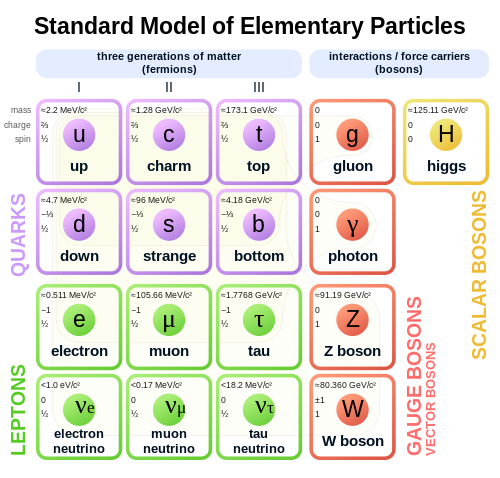
Standard Model - Source: Wikipedia


 The Standard Model of particle physics is the theoretical framework that describes the fundamental building blocks of the universe and the forces through which they interact. It is one of the most successful and rigorously tested theories in modern physics.

Here is a breakdown of how the universe is put together according to the Standard Model.

1. The Building Blocks: Matter Particles (Fermions)

All tangible matter in the universe is made up of particles called fermions, which have half-integer spin (e.g., 1/2). These are divided into two main categories, each split into three "generations" of increasing mass.

Quarks

Quarks are heavy particles that experience the strong nuclear force. They combine to form composite particles called hadrons (like protons and neutrons).

  • Generation 1: Up (u), Down (d) — These make up ordinary stable matter.

  • Generation 2: Charm (c), Strange (s)

  • Generation 3: Top (t), Bottom (b)

Leptons

Leptons do not feel the strong nuclear force.

  • Generation 1: Electron (e-), Electron Neutrino (νe)

  • Generation 2: Muon (μ), Muon Neutrino (νμ)

  • Generation 3: Tau (τ), Tau Neutrino (ντ)

Note: For every matter particle, there is a corresponding antimatter particle with the same mass but opposite electric charge (e.g., the positron is the antielectron).

2. The Messengers: Force Carriers (Gauge Bosons)

Particles interact by exchanging force-carrier particles called gauge bosons, which have integer spin (e.g., 1). The Standard Model accounts for three of the four fundamental forces of nature:

ForceDescriptionGauge Boson (Carrier)Mass / Range
ElectromagnetismGoverns atomic structure, light, and chemical reactions.Photon (γ)Massless / Infinite
Strong Nuclear ForceBinds quarks inside protons/neutrons and holds atomic nuclei together.Gluon ($g$)Massless / Short-range
Weak Nuclear ForceResponsible for radioactive decay (like beta decay) and initiating solar fusion.W+ / W- and Z0 BosonsVery heavy / Ultra short-range

3. The Mass Giver: The Higgs Boson

The Higgs Boson (H) is a scalar boson (spin 0) associated with the Higgs field, which permeates the entire universe.

  • Mechanism: As fundamental particles move through this field, they interact with it. The strength of this interaction determines the particle's inertial mass.

  • Particles like the top quark interact strongly and are very heavy; photons do not interact with it at all and remain massless.

  • Its discovery at CERN's Large Hadron Collider (LHC) in 2012 was the final piece confirming the Standard Model's framework.

What the Standard Model Left Out

While incredibly robust, the Standard Model is known to be an incomplete theory of nature because it fails to explain a few massive cosmological puzzles:

  • Gravity: It does not include general relativity. The hypothetical carrier of gravity, the graviton, has not been incorporated mathematically into the quantum framework.

  • Dark Matter & Dark Energy: The model only accounts for about 5% of the energy-mass composition of the observable universe. The remaining 95% is completely unaccounted for.

  • Neutrino Mass: In the original mathematical formulation of the Standard Model, neutrinos are massless. However, oscillation experiments have proved they possess tiny, non-zero masses.

  • Matter-Antimatter Asymmetry: It doesn't fully explain why the universe today is overwhelmingly made of matter, even though the Big Bang should have produced equal amounts of matter and antimatter.


Saturday, February 27, 2016

Virtual Visit to CMS at CERN (2016)

On February 24, 2016, at 15 hours, 55 students and 5 teachers in Escola Secundária Dr. Júlio Martins (Portuguese high school), made a virtual visit to CMS at CERN.


The activity was promoted by the European Project Inspiring Science Education (ISE), and it was made, for the second time, with a total of five portuguese schools: Escola Secundária Dr. Júlio Martins (Chaves); Escola Secundária Paços de Ferreira (Paços de Ferreira); Escola Secundária de Loulé (Faro), Agrupamento de Escolas Dra. Laura Ayres (Quarteira); Escola Secundária Adolfo Portela (Águeda).
The students saw the control room, the cavern of CMS (Compact Muon Solenoid) experiment, installed in LHC (Large Hadron Collider) and asked some questions to the scientists.
The students made a contact with Portuguese scientists, Pedro da Silva, André David Mendes and José Carlos da Silva, with technical support of Angelos Alexopoulos, Noemi Beni e Zoltan Zsillasi. They drove our students through CMS control room, and explained all the graphics in their computers, to the CMS cavern, 100 meters deep, and they explained all the objects observed, how it works and characteristics.

Thursday, March 12, 2015

Virtual Visit to CMS at CERN

On February 25, 2015, at 15 hours, 150 students and 10 teachers in Escola Secundária de Penafiel (Portuguese high school), made a virtual visit to CMS at CERN.

The activity was promoted by the European Project Open Discovery Space (ODS), and it was made, for the first time, with a total of five portuguese schools: Escola Secundária de Penafiel (Penafiel); Escola Secundária Ferreira Dias (Sintra); Escola Secundária José Saramago (Mafra), Agrupamento de Escolas Dra. Laura Ayres (Quarteira); Escola Secundária Adolfo Portela (Águeda).
The students saw the control room, the cavern of CMS (Compact Muon Solenoid) experiment, installed in LHC (Large Hadron Collider) and asked some questions to the scientists.
The students made a contact with portuguese scientists, Pedro da Silva, André David Mendes and José Carlos Silva, with technical support of Angelos Alexopoulos, Noemi Beni e Zoltan Zsillasi. They drove our students through CMS control room, and explained all the graphics in their computers, to the CMS cavern, 100 meters deep, and they explained all the objects observed, how it works and characteristics.


We achieved a total of 553 students in this virtual visit, and it was established a new record of students participating in a same session. All the students were pleased to visit virtually this especial science center.


Some feedback from our students:
Hello teacher, I would like to thank you the opportunity to participate in something unique. For students that study Physics, CERN is the epicenter of investigation and knowledge. I loved the fact that we made contact with scientists and it was so fun how they present the detector and technologies provided by CERN. It was useful to extend the knowledge of tiny world despite the fact that we need such a huge machine, like CMS, to discover that world. To see all of this visit in real time image was exceptional...
Thanks to all, specially people at CERN and our teachers to make this happened.” - André Queirós

"Hello teacher, I'm written this email about our virtual visit to CERN. It was a visit that arises our interest and curiosity to know better CERN and the experiments made by scientist. The simple language used by scientists helps us to understand the experiments, and kept students' attention.
I liked to thank the availability and I hope someday to know CERN even better." - Ana Catarina Moreira

"Hello teacher, I like to thank you for the visit, even virtually, it was very good and educative. I hope to perform another visit, but this time a live one. I was curious on CERN center and LHC detectors, and the explanation of both made by site scientists.
I wish a year full of success and with new discoveries!" - João Pereira.

"Hello teacher, the virtual visit was very interesting, now I understand what happen in there and what scientists do, how do they do it and the level to acquire such performance in science and technology. It was important to see the detector and jobs possibilities to students. Thank you so much for this opportunity" -  Tiago Carvalho

Acknowledgements:
CERN: Angelos Alexopoulos, André David, José Silva, Pedro Silva, Noemi Beni and Zoltan Zsillasi.
School’s pilot teachers: Cristina Pinho, Marília Peres, Miguel Neta, Álvaro Folhas and José Gonçalves.
ODS support: Rosa Doran and José Gonçalves.
Schools: To our students, teachers, directors and IT technicians.

On the web:
CERN event - https://indico.cern.ch/event/365946/ (with video)


Friday, November 21, 2014

two new particles


"Today the collaboration for the LHCb experiment at CERN1’s Large Hadron Collider announced the discovery of two new particles in the baryon family. The particles, known as the Xi_b'- and Xi_b*-, were predicted to exist by the quark model but had never been seen before. A related particle, the Xi_b*0, was found by the CMS experiment at CERN in 2012. The LHCb collaboration submitted a paper reporting the finding to Physical Review Letters." Source: CERN

Read more:

Saturday, July 20, 2013

Muon Neutrinos Transform to Electron Neutrinos

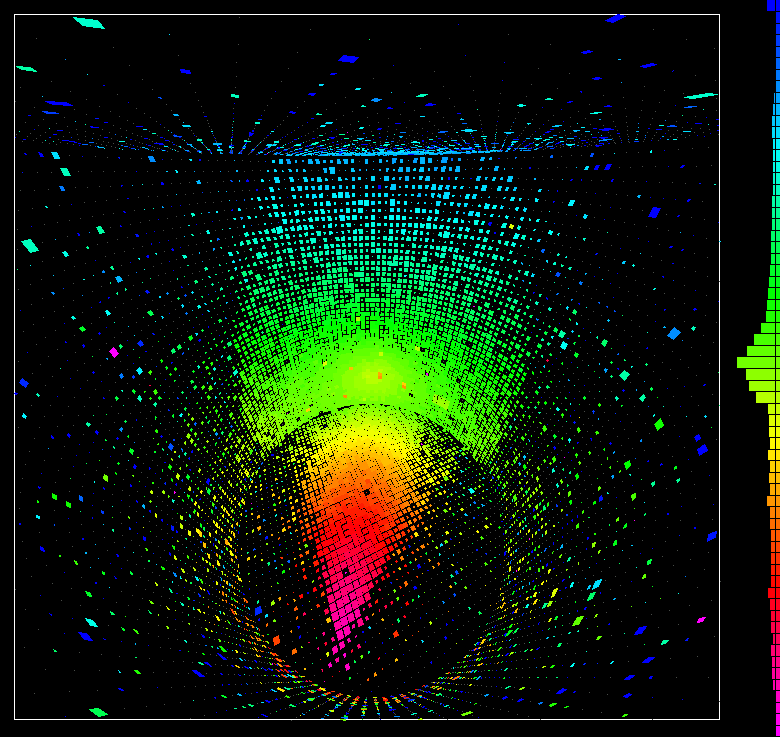
Super Kamiokande is the worldʼs largest underground neutrino detector,
and is located 1000 metres underground in Kamioka Mine, Hida, Gifu Precture, Japan.

Credit: Image courtesy of Stony Brook University

Yesterday at the European Physical Society meeting in Stockholm, the international T2K collaboration announced definitive observation of muon neutrino to electron neutrino transformation. In 2011, the collaboration announced the first indication of this process, a new type of neutrino oscillation, then; now with 3.5 times more data this transformation is firmly established. The probability that random statistical fluctuations alone would produce the observed excess of electron neutrinos is less than one in a trillion. Equivalently the new results exclude such possibility at 7.5 sigma level of significance. This T2K observation is the first of its kind in that an explicit appearance of a unique flavor of neutrino at a detection point is unequivocally observed from a different flavor of neutrino at its production point.

Friday, July 19, 2013

Rare particle decay detected at LHC

Protons collide in the CMS detector, producing a Bs particle that 
decays into two muons (red lines) in this event display from 2012 (Image: CMS)
New results to be presented today at the European Physical Society's High Energy Physics conference (EPS-HEP 2013) in Stockholm, Sweden, have put the Standard Model of particle physics to one of its most stringent tests to date. The CMS and LHCbexperiments at CERN’s Large Hadron Collider (LHC) will present measurements of one of the rarest measureable processes in physics: the decay of a Bs (pronounced B-sub-s) particle into two muons.
The new measurements show that only a handful of Bs particles per billion decay into pairs of muons. Because the process is so rare, it is an extremely sensitive probe for new physics beyond the Standard Model. Any divergence from the Standard Model prediction would be a clear sign of something new.
Both experiments will present results to a very high level of statistical significance (over 4 sigma for each experiment). These results are in good agreement with the Standard Model.
Font: CERN
Read more:
"A very rare decay has been seen by CMS- CMS collaboration 

Tuesday, July 16, 2013

Particle Physics (playlist)

Particle physics is a branch of physics that studies the nature of particles that are the constituents of what is usually referred to as matter and radiation. In current understanding, particles are excitations of quantum fields and interact following their dynamics. Although the word "particle" can be used in reference to many objects (e.g. a proton, a gas particle, or even household dust), the term "particle physics" usually refers to the study of the fundamental objects of the universe – fields that must be defined in order to explain the observed particles, and that cannot be defined by a combination of other fundamental fields. The current set of fundamental fields and their dynamics are summarized in a theory called the Standard Model, therefore particle physics is largely the study of the Standard Model's particle content and its possible extensions.
Source: Wikipedia

Watch this playlist about some of this particles:


More educational websites can be found here: http://www.particleadventure.org/other/othersites.html

Tuesday, June 18, 2013

Neutrinos: What is it?

Neutrinos' Detection. Credit: spiff.rit.edu
Last year I published a couple of posts about neutrinos. After the conclusion that the problem of the Gran Sasso's experiment was in the time measure, this particles return to normal speed (bellow the speed of light).

Now, Fermilab create a great video about this curious particles:


Read this Detecting neutrinos with an ice cube

Monday, December 31, 2012

"The Face of Creation" - Higgs remix

Time to say goodbye to 2012 with the biggest scientific new this year.
I wish you a happy 2013.

Monday, December 17, 2012

Building the next collider - by Nature Video

The Large Hadron Collider (LHC) is great for the discovery of particles, bit it isn't so precise.
So, scientist are thinking about this precision and it can be possible with a linear collider.
The International Linear Collider could be the next collider. The collisions will be between electrons and protons. The only problem is the global crisis.

Thursday, August 2, 2012

Latest news about Higgs Boson


(Phys.org) -- The two teams working (and causing headlines around the world) at the CERN Large Hadron Collider CMS and ATLAS, have both uploaded papers describing their work in searching for evidence of the particle that is believed to explain why matter sticks together, the elusive Higgs Boson, to the preprint server arXiv. In their paper, ATLAS has bumped up its sigma level of certainty from 5.0 to 5.9 while CMS has kept its level at the 4.9 to 5 range.

(Fermilab Today) -- The month of July 2012 is bound to be remembered as the crescendo of the summer of the Higgs boson. It began with the announcement of results from the Tevatron's search for the Standard Model Higgs boson, followed immediately by reports of the observation of a new particle by the LHC experiments. As the month continued, the CDF and DZero experiments released 10 publications on Higgs searches in multiple decay channels, building the pillars of the Tevatron's search for the Higgs boson in the state most difficult to pursue at the LHC, the Higgs boson decaying into two bottom quarks. Last week ended with the submission of the keystone paper in that combined effort, in which CDF and DZero announce finding evidence of a particle in the bottom quark pair search channel.

Friday, July 6, 2012

HST2012, CERN - Day 6

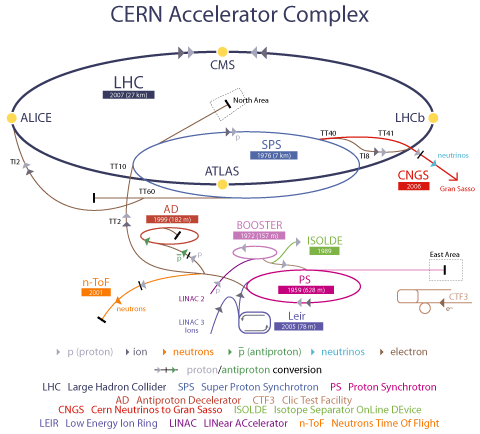
CERN Accelerator ComplexIn this day we had two lectures. One lecture was about the latest discoveries (top quark, bottom quark and tau neutrino); the second lecture was about the Principle of Uncertainty. I don't want to bored you with this stuff. So lets talk about our first visit: LINAC 2. We went to the restricted area with radiation control and watch the place where Physics started. Everything started with a tiny Hydrogen bottle. The H2 goes to a chamber where the electrons are retain and protons are "synchronized". After that the protons are injected to a linear accelerator and goes to LEIR. Look here:


Thursday, July 5, 2012

HST2012, CERN - Day 5


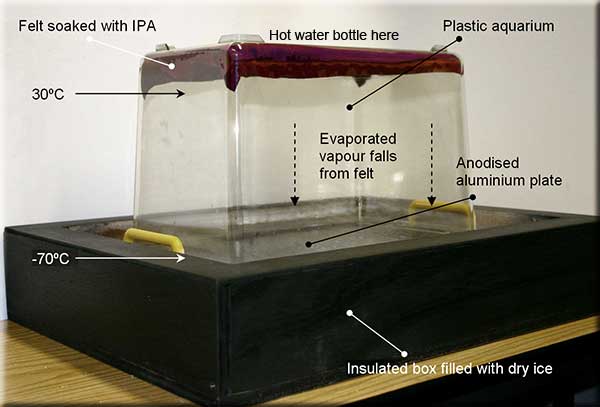
Today we made a Cloud Chamber or Wilson Chamber.
Credit:  scifun.ed
Basically consists of a closed environment which has inside it an isopropyl alcohol 100%. 
When a charged particle (examples, an alpha or beta particle) interacts with the mixture, it will ionize it. The resulting ions act as condensation nuclei, around which will form in the mist (because the mixture is in the dew point).
This type of particle detector (used for cosmic rays) had a prominent role in particle physics experiments between 1920s and 1950s. The findings of the positron in 1932 and the kaon in 1953 were made by using this type of detectors.

Wednesday, July 4, 2012

Higgs boson explained


Soundbytes from the interviews to Peter Higgs, Francois Englert, Carl Hagen and Gerald Guralnik, recorded at CERN on the announcement of the latest results from ATLAS and CMS on the Higgs boson searches: http://cdsweb.cern.ch/record/1459523

Sunday, May 6, 2012

The Higgs Boson explained

The world of particles is very attractive to physicist. I written several posts about it.
But, PHD Comics made a simple video that explain all of it and how LHC tray to find Higgs Boson. Watch it:

The Higgs Boson Explained from PHD Comics on Vimeo.

Friday, April 27, 2012

Observation of an excited Xi(b) baryon

Schematic diagram of the decay chain explored in this analysis.
The CMS experiment has submitted a paper for publication describing the firstobservation of a new, excited beauty baryon known as the Ξ*b0, with a statistical significance of more than 5 standard deviations (5σ) above the expected background. The mass is measured to be 5945.0 ± 2.8 MeV.
in PhysOrg 


Observation of an excited Xi(b) baryon

The observation of an excited b baryon via its strong decay into Xi(b)^- pi^+ (plus charge conjugates) is reported. The measurement uses a data sample of pp collisions at sqrt(s) = 7 TeV collected by the CMS experiment at the LHC, corresponding to an integrated luminosity of 5.3 inverse femtobarns. The known Xi(b)^- baryon is reconstructed via the decay chain Xi(b)^- to J/psi Xi^- to mu^+ mu^- Lambda^0 pi^-, with Lambda^0 to p pi^-. A peak is observed in the distribution of the difference between the mass of the Xi(b)^- pi^+ system and the sum of the masses of the Xi(b)^- and pi^+, with a significance exceeding five standard deviations. The mass difference of the peak is 14.84 +/- 0.74 (stat.) +/- 0.28 (syst.) MeV. The new state most likely corresponds to the Xi(b)^{*0} baryon, the J^P=3/2^+ excitation of the Xi(b)^0.
in arXiv
read more in CERN and Quantum Diaries

Featured Post

IBSE about Light Pollution

Here is my presentation that happened in the Discover the Cosmos Conference (Volos, Greece - 2013). The presentation was an Inquiry Base...

Popular Posts