Follow eufisica

Follow eufisica

Showing posts with label black body. Show all posts

Thursday, July 25, 2013

Black-Body Radiation and Gravity

Blackbody radiation induces attractive force stronger than gravity
Artistic visualization of the interaction between an atom and a Black-Body. Due to the atractive force of the Black-Body, the atom is pulled to the direction of this body. Credit: M. Sonnleitner, et al. ©2013 American Physical Society
The black-body objects are perfect not-reflectors that produce constant radiation when they are at a uniform temperature. Thus, the properties of a black-body depends on its temperature, thinking that this radiation would have a repulsive effect. Now a new, scientists have demonstrated theoretically that black-body radiation induces a second force in atoms and molecules that are near its surface which is attractive and stronger than the repulsive radiation pressure. Consequently, the atoms and molecules are pulled to the surface of the black-body by a force which may be greater than gravity. The new attractive force - what scientists describe as "black-body force" - suggests that a variety of astrophysical scenarios need to be revisited.
blackbody_radn_curves_Swinburne University of Technology
À medida que a temperatura diminui, o pico da curva da radiação de um corpo negro se desloca para menores intensidades e maiores comprimentos de onda.
Scientist identify a few interesting results in their formulation. First, this force decays with the third power of the distance to the black-body (F ∝ 1/r3). Second, it is more stronger for small objects. Third, the force is more stronger for warmer objects. Above a few thousand degrees Kelvin, the force of attraction changes to repulsion.
In their study, scientists demonstrated that the strength of the black-body in a grain of dust, at a temperature of 100 K, is much stronger than the gravitational force in this grain. However, for a massive star at a temperature of 6000 K black-body force is much weaker than the gravitational force.
Scientific Article: M. Sonnleitner, et al. “Attractive Optical Forces from Blackbody Radiation.” PRL 111, 023601 (2013). DOI: 10.1103/PhysRevLett.111.023601

Tuesday, April 23, 2013

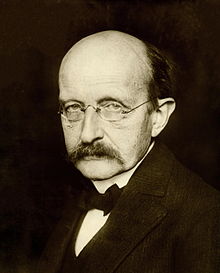
Max Planck - Born in April 23, 1858


Max Karl Ernst Ludwig Planck, (April 23, 1858 – October 4, 1947) was a German theoretical physicist who originated quantum theory, which won him the Nobel Prize in Physics in 1918.
Max Planck 1933.jpg
Max Planck. Credit: Wikipedia
Planck made many contributions to theoretical physics, but his fame rests primarily on his role as originator of the quantum theory. This theory revolutionized human understanding of atomic and subatomic processes, just as Albert Einstein’s theory of relativity revolutionized the understanding of space and time. Together they constitute the fundamental theories of 20th-century physics. Both have led humanity to revise some of its most cherished philosophical beliefs, and have brought about industrial and military applications that affect many aspects of modern life.
His work on Black Body Radiation was the begging of Quantum Mechanics.

The Planck constant (denoted h, also called Planck's constant) is a physical constant that is the quantum of action in quantum mechanics. The Planck constant was first described as the proportionality constant between the energy (E) of a photon and the frequency (f) of its associated electromagnetic wave. This relation between the energy and frequency is called the Planck relation: E = h f.


"Blackbody radiation" or "cavity radiation" refers to an object or system which absorbs all radiation incident upon it and re-radiates energy which is characteristic of this radiating system only, not dependent upon the type of radiation which is incident upon it. The radiated energy can be considered to be produced by standing wave or resonant modes of the cavity which is radiating. 
From the assumption that the electromagnetic modes in a cavity were quantized in energy with the quantum energy equal to Planck's constant times the frequency, Planck derived a radiation formula. The average energy per "mode" or "quantum" is the energy of the quantum times the probability that it will be occupied:

This average energy times the density of such states, expressed in terms of either frequency or wavelength
gives the energy density , the Planck radiation formula.
Font: HyperPhysics, Wikipedia

Here is a simulation of the Blacbody radiation (PhET)


You can also try this cool simulation from Open Source Physics.

Finally watch this video with a brief History of Quantum Mechanics:


Featured Post

IBSE about Light Pollution

Here is my presentation that happened in the Discover the Cosmos Conference (Volos, Greece - 2013). The presentation was an Inquiry Base...

Popular Posts