The two simplest of these circuits are called series and parallel and occur very frequently. In the image (above) we can see the schemes of two simple electric circuits. The first circuit (fig. 1) the lamps are connecting in a series circuit. The second circuit (fig. 2) we have the lamps are connecting in a parallel circuit.
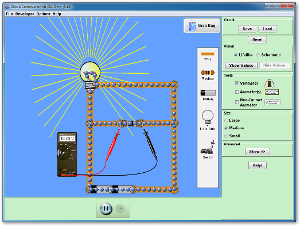
You can try to build both circuits by using a PhET simulation. Try to do it by clicking the image bellow.
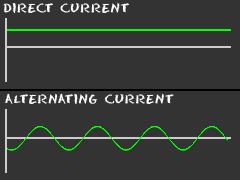
In alternating current (AC, also ac), the flow of electric charge periodically reverses direction. In direct current (DC, also dc), the flow of electric charge is only in one direction.
The abbreviations AC and DC are often used to mean simply alternating and direct, as when they modify current or voltage.
AC is the form in which electric power is delivered to businesses and residences. The usual waveform of an AC power circuit is a sine wave. In certain applications, different waveforms are used, such as triangular or square waves. Audio and radio signals carried on electrical wires are also examples of alternating current. In these applications, an important goal is often the recovery of information encoded (or modulated) onto the AC signal.
Direct Current (DC) and Alternating Current (AC). Credit: Physics4Kids
Direct current (DC) is the unidirectional flow of electric charge. Direct current is produced by sources such as batteries,thermocouples, solar cells, and commutator-type electric machines of the dynamo type. Direct current may flow in a conductor such as a wire, but can also flow through semiconductors, insulators, or even through a vacuum as in electron or ion beams. The electric current flows in a constant direction, distinguishing it from alternating current (AC).
Direct current may be obtained from an alternating current supply by use of a current-switching arrangement called a rectifier, which contains electronic elements (usually) or electromechanical elements (historically) that allow current to flow only in one direction. Direct current may be made into alternating current with an inverter or a motor-generator set.
The first commercial electric power transmission (developed by Thomas Edison in the late nineteenth century) used direct current. Because of the significant advantages of alternating current over direct current in transforming and transmission, electric power distribution is nearly all alternating current today. In the mid 1950s, HVDC transmission was developed, and is now an option instead of long-distance high voltage alternating current systems. For applications requiring direct current, such as third rail power systems, alternating current is distributed to a substation, which utilizes a rectifier to convert the power to direct current. See War of Currents.
Direct current is used to charge batteries, and in nearly all electronic systems, as the power supply. Very large quantities of direct-current power are used in production of aluminum and other electrochemical processes. Direct current is used for some railway propulsion, especially in urban areas. High-voltage direct current is used to transmit large amounts of power from remote generation sites or to interconnect alternating current power grids.
An electric motor is an electromechanical device that converts electrical energy into mechanical energy.
Most electric motors operate through the interaction of magnetic fields and current-carrying conductors to generate force. The reverse process, producing electrical energy from mechanical energy, is done by generators such as an alternator or a dynamo; some electric motors can also be used as generators, for example, a traction motor on a vehicle may perform both tasks. Electric motors and generators are commonly referred to as electric machines. (Wikipedia)
Do you want to build one? You can learn how to. Just read this paper.
You can find more information about electric motors here.
There is a virus video that are making crazy my students. "How can be possible?" They asked. I told them that can not be. How he did that? Easy, when he puts the lamp we can't see the extension. That means that is connect to elsewhere.
Here is the video:
And here is how my facebook's friend Iberê made the same experiment and the explanation:
Remember one of Physics laws: Energy can not be created or destroyed. Energy transforms one to another types.
The SI unit for measuring the rate of flow of electric charge is the ampere, which is charge flowing through some surface at the rate of one coulomb per second. Electric current is measured using an ammeter.
Voltage, otherwise known as electrical potential difference or electric tension (denoted ∆V and measured in volts, or joules per coulomb) is the potential difference between two points — or the difference in electric potential energy per unit charge between two points. Voltage is equal to the work which would have to be done, per unit charge, against a static electric field to move the charge between two points. A voltage may represent either a source of energy (electromotive force), or it may represent lost or stored energy (potential drop). A voltmeter can be used to measure the voltage (or potential difference) between two points in a system; usually a common reference potential such as the ground of the system is used as one of the points. Voltage can be caused by static electric fields, by electric current through a magnetic field, by time-varying magnetic fields, or a combination of all three.
On a problem set last week, I gave students the simple circuit shown to the right. I asked what would happen to various parts of the circuit when I decreased R2. One of the questions in particular said, "What will happen to the current flowing from the battery when the value of R2 is decreased?"
The most common answer:
"The current will not change, because it's the same battery, so it will always provide the same current."
Silly students, a battery provides a constant VOLTAGE, not a constant current -- but that's a common misconception in the first week of circuits.
The second most common answer:
"The current will not change, because R2 is the farthest resistor from the battery, and so the current hasn't reached R2 yet.
(click here to read entire article and see how Mr. Jacobs solve the students' misconception)
Atomic wire made of phosphorus. It links to silicon atoms.
Credit: Physics World
Ohm's Law
Ohm's law states that the current through a conductor between two points is directly proportional to the potential difference across the two points. Introducing the constant of proportionality, the resistance, one arrives at the usual mathematical equation that describes this relationship:
where I is the current through the conductor in units of amperes, V is the potential difference measured across the conductor in units of volts, and R is the resistance of the conductor in units of ohms. More specifically, Ohm's law states that the R in this relation is constant, independent of the current.
The law was named after the German physicist Georg Ohm, who, in a treatise published in 1827, described measurements of applied voltage and current through simple electrical circuits containing various lengths of wire. He presented a slightly more complex equation than the one above to explain his experimental results. The above equation is the modern form of Ohm's law.
In physics, the term Ohm's law is also used to refer to various generalizations of the law originally formulated by Ohm. The simplest example of this is:
where J is the current density at a given location in a resistive material, E is the electric field at that location, and σ is a material dependent parameter called the conductivity. This reformulation of Ohm's law is due to Gustav Kirchhoff.
The Drude model treats electrons (or other charge carriers) like pinballs bouncing between the ions that make up the structure of the material. (read more in Wikipedia).
An atomic scale experiment results
"A new technique for embedding atomic-scale wires within crystals of silicon has revealed that Ohm's law can hold true for wires just four atoms thick and one atom tall. The result comes as a surprise because conventional wisdom suggests that quantum effects should cause large deviations from Ohm's law for such tiny wires. Paradoxically, the researchers hope the finding will aid the development of quantum computers."
A team of Arizona State University created a channel in the silicon by removing layers of silicon atoms, by using the tip of a scanning probe microscope. The surface was then exposed to phosphorus gas, followed by the deposition of silicon atoms. The result was a chain of phosphorus atoms embedded inside a silicon crystal – an atomic wire.The team found that the resistivity of those wires was constant. That means the resistance of such a wire is proportional to its length and inversely proportional to its area, just as we seen in Ohm's law.
Implications
The discovery has several implications, including:
For engineers it could provide a roadmap to future nanoscale computational devices where atomic sizes are at the end of Moore's law. The theory shows that a single dense row of phosphorus atoms embedded in silicon will be the ultimate limit of downscaling.
For computer scientists, it places donor-atom based silicon quantum computing closer to realization.
And for physicists, the results show that Ohm's Law, which demonstrates the relationship between electrical current, resistance and voltage, continues to apply all the way down to an atomic-scale wire.
Redefining the kilogram and the ampere
New research using graphene presents the most precise measurements of the quantum Hall effect ever made, one of the key steps in the process to redefine two SI units.
"Key units to be redefined are the kilogram (mass) and the ampere (electric current). Presently the kilogram is defined by a physical lump of platinum-iridium and the ampere is defined via the force produced between two wires.
The goal is to define the kilogram in terms the Planck constant h and the ampere in terms of the electron charge e."
New electric diwheel hints at future of city transportation (PhysOrg.com) -- In a bit of technical wizardry, students from the University of Adelaide, Australia, have devised and built an electric diwheel, that with modification, could possibly solve inner city transportation problems. The team, comprised of 14 mechanical engineering students, has taken the idea of a diwheel and quite literally, turned it on its head, and in the process have created a vehicle that could be used to safely transport people around; all with a minimum amount of energy.
More evidence suggests electric cars need night time charging
(PhysOrg.com) -- Researchers in America have shown that ozone -- a known pollutant at low levels in the earth's atmosphere, causing harmful effects on the respiratory system and sensitive plants -- can be reduced, on average, when electric vehicle charging is done at night time.
As you see some parents, in the past, had a good explanation.
When I was young, at the age of seven, I asked to my father how a motor engine works. He explained with all the details. In that time I didn't understood too much, but years later at school I learned that topic faster than my colleagues.
So, don't be shine and explain as it is all the questions that your children have. (click below to read the rest of the article)





 "
"


