In this new school year we can start to push students heads in how to calculate the distance of each planet to our Sun and the respective size. Well, my fellow colleagues I prepared a spreadsheet.
Saturn orbits the Sun at an average distance of 9.5 times the distance from Earth to the Sun. Because of this, he gets close to 100 times less light than the Earth!
Saturn is the planet of the Solar System with the lowest average density (0.69 g / cm ³). The density of water is 1 g / cm ³, so Saturn has a density 31% less than water. We could put the planet floating in water.
It has been the most flattened planet of the Solar System. The difference between the equatorial and polar diameters is 10%.
Saturn is not the only planet in the Solar System that has rings, although the most noticeable and which are made up of ice and dust particles (variable sizes).
More interesting curiosities and video (by my G+ friend Fraser Cain) can be found here.
(Phys.org)—NASA's Curiosity rover mission has found evidence a stream once ran vigorously across the area on Mars where the rover is driving. There is earlier evidence for the presence of water on Mars, but this evidence—images of rocks containing ancient streambed gravels—is the first of its kind.
NASA's Mars rover Curiosity has discovered what appears to be an ancient streambed, suggesting that water once flowed in large volumes — perhaps hip-deep in places — across the Martian surface. (space.com)
PASADENA, Calif. -- NASA's Curiosity rover mission has found evidence a stream once ran vigorously across the area on Mars where the rover is driving. There is earlier evidence for the presence of water on Mars, but this evidence -- images of rocks containing ancient streambed gravels -- is the first of its kind.
Scientists are studying the images of stones cemented into a layer of conglomerate rock. The sizes and shapes of stones offer clues to the speed and distance of a long-ago stream's flow. (NASA)
Here is a set of photos from Curiosity Mars Rover:
Gale Crater Vista
This is the first 360-degree panorama in color of the Gale Crater landing site taken by NASA's Curiosity rover. The panorama was made from thumbnail versions of images taken by the Mast Camera. Image Credit: NASA/JPL-Caltech/MSSS
Self Portrait on deck
This full-resolution self-portrait shows the deck of NASA's Curiosity rover from the rover's
Navigation cameras. The back of the rover can be seen at the top left of the image, and two of the rover's right side wheels can be seen on the left. Part of the pointy rim of Gale Crater forms the lighter color strip in the background. Bits of gravel, about 1 centimeter in size, are visible on the deck of the rover.
Seams between the images have been minimized, but a few are still visible. The wide field of view introduces some distortion at the edges of the mosaic.
The "augmented reality" or AR tag seen in the middle of the image can be used in the future with smart phones to obtain more information about the mission.
Image Credit: NASA/JPL-Caltech
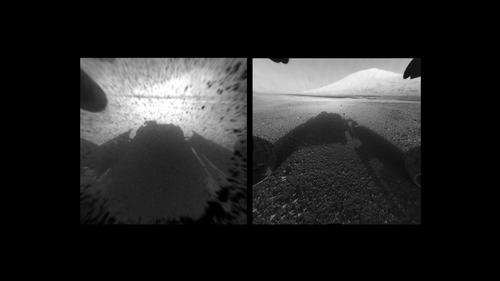
Clear Views on Mars
This image comparison shows a view through a Hazard-Avoidance camera on NASA's Curiosity rover before and after the clear dust cover was removed.
Both images were taken by a camera at the front of the rover. Mount Sharp, the mission's ultimate destination, looms ahead.
The view on the left, with the dust cover on, is one quarter of full resolution, while the view on the right is full resolution. Full- resolution images taken withthe dust cover still on are not available at this time. The only other instrument on Curiosity with a dust cover is the Mars Hand Lens Imager (or MAHLI), located on the rover's arm. In this case, the dust cover is not removed but will be opened when needed.
This way, the instrument is protected from dust that may be generated from other tools on the rover's arm, in addition to wind-blown dust.
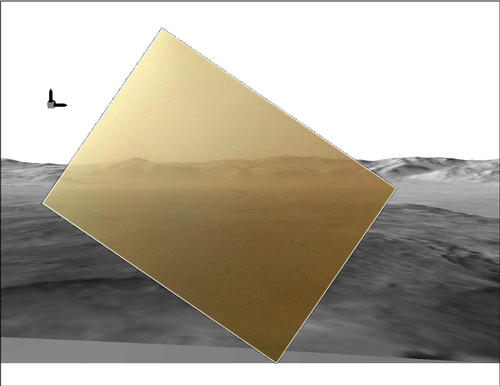
Image Credit: NASA/JPL-Caltech Curiosity's Landscape Portrait in Context
This picture of the Martian landing site of NASA's Curiosity rover puts a color view obtained by the rover in the context of a computer simulation derived from images acquired from orbiting spacecraft. The view looks north, showing a distant ridge that is the north wall and rim of Gale Crater.
The MAHLI image was taken while the camera's transparent dust cover was still on.
Curiosity's descent coated the cover with a thin film of dust.
The computer simulation is a digital elevation model that incorporates data from the High Resolution Imaging Science Experiment (HiRISE) and Context Camera on NASA's Mars Reconnaissance Orbiter and the High Resolution Stereo Camera on ESA's Mars Express.
The peak seen on the left-side of the MAHLI image is about 24 kilometers distant with a height of about 1,150 meters high. The box with arrows at the upper left indicates direction. The arrow pointing up is 'up' with respect to the gravity of Mars. The arrow pointing to the right is east. North would be an arrow pointing into the image (that is, the MAHLI view is toward the north).
The main purpose of Curiosity's MAHLI camera is to acquire close-up, high-resolution views of rocks and soil at the rover's Gale Crater field site. The camera is capable of focusing on any target at distances of about 2.1 centimeters to infinity. This means it can, as shown here, also obtain pictures of the Martian landscape.
Image Credit: NASA/JPL-Caltech/MSSS
Image and text credits: NASA/JPL-Caltech (click to obtain more images and in high resolution)
Venus is almost the same size of our planet. So, how many Earths could be inside our Sun, if could be that possible?
Let's assume that Earth, by approximation, is a little sphere that we going to put inside a giant sphere, our Sun.
To calculate how many our Sun is large in volume than our Earth, we find the relation between both astronomical objects. So, we can establish the volume ratio between Sun and Earth:
VSun = X x VEarth ↔ X = VSun / VEarth [1]
The sphere's volume can be calculated using the mathematical expression
4/3 π R3
Thus, applied in the equation [1] brings:
X = (4/3 π R3Sun) / (4/3 π R3Earth) ↔ X = (R3Sun) / (R3Earth) [2]
We can find the Sun and Earth radius values in Wikipedia:
NASA's Kepler spacecraft is discovering a veritable avalanche of alien worlds. As the numbers mount, it seems to be just a matter of time before Kepler finds what astronomers are really looking for: an Earth-like planet orbiting its star in the "Goldilocks zone".
Pluto, formal designation134340 Pluto, is the second-most-massive known dwarf planet in the Solar System (after Eris) and the tenth-most-massive body observed directly orbiting the Sun. Originally classified as the ninth planet from the Sun, Pluto was recategorized as a dwarf planet and plutoid due to the discovery that it is one of several large bodies within the newly charted Kuiper belt. inWikipedia
Johannes Kepler (December 27, 1571 – November 15, 1630) is not a name that most people recognize, but if you are aware of the recent discoveries of new planets, will recognize that many new planets bear his name. Perhaps the best birthday gift we can give to this scientist isKepler 22b, the first planet discovered in the habitable zone of a star, an earth possible planet like ours.
The planetsdescribeelliptical orbitswith the sunat one focus.
Theradius vectorconnectingthe planet to thesundescribesequal areasin equal times.(law of areas)
The squaresof the periodsof revolution(T) are proportionalto the cubes ofmean distances(a)from the Sunto the planets.T2=k a3, where k isaproportionality constant.
Probablymost of uswill never usethis informationin our life, but it does wellto remember that thosewas importantintellectual achievementsof Western civilization.We could eventhinkto rememberKepleritselfand itslawswould beenough, but Keplerhad moreprojects, forexample, projectsof the firstglasses for myopiaand hyperopia.
Astronomers find evidence for a strange new planetary system
(PhysOrg.com) -- A team of astronomers, including Dr Gavin Ramsay of the Armagh Observatory, has found evidence that suggests the existence of an extraordinary planetary system. Two giant planets appear to be revolving at some distance around a compact, interacting stellar binary known as UZ For, which comprises two small stars orbiting very closely one about the other.
Dry ice lake suggests Mars once had a 'Dust Bowl' (Update)
A newly found, buried deposit of frozen carbon dioxide -- dry ice -- near the south pole of Mars contains about 30 times more carbon dioxide than previously estimated to be frozen near the pole. Image credit: NASA/JPL-Caltech/Sapienza University of Rome/Southwest Research Institute
(PhysOrg.com) -- NASA's Mars Reconnaissance Orbiter has discovered the total amount of atmosphere on Mars changes dramatically as the tilt of the planet's axis varies. This process can affect the stability of liquid water, if it exists on the Martian surface, and increase the frequency and severity of Martian dust storms.
Want to know the 3D shape of terrain on another planet? Want to study the height and density of Earth's forests? An amazing tool called LIDAR can help! Learn more in this video.