
In alternating current (AC, also ac), the flow of electric charge periodically reverses direction. In direct current (DC, also dc), the flow of electric charge is only in one direction.
The abbreviations AC and DC are often used to mean simply alternating and direct, as when they modify current or voltage.
AC is the form in which electric power is delivered to businesses and residences. The usual waveform of an AC power circuit is a sine wave. In certain applications, different waveforms are used, such as triangular or square waves. Audio and radio signals carried on electrical wires are also examples of alternating current. In these applications, an important goal is often the recovery of information encoded (or modulated) onto the AC signal.
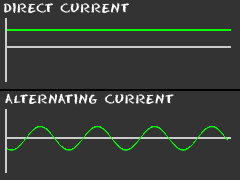 |
| Direct Current (DC) and Alternating Current (AC). Credit: Physics4Kids |
Direct current (DC) is the unidirectional flow of electric charge. Direct current is produced by sources such as batteries,thermocouples, solar cells, and commutator-type electric machines of the dynamo type. Direct current may flow in a conductor such as a wire, but can also flow through semiconductors, insulators, or even through a vacuum as in electron or ion beams. The electric current flows in a constant direction, distinguishing it from alternating current (AC).
Direct current may be obtained from an alternating current supply by use of a current-switching arrangement called a rectifier, which contains electronic elements (usually) or electromechanical elements (historically) that allow current to flow only in one direction. Direct current may be made into alternating current with an inverter or a motor-generator set.
The first commercial electric power transmission (developed by Thomas Edison in the late nineteenth century) used direct current. Because of the significant advantages of alternating current over direct current in transforming and transmission, electric power distribution is nearly all alternating current today. In the mid 1950s, HVDC transmission was developed, and is now an option instead of long-distance high voltage alternating current systems. For applications requiring direct current, such as third rail power systems, alternating current is distributed to a substation, which utilizes a rectifier to convert the power to direct current. See War of Currents.
Direct current is used to charge batteries, and in nearly all electronic systems, as the power supply. Very large quantities of direct-current power are used in production of aluminum and other electrochemical processes. Direct current is used for some railway propulsion, especially in urban areas. High-voltage direct current is used to transmit large amounts of power from remote generation sites or to interconnect alternating current power grids.
Another interesting page: Electric Current in Physics4Kids


