Follow eufisica

Follow eufisica

Showing posts with label quantum. Show all posts

Tuesday, March 31, 2020

A new era of internet?

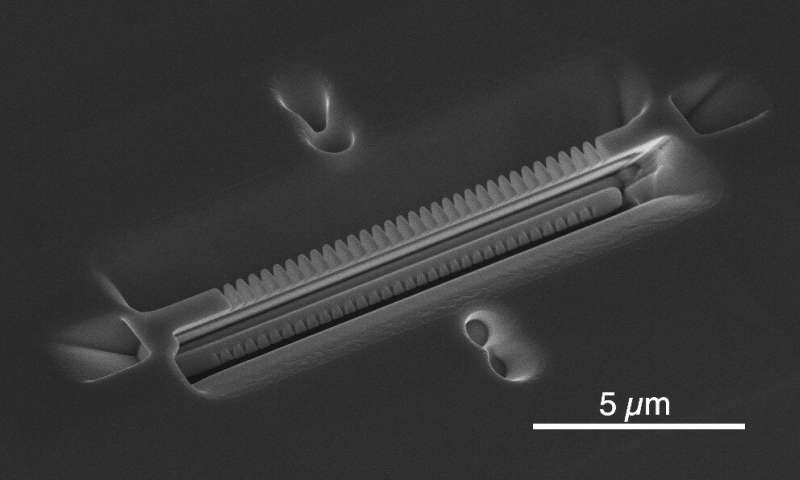
Tiny optical cavity could make quantum networks possible
A nanophotonic cavity created by the Faraon lab. Credit: Faraon lab/Caltech

Well, not yet. But this is a start to connect quantum computers through a quantum network. Development of experiments to connect two quantum bits is the next step. Let's see what reserves in the future.
"Engineers at Caltech have shown that atoms in optical cavities—tiny boxes for light—could be foundational to the creation of a quantum internet. Their work was published on March 30 by the journal Nature. (...) Currently, the team's focus is on creating the building blocks of a quantum network. Next, they hope to scale up their experiments and actually connect two quantum bits, Faraon says."
In phys.org

Monday, September 19, 2016

Can We Really Touch Anything?


"some of you will wonder: “If electron repulsion prevents us from ever truly touching anything, why do we perceive touch as a real thing?” The answer boils down to how our brains interpret the physical world." 
read the complete article here: http://futurism.com/apotd-curiosity-from-mro/

Monday, November 3, 2014

Quantum Numbers

Quantum numbers describe values of conserved quantities in the dynamics of a quantum system. In the case of quantum numbers of electrons, they can be defined as "The sets of numerical values which give acceptable solutions to theSchrödinger wave equation for the Hydrogen atom". Perhaps the most important aspect of quantum mechanics is thequantization of observable quantities, since quantum numbers are discrete sets of integers or half-integers, although they could approach infinity in some cases. This is distinguished from classical mechanics where the values can range continuously. Quantum numbers often describe specifically the energy levels of electrons in atoms, but other possibilities include angular momentumspin, etc. Any quantum system can have one or more quantum numbers; it is thus difficult to list all possible quantum numbers.
There are four quantum numbers which can describe the electron completely.
The principal quantum number (n) describes the electron shell, or energy level, of an atom. The value of n ranges from 1 to the shell containing the outermost electron of that atom.
The azimuthal quantum number () (also known as the angular quantum number or orbital quantum number) describes the subshell, and gives the magnitude of the orbital angular momentum.
The magnetic quantum number (m) describes the specific orbital (or "cloud") within that subshell, and yields the projection of the orbital angular momentum along a specified axis.
The spin projection quantum number (ms) describes the spin (intrinsic angular momentum) of the electron within that orbital, and gives the projection of the spin angular momentum S along the specified axis. An electron has spin s = ½, consequently ms will be ±½, corresponding with "spin" and "opposite spin." Each electron in any individual orbital must have different spins because of the Pauli exclusion principle, therefore an orbital never contains more than two electrons.
NameSymbolOrbital meaningRange of valuesValue examples
principal quantum numbernshell1 ≤ nn = 1, 2, 3, …
azimuthal quantum number (angular momentum)subshell (s orbital is listed as 0, p orbital as 1 etc.)0 ≤  ≤ n − 1for n = 3:
 = 0, 1, 2 (s, p, d)
magnetic quantum number, (projection ofangular momentum)menergy shift (orientation of the subshell's shape) ≤ m ≤ for  = 2:
m = −2, −1, 0, 1, 2
spin projection quantum numbermsspin of the electron (−½ = "spin down", ½ = "spin up")s ≤ ms ≤ sfor an electron s = ½,
so ms = −½, ½


Thursday, July 25, 2013

STOP that light

Crédito: Adrian
Credit: Adrian
The fastest thing in the universe was completely stopped and stored for a minute (new record). In vacuum, light travels about 18 million kilometers, in those 60 seconds - which represents more than 20 trips to the moon and back.
"A minute is a very, very long," says Thomas Krauss, St. Andrews University, UK. "This is really an important milestone."
The exploit could allow secure quantum communications to work at long distances.
As the light typically travels just under 300,000 kilometers per second in a vacuum, physicists  were able to slow it down just to only 17 meters per second in 1999, and two years later, stop it completely, though only by a fraction of a second. Earlier this year, researchers increased this time stopping the light for 16 seconds using cold atoms.
Light Trap
To break the minute barrier, George Heinze and colleagues at the University of Darmstadt, Germany, fired a laser control over an opaque crystal, the atoms leading to a quantum superposition of two states. This made it clear to a small range of frequencies. The Heinze's team then stopped a second laser beam which entered the crystal, turning the first laser off and, consequently, the transparency of that crystal disappeared.
The storage time depends upon the crystal's superposition. A magnetic field extends it, but it complicates the configuration of the control laser. Heinze's team used an algorithm to "generate" the magnets and laser combinations, leading them to trap the light for a minute.
Should still be possible to achieve longer storage of light with other crystals, Heinze says, as they did with the physical limits of this material.
Fonte: newscientist

Tuesday, June 11, 2013

Measure Quantum Motions of 1 Femtometer


The femtometre (symbol fmis an SI unit of length equal to 10−15 metres. This distance can also be called fermi and was so named in honour of Enrico Fermi and is often encountered in nuclear physics as a characteristic of this scale.
1 femtometre = 1.0 x 10⁻¹⁵ metres = 1 fermi = 0.001 picometre = 1000 attometres


1,000,000 femtometers = 1 nanometer.


For example, the diameter of a gold nucleus is approximately 8.45 femtometres.
In the video, Physicists Amir Safavi-Naeini and Oskar Painter describe how they were able to measure quantum motions of 1 femtometer (0.000000000000001 meters) in a micro-scale object.


Interesting reading:

Notes from Standford University: http://www.stanford.edu/~rsasaki/AP226/text4.pdf

arXiv preprints:

Mechanical systems in the quantum regime
Menno Poot, Herre S. J. van der Zant
Abstract
Mechanical systems are ideal candidates for studying quantum behavior of macroscopic objects. To this end, a mechanical resonator has to be cooled to its ground state and its position has to be measured with great accuracy. Currently, various routes to reach these goals are being explored. In this review, we discuss different techniques for sensitive position detection and we give an overview of the cooling techniques that are being employed. The latter include sideband cooling and active feedback cooling. The basic concepts that are important when measuring on mechanical systems with high accuracy and/or at very low temperatures, such as thermal and quantum noise, linear response theory, and backaction, are explained. From this, the quantum limit on linear position detection is obtained and the sensitivities that have been achieved in recent opto and nanoelectromechanical experiments are compared to this limit. The mechanical resonators that are used in the experiments range from meter-sized gravitational wave detectors to nanomechanical systems that can only be read out using mesoscopic devices such as single-electron transistors or superconducting quantum interference devices. A special class of nanomechanical systems are bottom-up fabricated carbon-based devices, which have very high frequencies and yet a large zero-point motion, making them ideal for reaching the quantum regime. The mechanics of some of the different mechanical systems at the nanoscale is studied. We conclude this review with an outlook of how state-of-the-art mechanical resonators can be improved to study quantum mechanics
http://arxiv.org/pdf/1106.2060.pdf

Quantum Nanomechanics
Pritiraj Mohanty
Abstract 
Quantum Nanomechanics is the emerging field which pertains to the mechanical behavior of nanoscale systems in the quantum domain. Unlike the conventional studies of vibration of molecules and phonons in solids, quantum nanomechanics is defined as the quantum behavior of the entire mechanical structure, including all of its constituents—the atoms, the molecules, the ions, the electrons as well as other excitations. The relevant degrees of freedom of the system are described by macroscopic variables and quantum mechanics in these variables is the essential aspect of quantum nanomechanics. In spite of its obvious importance, however, quantum nanomechanics still awaits proper and complete physical realization.
In this article, I provide a conceptual framework for defining quantum nanomechanical systems and their characteristic behaviors, and chart out possible avenues for the experimental realization of bona fide quantum nanomechanical systems.

Sunday, November 11, 2012

Length vs Speed

I don't know who made this graphic, but it's a great way to compare length vs speed and the Physics that can be applied.

Wednesday, March 21, 2012

Light pulses in a quantum walk

The principle of quantum random motion in two dimensions: At a node, a light pulse can continue on its journey through a network of optical fibres in four directions: forwards, backwards, to the right or to the left. As a quantum object, it is in fact at all the locations that are on the possible routes to a destination. Credit: MPI for the Science of Light/University of Paderborn 
Tourists who drift aimlessly during a sightseeing tour are moving randomly - just like electrons that move from one atom to the next. To obtain a better understanding of these random motions it is often useful to reduce their complexity. Physicists do this by simulating random walks. These simulations can bring new insights in the quantum world as well. Researchers at the Max Planck Institute for the Science of Light and the University of Paderborn and their colleagues are now the first to successfully realize an arrangement for a quantum walk in two dimensions. The experimental setup can be used to investigate many quantum phenomena.
in PhysOrg

Multidimensional quantum walks can exhibit highly nontrivial topological structure, providing a powerful tool for simulating quantum information and transport systems. We present a flexible implementation of a two-dimensional (2D) optical quantum walk on a lattice, demonstrating a scalable quantum walk on a nontrivial graph structure. We realized a coherent quantum walk over 12 steps and 169 positions using an optical fiber network. With our broad spectrum of quantum coins, we were able to simulate the creation of entanglement in bipartite systems with conditioned interactions. Introducing dynamic control allowed for the investigation of effects such as strong nonlinearities or two-particle scattering. Our results illustrate the potential of quantum walks as a route for simulating and understanding complex quantum systems.


Monday, February 27, 2012

One more victory over uncertainty in quantum physics measurements

Michael Chapman, a professor in the School of Physics at Georgia Tech, poses with optical equipment in his laboratory. Chapman’s research team is exploring squeezed states using atoms of Bose-Einstein condensates. (Credit: Gary Meek)

(PhysOrg.com) -- Most people attempt to reduce the little uncertainties of life by carrying umbrellas on cloudy days, purchasing automobile insurance or hiring inspectors to evaluate homes they might consider purchasing. For scientists, reducing uncertainty is a no less important goal, though in the weird realm of quantum physics, the term has a more specific meaning.
Watch this video to know more about The Uncertainty Principle:

Useful tip: Save money on quantum physics books by using Barnes and Noble promotional codes.

Sunday, January 15, 2012

Touch Screens & Quantum Tunnelling - Sixty Symbols

Time to look at the latest touch screen technology and how it uses the strange phenomenon of quantum tunnelling.


Monday, December 19, 2011

Quantum dot TV


The quantum dots will be in use for ultra thin, light flat screen TVs by the end of next year, and, in another three years, will be used in flexible screens rolled up like paper or used as wall coverings.
Entire article in PhysOrg.com


Thursday, November 17, 2011

Let there be light

Scientists create light from vacuum
In the Chalmers scientists’ experiments, virtual photons bounce off a “mirror” that vibrates at a speed that is almost as high as the speed of light. The round mirror in the picture is a symbol, and under that is the quantum electronic component (referred to as a SQUID), which acts as a mirror. This makes real photons appear (in pairs) in vacuum. Credit: Philip Krantz, Chalmers
(PhysOrg.com) -- Scientists at Chalmers University of Technology have succeeded in creating light from vacuum – observing an effect first predicted over 40 years ago. The results will be published tomorrow (Wednesday) in the journal Nature. In an innovative experiment, the scientists have managed to capture some of the photons that are constantly appearing and disappearing in the vacuum.


Complete article here.

Monday, February 7, 2011

A new quantum state of water

Credits: physicsworld.com
A recent publication scientist discovered that "water is confinned on scales of 20 A, this wave function responds to the details of the confi nement, corresponds to a strongly anharmonic local potential, shows evidence in some cases of coherent delocalization in double wells, and involves changes in zero point kinetic energy of the protons from -40 to +120 meV di erence from that of bulk water at room temperature. This behavior appears to be a generic feature of nanoscale confi nement."

From physicsworld.com:
George Reiter of the University of Houston and colleagues study in detail the key to water's unusual properties – the hydrogen bond. This is the bond between water molecules, connecting the oxygen atom of one molecule to the hydrogen atom in another.[...]They found that the momentum distribution of the protons was strongly temperature dependent, with as much as 50% more kinetic energy than the electrostatic model predicts at low temperatures and 20% more kinetic energy at room temperature. The electrostatic model gives broadly the correct values for bulk water at room temperature.The team argues that this is evidence that the protons exist in a previously unobserved quantum state when water is confined to a very tiny volume – a state that is not described by the electrostatic model.[...]
read the full article in physicsworld.com

Featured Post

IBSE about Light Pollution

Here is my presentation that happened in the Discover the Cosmos Conference (Volos, Greece - 2013). The presentation was an Inquiry Base...

Popular Posts