Follow eufisica

Follow eufisica

Showing posts with label curiosity. Show all posts

Saturday, September 28, 2013

Latest news from Curiosity


Low concentration of methane in the atmosphere
The data collected by Curiosity rover revealed a poor concentration of methane in Mars. This results are interesting because they are in contradiction with the data collected by other missions in Mars' orbit.
The methane is important to scientist because it came from geological phenomena and biological process.
“This results minimized the probability of microbiological process in Mars, but there are many types of terrestrial microbes that do not generate methane.”
The Curiosity measured six times the concentration of methane in samples from the Martian atmosphere, in the period between October 2012 and June this year. In any cases, the robot has detected its presence. Due to the high sensitivity of the instrument used, the tunable laser spectrometer which follows the edge of the robot, scientists estimate that the concentration of atmospheric methane Mars should not exceed 1.3 parts per million. This value corresponds to roughly one-sixth of some previous estimates.
More info ScienceMag.


Water in the martian soil
After careful analysis, the fifth soil collection done by Curiosity rover in 'Rocknest' showed the presence of water, carbon dioxide, oxygen and sulfur. As a result of this analysis, it appears that the Martian soil is composed by 2% water, which leads scientists to project future missions to colonize the red planet.
"We know that there must be water on Mars so abundant and accessible," said Laurie Leshin, lead author of the study, concluding that "when we send people to Mars, they may collect soil from the Martian surface, heat it a little and draw water ". According to the study, we can extract about 0.47 liters of water from 0.03 cubic meter of soil.
More info in Space.com
Source: NASA
Images: NASA/JPL-Caltech/MSSS

Saturday, August 10, 2013

One Year in Mars

Credit: NASA
The Curiosity Mars Rover celebrates one year (Earth's years) in Mars.
One year ago (August, 5), NASA's Curiosity rover survived to the Red Planet landing.
"Curiosity stuck close to its landing site for most of its first 12 months on the Red Planet. Observations from NASA's Mars Reconnaissance Orbiter suggested that rocks in the area may have been exposed to liquid water long ago, and mission scientists wanted the rover to check out these landforms."
In September, Curiosity had rolled through an ancient streambed, where water had flowed perhaps hip-deep in places. In March, the mission team announced that Yellowknife Bay was indeed habitable billions of years ago.
The mission still running, and more to overcome in a near future.
More info in space.com

Saturday, April 13, 2013

Curiosity Rover Report (April 12, 2013): Mars' Bygone Atmosphere

This image shows the first holes into rock drilled by NASA's Mars rover Curiosity
Credit: NASA

Here is the latest news about the Curiosity Rover:

Remaining Martian Atmosphere Still Dynamic


Mars has lost much of its original atmosphere, but what's left remains quite active, recent findings from NASA's Mars rover Curiosity indicate. Rover ...
› Read More

Curiosity Resumes Science Investigations

NASA's Mars rover Curiosity has resumed science investigations after recovery from a computer glitch that prompted the engineers to switch the rover ...
› Read More

Curiosity Mars Rover Sees Trend in Water Presence

NASA's Mars rover Curiosity has seen evidence of water-bearing minerals in rocks near where it had already found clay minerals inside a drilled rock.
› Read More


Friday, September 28, 2012

Old streambed on martian surface

(Phys.org)—NASA's Curiosity rover mission has found evidence a stream once ran vigorously across the area on Mars where the rover is driving. There is earlier evidence for the presence of water on Mars, but this evidence—images of rocks containing ancient streambed gravels—is the first of its kind.

NASA's Mars rover Curiosity has discovered what appears to be an ancient streambed, suggesting that water once flowed in large volumes — perhaps hip-deep in places — across the Martian surface. (space.com)

PASADENA, Calif. -- NASA's Curiosity rover mission has found evidence a stream once ran vigorously across the area on Mars where the rover is driving. There is earlier evidence for the presence of water on Mars, but this evidence -- images of rocks containing ancient streambed gravels -- is the first of its kind.
Scientists are studying the images of stones cemented into a layer of conglomerate rock. The sizes and shapes of stones offer clues to the speed and distance of a long-ago stream's flow. (NASA)

Thursday, August 23, 2012

Thursday, August 9, 2012

Curiosity photos


Here is a set of photos from Curiosity Mars Rover:


Gale Crater Vista

This is the first 360-degree panorama in color of the Gale Crater landing site taken by NASA's Curiosity rover. The panorama was made from thumbnail versions of images taken by the Mast Camera.
Image Credit: NASA/JPL-Caltech/MSSS


Self Portrait on deck
This full-resolution self-portrait shows the deck of NASA's Curiosity rover from the rover's 

Navigation cameras. The back of the rover can be seen at the top left of the image, and two of the rover's right side wheels can be seen on the left. Part of the pointy rim of Gale Crater forms the lighter color strip in the background. Bits of gravel, about 1 centimeter in size, are visible on the deck of the rover.


Seams between the images have been minimized, but a few are still visible. The wide field of view introduces some distortion at the edges of the mosaic.


The "augmented reality" or AR tag seen in the middle of the image can be used in the future with smart phones to obtain more information about the mission. 


Image Credit: NASA/JPL-Caltech 


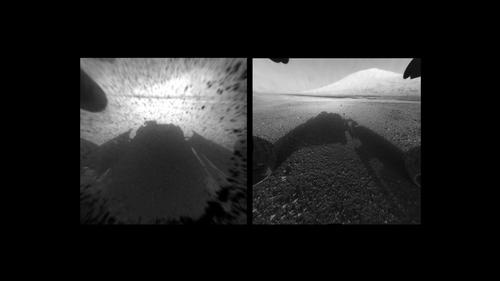
Clear Views on Mars
Clear Views on Mars
This image comparison shows a view through a Hazard-Avoidance camera on NASA's Curiosity rover before and after the clear dust cover was removed. 

Both images were taken by a camera at the front of the rover. Mount Sharp, the mission's ultimate destination, looms ahead.
The view on the left, with the dust cover on, is one quarter of full resolution, while the view on the right is full resolution. Full- resolution images taken with the dust cover still on are not available at this time. The only other instrument on Curiosity with a dust cover is the Mars Hand Lens Imager (or MAHLI), located on the rover's arm. In this case, the dust cover is not removed but will be opened when needed.
This way, the instrument is protected from dust that  may be generated from other tools on the rover's arm, in addition to wind-blown dust.

Image Credit: NASA/JPL-Caltech 

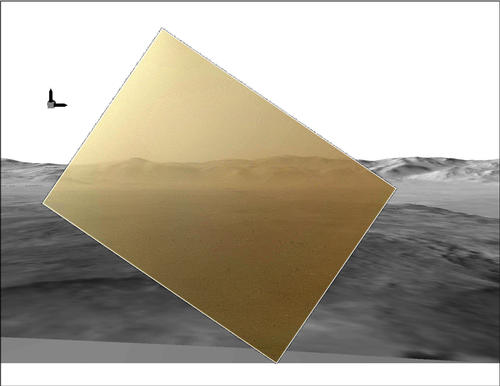
Curiosity's Landscape Portrait in ContextCuriosity's Landscape Portrait in Context

This picture of the Martian landing site of NASA's Curiosity rover puts a color view obtained by the rover in the context of a computer simulation derived from images acquired from orbiting spacecraft. The view looks north, showing a distant ridge that is the north wall and rim of Gale Crater. 
The MAHLI image was taken while the camera's transparent dust cover was still on. 
Curiosity's descent coated the cover with a thin film of dust.

The computer simulation is a digital elevation model that incorporates data from the High Resolution Imaging Science Experiment (HiRISE) and Context Camera on NASA's Mars Reconnaissance Orbiter and the High Resolution Stereo Camera on ESA's Mars Express. 

The peak seen on the left-side of the MAHLI image is about 24 kilometers distant with a height of about 1,150 meters high. The box with arrows at the upper left indicates direction. The arrow pointing up is 'up' with respect to the gravity of Mars. The arrow pointing to the right is east. North would be an arrow pointing into the image (that is, the MAHLI view is toward the north).

The main purpose of Curiosity's MAHLI camera is to acquire close-up, high-resolution views of rocks and soil at the rover's Gale Crater field site. The camera is capable of focusing on any target at distances of about 2.1 centimeters to infinity. This means it can, as shown here, also obtain pictures of the Martian landscape. 

Image Credit: NASA/JPL-Caltech/MSSS 

Image and text credits: NASA/JPL-Caltech (click to obtain more images and in high resolution)

Monday, August 6, 2012

First images from Mars Curiosity Rover

Curiosity Mars Rover has landed. Here is the first image from Mars Science Lab:
Credit: JPL/NASA

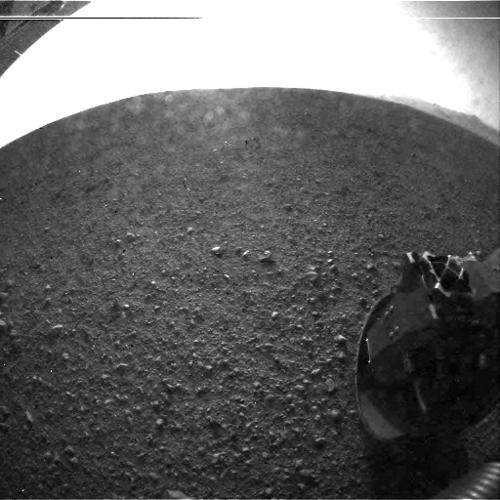
Curiosity's Surroundings

This is one of the first images taken by NASA's Curiosity rover, which landed on Mars the evening of Aug. 5 PDT (morning of Aug. 6 EDT).
"This is one of the first images taken by NASA's Curiosity rover, which landed on Mars the evening of Aug. 5 PDT (morning of Aug. 6 EDT). It was taken through a "fisheye" wide-angle lens on the left "eye" [...]. The clear dust cover that protected the camera during landing has been sprung open. Part of the spring that released the dust cover can be seen at the bottom right, near the rover's wheel.
On the top left, part of the rover's power supply is visible.
Some dust appears on the lens even with the dust cover off.
The cameras are looking directly into the sun, so the top of the image is saturated. Looking straight into the sun does not harm the cameras. The lines across the top are an artifact called "blooming" that occurs in the camera's detector because of the saturation. 
As planned, the rover's early engineering images are lower resolution. Larger color images from other cameras are expected later in the week [...]."

Image Credit: NASA/JPL-Caltech
Text credit: NASA/JPL

Sunday, August 5, 2012

Curiosity Mars Rover Landing (Live)

Watch Curiosity's Landing!

Aug 5, 2012     10:31 p.m.   Pacific
Aug 6, 2012     1:31 a.m.   Eastern
Aug 6, 2012     5:31 a.m.   Universal

Live broadcasting by Ustream

Challenges of Getting to Mars: Curiosity's Seven Minutes of Terror

"Team members at NASA's Jet Propulsion Laboratory share the challenges of the Curiosity Mars rover's final minutes to landing on the surface of Mars." (JPL youtube page)


Here is an image of the landing operation (credit: JPL/NASA):
Final Minutes of Curiosity's Arrival at Mars


Follow the Curiosity Mars Rover landing here (LIVE). 
Aug 5, 2012     10:31 p.m.   Pacific
Aug 6, 2012     1:31 a.m.   Eastern
Aug 6, 2012     5:31 a.m.   Universal


This figure shows the location of the ten science instruments on the rover.
Credit: JPL/NASA
The science instruments in this rover are tools for acquiring information about the geology, atmosphere, environmental conditions, and potential biosignatures on Mars. 
The instruments that carry Mars Science Laboratory are:
  • Cameras
  • Spectrometers
  • Radiation Detectors
  • Environmental Sensors
  • Atmospheric Sensors
font JPL/NASA website

Monday, June 25, 2012

Where is curiosity right now?
NASA's next Mars rover, Curiosity, is slated to land on the Red Planet on Aug. 6, 2012 (EDT). Watch a real-time visualization of its journey through space and get up-to-date data sets using NASA's Eyes on the Solar System 3-D interactive. (Free browser plug-in required.)

One of the challenges to NASA's rover is the land site.
According to NASA "the car-sized rover will arrive closer to its ultimate destination for science operations, but also closer to the foot of a mountain slope that poses a landing hazard."
Revised landing target for Mars Rover Curiosity
This image shows changes in the target landing area for Curiosity,
the rover of NASA's Mars Science Laboratory project. I
mage credit: NASA/JPL-Caltech/ESA/DLR/FU Berlin/MSSS

"The landing target ellipse had been approximately 20 kilometers wide and 25 kilometers long. Continuing analysis of the new landing system's capabilities has allowed mission planners to shrink the area to approximately 7 kilometers wide and 20 kilometers long, assuming winds and other atmospheric conditions are as predicted.
Even with the smaller ellipse, Curiosity will be able to touch down at a safe distance from steep slopes at the edge of Mount Sharp."
font NASA

That day will be a stressful day at NASA (at least, 7 minutes of terror):


Featured Post

IBSE about Light Pollution

Here is my presentation that happened in the Discover the Cosmos Conference (Volos, Greece - 2013). The presentation was an Inquiry Base...

Popular Posts