
Showing posts with label Feynman. Show all posts
Showing posts with label Feynman. Show all posts
Thursday, May 24, 2012

Saturday, May 12, 2012
Richard Feynman
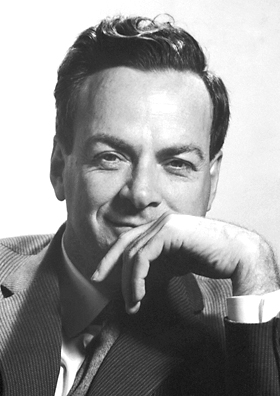
Richard Phillips Feynman (May 11, 1918 – February 15, 1988) was an American physicist known for his work in the path integral formulation of quantum mechanics, the theory of quantum electrodynamics, and the physics of the superfluidity of supercooled liquid helium, as well as in particle physics (he proposed the parton model). For his contributions to the development of quantum electrodynamics, Feynman, jointly with Julian Schwinger and Sin-Itiro Tomonaga, received theNobel Prize in Physics in 1965. He developed a widely used pictorial representation scheme for the mathematical expressions governing the behavior of subatomic particles, which later became known as Feynman diagrams. During his lifetime, Feynman became one of the best-known scientists in the world. In a 1999 poll of 130 leading physicists worldwide by the British journal Physics World he was ranked as one of the ten greatest physicists of all time. [2]
[1] in The Quotations Page
[2] in Wikipedia (12-05-2012)
 |
| In this Feynman diagram, an electron and a positronannihilate, producing a photon (represented by the blue wavy line) that becomes a quark-antiquark pair. Then one radiates a gluon (represented by the green spiral). |
A playlist from eufisica's channel:
Tuesday, March 20, 2012
Dissecting the Pinguin

Flip Tanedo wrote a great post about one of the amusing tales in particle physics: The story of how the “penguin diagram” got its name. Taneda won’t go into that in his post, instead, he will make use of some of the tools developed with Feynman diagrams to understand the physics behind these ‘penguin’ diagrams. In doing so, he will have a nice playground to really make use of what we’ve learned so far about Feynman rules. (Feel free to review the series if you need a refresher!)
Read entire article here: Quantum Diaries
Friday, February 17, 2012
Feynman Diagrams - Sixty Symbols
 |
| In this Feynman diagram, an electron and a positronannihilate, producing a virtual photon (represented by the blue wavy line) that becomes a quark-antiquark pair. Then one radiates a gluon (represented by the green spiral). |
Feynman diagrams are pictorial representations of the mathematical expressions governing the behavior of subatomic particles. The scheme is named for its inventor, Nobel Prize-winning American physicist Richard Feynman, and was first introduced in 1948. The interaction of sub-atomic particles can be complex and difficult to understand intuitively, and the Feynman diagrams allow for a simple visualization of what would otherwise be a rather arcane and abstract formula.
The calculation of probability amplitudes in theoretical particle physics requires the use of rather large and complicated integrals over a large number of variables. These integrals do, however, have a regular structure, and may be represented graphically as Feynman diagrams. More precisely, and technically, a Feynman diagram is a graphical representation of a perturbative contribution to the transition amplitude or correlation function of a quantum mechanical or statistical field theory.
from Wikipedia
Subscribe to:
Posts (Atom)
Popular Posts
-
This is a theoretical problem on a Mars habitat and the astronauts have to move it from the planet. Check the full reading:
-
Recently I discovered or someone gave me the link with a great websites. Let's talk about this two sites: 1) http://www.malakfunsci...
-
Observed and expected exclusion limits for a Standard Model Higgs boson at the 95-percent confidence level for the combined CDF and DZero ...
-
 Standard Model - Source: Wikipedia The Standard Model of particle physics is the theoretical framework that describes the fundamental bu...


