Follow eufisica

Follow eufisica

Showing posts with label mass. Show all posts

Monday, March 25, 2013

World's Roundest Object! Redefining The Kilogram

Difference between mass and weight. Font: eschooltoday

The kilogram (SI symbol: kg), is the base unit of mass in the International System of Units and is defined as being equal to the mass of the International Prototype of the Kilogram (IPK).
The gram was originally defined in 1795 as the mass of one cubic centimeter of water at 4°C, making the kilogram equal to the mass of one liter of water. The prototype kilogram, manufactured in 1799 and from which the current kilogram is based has a mass equal to the mass of 1.000025 liters of water.
The kilogram is the only SI base unit with an SI prefix ("kilo", symbol "k") as part of its name. It is also the only SI unit that is still directly defined by an artifact rather than a fundamental physical property that can be reproduced in different laboratories. Four of the seven base units in the SI system are defined relative to the kilogram so its stability is important.
The International Prototype Kilogram was commissioned by the General Conference on Weights and Measures (CGPM) under the authority of the Metre Convention (1875), and is in the custody of the International Bureau for Weights and Measures (BIPM) who hold it on behalf of the CGPM. After the International Prototype Kilogram had been found to vary in mass over time, the International Committee for Weights and Measures (CIPM) recommended in 2005 that the kilogram be redefined in terms of a fundamental constant of nature. At its 2011 meeting, the General Conference on Weights and Measures (CGPM) agreed in principle that the kilogram should be redefined in terms of the Planck constant, but deferred a final decision until its next meeting, scheduled for 2014.
The International Prototype Kilogram (IPK) is rarely used or handled. Copies of the IPK kept by national metrology laboratories around the world were compared with the IPK in 1889, 1948, and 1989 to provide traceability of measurements of mass anywhere in the world back to the IPK.
font: wikipedia


You can read this interesting post about mass.

Saturday, May 12, 2012

Mass - Energy equivalence


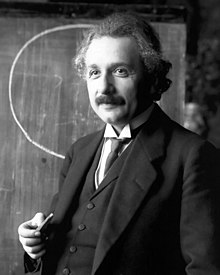
In physicsmass–energy equivalence is the concept that the mass of a body is a measure of its energy content. This means, for example, that the total internal energy E of a body at rest is equal to the product of its rest mass m and a suitable conversion factor to transform from units of mass to units of energy. Albert Einstein proposed mass–energy equivalence in 1905. The equivalence is described by the famous equation:
E = mc^2 \,\!
where E is energy, m is mass, and c is the speed of light in a vacuum. The equation E = mcindicates that energy always exhibits relativistic mass in whatever form the energy takes. Mass–energy equivalence does not imply that mass may be "converted" to energy, but it allows for matter to be converted to energy. Through all such conversions, mass remains conserved, since it is a property of matter and any type of energy. In physics, mass must be differentiated from matter. Matter, when seen as certain types of particles, can be created and destroyed (as in particle annihilation or creation), but the system of precursors and products of such reactions, as a whole, retain both the original mass and energy, with each of these system properties remaining unchanged (conserved) throughout the process. Simplified, this means that the total amount of energy (E) before the experiment is equal to the amount of energy after the experiment. Letting the m in E = mc2 stand for a quantity of "matter" (rather than mass) may lead to incorrect results, depending on which of several varying definitions of "matter" are chosen.
Einstein was not the first to propose a mass–energy relationship. However, Einstein was the first scientist to propose the E = mc2 formula and the first to interpret mass–energy equivalence as a fundamental principle that follows from the relativistic symmetries of space and time.
adapted from Wikipedia

Sunday, October 2, 2011

Precise measure of kilogram and ampere

Redefining the kilogram and the ampere
New research using graphene presents the most precise measurements of the quantum Hall effect ever made, one of the key steps in the process to redefine two SI units.


"Key units to be redefined are the kilogram (mass) and the ampere (electric current). Presently the kilogram is defined by a physical lump of platinum-iridium and the ampere is defined via the force produced between two wires.
The goal is to define the kilogram in terms the Planck constant h and the ampere in terms of the electron charge e."
in PhysOrg.com

Featured Post

IBSE about Light Pollution

Here is my presentation that happened in the Discover the Cosmos Conference (Volos, Greece - 2013). The presentation was an Inquiry Base...

Popular Posts