Follow eufisica

Follow eufisica

Showing posts with label decay. Show all posts

Friday, July 19, 2013

Rare particle decay detected at LHC

Protons collide in the CMS detector, producing a Bs particle that 
decays into two muons (red lines) in this event display from 2012 (Image: CMS)
New results to be presented today at the European Physical Society's High Energy Physics conference (EPS-HEP 2013) in Stockholm, Sweden, have put the Standard Model of particle physics to one of its most stringent tests to date. The CMS and LHCbexperiments at CERN’s Large Hadron Collider (LHC) will present measurements of one of the rarest measureable processes in physics: the decay of a Bs (pronounced B-sub-s) particle into two muons.
The new measurements show that only a handful of Bs particles per billion decay into pairs of muons. Because the process is so rare, it is an extremely sensitive probe for new physics beyond the Standard Model. Any divergence from the Standard Model prediction would be a clear sign of something new.
Both experiments will present results to a very high level of statistical significance (over 4 sigma for each experiment). These results are in good agreement with the Standard Model.
Font: CERN
Read more:
"A very rare decay has been seen by CMS- CMS collaboration 

Tuesday, April 17, 2012

Dineutron Decay


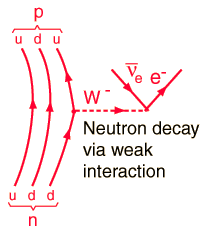
A single Neutron Decay
A free neutron will decay with a half-life of about 10.3 minutes but it is stable if combined into a nucleus. This decay is an example of beta decay with the emission of an electron and an electron antineutrino. The decay of the neutron involves the weak interaction (image at the right):

 
The Dineutron Decay
"The newly discovered dineutron decay mode joins the 15 other known forms of atomic decay, including double proton emission, double beta decay and double positron emission. The results hold promise to strengthen scientists’ understanding of the strong force that holds nuclei together and the processes taking place within neutron stars."

The experiment revealed a brand new form of nuclear decay, the process by which unstable atoms release energy and transform into more stable forms. But instead of emitting known patterns of radiation, the nucleus ejected two correlated simultaneously – a dineutron. Though physicists had long theorized about the existence of this form of decay, this was the first experiment to see the dineutron event in action.“We have for the first time unambiguously observed dineutron decay and clearly identified it in beryllium-16,” said Artemis Spyrou, professor of nuclear physics.

More in PhysOrg

Featured Post

IBSE about Light Pollution

Here is my presentation that happened in the Discover the Cosmos Conference (Volos, Greece - 2013). The presentation was an Inquiry Base...

Popular Posts