Follow eufisica

Follow eufisica

Showing posts with label antimatter. Show all posts

Thursday, July 25, 2013

Solar Flares gives antimatter

NASA’s SOHO spacecraft captured this image of a solar flare as it erupted from the Sun on October 28, 2003 (NASA / SOHO)
Erupção solar captada pela SOHO em 28 de outubro de 2003 (NASA / SOHO)
Associated with solar magnetic storms, solar flares are giant explosions on the sun that send energy, light and particles in all directions to the space. Their number increases approximately every 11 years.
When the universe was formed 13.8 billion years ago in the event known as the Big Bang, there was the same amount of matter and antimatter. Somehow the matter antimatter annihilated (when matter and antimatter meet, they annihilate each other), leaving only a portion of matter, enough to form stars, planets and galaxies that make up our universe.
The study of natural sources of antimatter, will allow researchers to understand why antimatter lost the battle to matter in the beginning of our universe.
Positrons are antiparticles of the antimatter. The positron, e+, and electrons, e-, (populating the common atoms) have the same physical behavior, except that the electrons have a negative charge while the positrons, as its name indicates, have a positive charge. This charge's difference causes that positrons interact differently with electromagnetic fields, which Professor Gregory Fleishman, from the New Jersey Institute of Technology and his colleagues from the Russia's Institute of Solar-Terrestrial Physics used to distinguish them.
The process of solar flares are very energetic and the ejected mass accelerates particles to speeds approaching the speed of light, allowing the creation of these positrons.
Using data from SOHO and radio images of two different frequencies obtained from Japan's Nobeyama Radioheliograph, the Russian-American team found that the light was polarized in different directions for low frequencies, where the ordinary matter dominates, compared to higher frequencies where antimatter is more expected.
"That this kind of antiparticles are created in solar flares is not surprising, but this is the first time that the immediate effects are detected," these results were presented on July 8, at the 44th meeting of Society American Astronomical Society's Solar Physics Division of the Bozeman, Montana.

The study has profound implications for obtaining valuable knowledge through remote sensing antiparticles relativistic starting the Sun and possibly other astrophysical objects through observations of radio telescopes.

Friday, May 3, 2013

What happened to antimatter? - Rolf Landua

Me and Rolf Landua holding the antimatter container of DaVinci's Code


Do you remember the antimatter bomb in the DaVinci's Code movie?

In my journey at CERN, Rolf Landua gave a lecture about antimatter. Basically the topics in the lecture was this questions: What is it? Where is it create? How can be created? What is the mystery behind it? How can we study it? Can we use it as a energy font or a bomb? Is any antimatter in our daylife?
In particle physics, antimatter is material composed of antiparticles, which have the same mass as particles of ordinary matter but have opposite charge and quantum spin. Antiparticles bind with each other to form antimatter in the same way that normal particles bind to form normal matter. For example, a positron (the antiparticle of the electron, with symbol e+) and an antiproton (symbol p) can form an antihydrogen atom. Furthermore, mixing matter and antimatter can lead to the annihilation of both, in the same way that mixing antiparticles and particles does, thus giving rise to high-energy photons (gamma rays) or other particle–antiparticle pairs. The end result of antimatter meeting matter is a release of energy proportional to the mass as the mass-energy equivalence equation, E=mc2 shows.
At this time, the apparent asymmetry of matter and antimatter in the visible universe is one of the greatest unsolved problems in physics.

Antimatter is created in the LHC, and the LHCb is the detector responsible to detect particles in the antiprotons' collisions. The antiprotons' production is achieved with the collisions between protons and nucleus of Iridium, Cupper, and others. The antiprotons are decelerated and keep trapped with a combination of electric and magnetic fields (so it doesn't touch matter). In this way, the resultant material is detected by the detector before the annihilation. That event is one of the biggest mysteries of the Big Bang, and scientist are trying to answer it: the domination of the matter over the antimatter.
FDG molecule
FDG is a glucose molecule, with fluorine-18 attached
This antimatter cannot be used as energy or weapon because we need energy to create it. Imagine that we want to produce 0.5 g of antimatter. Well, we need 22 kton (22,000 ton) of TNT (almost the same value of the Hiroshima's bomb), to produce 0.5 g of matter and antimatter. The energy in this process is about 4.5 x 1013 J. The total energy that we need (because the efficiency is 10-9 %) will be 4,5 x 1022 J. Even with CERN's discount made by French Electric Company [1 kwh = 3,6 x 10⁶ J= 0,1 €], the total cost will be 1 x 10⁸ € and it will be take a billion years to produce and supply this production to CERN.
But, antimatter is used in our body for PET scan detection. The glucose has a fluorine-18 attached that will emit positrons when that molecule travels in our body, and the scanner detects where the positrons go.
The next step that scientist at CERN are trying to develop is to use positrons and antiprotons as therapy in some deceases.
References:


Sunday, July 15, 2012

HST2012, CERN - Day 12


Rolf Landua and ME holding the antimatter bottle.
During this day we had two lectures and we continued into work group
The first lecture was the continuation about Accelerators. We leaved the technical details and we got into the Physics: energy, number of events, luminosity, etc.


It was emphasized that in the LHC does not circulate a steady stream of protons, they are sent in bunches and compressed by existing dipoles and quadrupoles in the accelerator. The curvature and focal power we use in optics is applied here at the LHC in terms of the strength of the different magnets. The magnetic field created at the LHC is 8.33 T, in the Earth is situated between 24 mT and 66 mT. There are approximately 6000 magnets in the LHC.

The second lecture was about Antimatter, performed by Rolf Landua based on the movie Angels and Demons. Basically, we tried to respond to seven questions related to the subject: What is it? Where is it created? How is it created? What is the mystery behind this? How to study it? Can be used as energy source or a bomb? There antimatter in our day-to-day?
Antimatter is real and is composed of antiparticles. For example, the hydrogen atom is formed by a proton and an electron, in the version of the antimatter, antihydrogen consists of a positron and antiproton. Antimatter is created in the LHC, the LHCb is the detector for those particles. 
To create antiprotons, LHC collide protons with cores of Iridium, copper, etc. .. Antiprotons are created, retarded and maintained as "prisoners" in a combination of electric and magnetic fields. Thus the material before the resulting annihilation is captured by the detector. 
This annihilation is one of the great mysteries of the Big Bang that scientists try to answer (the conversion of antimatter to matter in this dominance). 
This antimatter can not be used as energy or weapon because it requires a lot of energy to produce it. To have an idea, we use the following example: Let's try to create 0.5 g of antimatter. Therefore, it is necessary 22 kton (kilo ton) of TNT (approximately the same as Hiroshima's bomb) to produce a half gram of matter and antimatter. The energy associated with 0.5 g of antimatter is  4,5 x 10¹³ J. The total energy required (efficiency ~10-9 %) would be  4,5 x 1022 J. Even with the CERN discount given by the French electricity company [1 kWh = 3.6 x 10⁶ J = 0.1 €], the cost would be  1 x 10⁸ €  and would take one billion years deliver it.
Finally, it should be noted that antimatter is used in the body, where a proton is replaced by a positron in the glucose molecule to be detected by PET (Positron Emission Tomography) used in medicine. The next step for the scientists will be create a therapy using positrons.
 About the work we are developing in groups I will talk about later.

Wednesday, February 1, 2012

Repulsive gravity as an alternative to dark energy


(PhysOrg.com) -- When scientists discovered in 1998 that the Universe is expanding at an accelerating rate, the possibility that dark energy could explain the observation was intriguing. But because there has been little progress in figuring out exactly what dark energy is, the idea has since become more of a problem than a solution for some scientists. One physicist, Massimo Villata of the National Institute for Astrophysics (INAF) in Pino Torinese, Italy, describes dark energy as “embarrassing,” saying that the concept is an ad hoc element to standard cosmology and is devoid of any physical meaning. Villata is one of many scientists who are looking for new explanations of the Universe’s accelerating expansion that involve some form of repulsive gravity. In this case, the repulsive gravity could stem from antimatter hiding in voids.

(PhysOrg.com) -- During the past few years, CERN physicist Dragan Hajdukovic has been investigating what he thinks may be a widely overlooked part of the cosmos: the quantum vacuum. He suggests that the quantum vacuum has a gravitational charge stemming from the gravitational repulsion of virtual particles and antiparticles. Previously, he has theoretically shown that this repulsive gravity can explain several observations, including effects usually attributed to dark matter. Additionally, this additional gravity suggests that we live in a cyclic Universe (with no Big Bang) and may provide insight into the nature of black holes and an estimate of the neutrino mass. In his most recent paper, published in Astrophysics and Space Science, he shows that the quantum vacuum could explain one more observation: the Universe’s accelerating expansion, without the need for dark energy. 

Tuesday, August 9, 2011

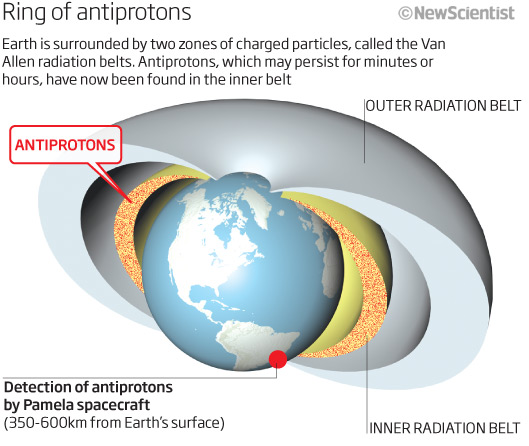
Anel de Antipartículas da Terra


Um artigo publicado pela New Scientist, no dia 04 de Agosto, revela que a Terra tem um anel de antiprotões confinado pelo campo magnético terrestre. A antimatéria poderia, em teoria, ser usado para abastecer foguetes ultra-eficientes do futuro (ler aqui e aqui).
Trajectória dos antiprotões nas linhas de  
campo magnético.
Estas linhas fazem parte da cintura de
radiação interna.
Os satélites já tinham descoberto positrões - os parceiros de antimatéria dos elétrões - na cintura de radiação. Agora, uma sonda detectou antiprotões, que são cerca de 2000 vezes mais massivos. Para o efeito, foi usado o PAMELA, um detector de raios cósmicos ligado a um satélite de observação russo. A nave voa através do interior da cintura interna de radiação da Terra sobre o Atlântico sul.
Entre julho de 2006 e dezembro de 2008, o PAMELA detectou antiprotões presos em órbitas espirais em torno das linhas do campo magnético que brotam do pólo sul da Terra. As amostras do PAMELA são apenas uma pequena parte da cintura de radiação interna, mas os antiprotões deverão, provavelmente, estar presos ao longo dessa cintura.


Fonte:  
New Scientist
Artigo para publicação em arXiv.org

Artigo completo publicado na astropt.org

Thursday, May 5, 2011

Antihydrogen for 1000 seconds

(a) A schematic view of the ALPHA trap. Penning trap electrodes are held at ~9 K, and have an inner diameter of 44.5 mm. A three-layer silicon vertex detector surrounds the magnets and the cryostat. A 1 T base field is provided by an external solenoid (not shown). An antiproton beam is introduced from the right, while positrons from an accumulator are brought in from the left. (b) The magnetic field strength in the y-z plane (z is along the trap axis, with z=0 at the centre of the magnetic trap). Green dashed lines in this and other figures depict the location of the inner walls of the electrodes. (c) The axial field profile, with an effective trap length of ~270 mm. (d) The field strength in the x-y plane. (e) The field strength profile along the x-axis. Image credit: ArXiv paper
CERN scientists confine antihydrogen atoms for 1000 seconds
(PhysOrg.com) -- Seventeen minutes may not seem like much, but to physicists working on the Antihydrogen Laser Physics Apparatus (ALPHA) project at the CERN physics complex near Geneva, 1000 seconds is nearly four orders of magnitude better than has ever been achieved before in capturing and holding onto antimatter atoms. In a paper published in arXiv, a team of researchers studying the properties of antimatter, describe a process whereby they were able to confine antihydrogen atoms for just that long, paving the way for new experiments that could demonstrate properties of antimatter that until now, have been largely speculation.
More info: http://arxiv.org/abs/1104.4982

Wednesday, April 13, 2011

Anti-Gravity

Image credit: NASA
(PhysOrg.com) -- In 1998, scientists discovered that the Universe is expanding at an accelerating rate. Currently, the most widely accepted explanation for this observation is the presence of an unidentified dark energy, although several other possibilities have been proposed. One of these alternatives is that some kind of repulsive gravity – or antigravity – is pushing the Universe apart. As a new study shows, general relativity predicts that the gravitational interaction between matter and antimatter is mutually repulsive, and could potentially explain the observed expansion of the Universe without the need for dark energy.

Versão Portuguesa aqui.

Monday, March 28, 2011

The antihelium was discover

STAR detector

The antihelium
Physics of the Relativistic Heavy Ion Collider (RHIC) in New York claim that they created nuclei of antihelium-4 for the first time – the heaviest antimatter element ever seen on Earth.

Antimatter nuclei are made from antiprotons and antineutrons but, with all the types of combinations of two and three quarks that can appear in the particle collisions, it is rare that multiple antiprotons and antineutrons appear close enough to each other to form anti-nuclei. Although the first antiprotons and antineutrons were discovered in 1950s, the construction of heavier nuclei has been very difficult and each additional anti-nucleon makes the anti-nuclei 1000 less probable to appear in a collision of particles. Until now, the heaviest anti-nuclei observed was limited to three anti-nucleons. But with RHIC experiment and the new detectors of STAR was possible to detect such anti-nuclei.

read more in: physicsworld.com

Versão Portuguesa: em astroPT ou eufisica.com

Monday, December 20, 2010

Trapping antihydrogen

Amplify’d from blogs.physicstoday.org

Trapping antihydrogen

Are there any unexpected differences between matter and antimatter? The international ALPHA collaboration has taken an important step toward answering that question by constructing an apparatus at CERN that can confine freshly made atoms of antihydrogen, the bound state of an antiproton and a positron, for nearly 0.2 seconds—long enough for the antimatter to be examined spectroscopically. A hot plasma of roughly 104 antiprotons—produced by slamming 26-GeV protons into a metal target—is cooled and introduced into one end of the apparatus, while about 106 low-energy positrons from the decay of radioactive sodium are introduced into the other. Electric fields gently nudge the charged species together in the heart of the device, pictured here, where they mix at cryogenic temperatures and form antihydrogen. If their kinetic energies are low enough—in temperature units, less than 0.5 K—the antihydrogen atoms are held in the grip of a superconducting octupole magnet and solenoidal “mirror” coils that together interact with the atoms’ magnetic moments. When the magnetic fields are abruptly turned off, the atoms are released and their spatial distribution captured by a three-layer silicon detector, which locates the atoms’ annihilations and distinguishes them from events triggered by lone antiprotons and stray cosmic rays. In 335 trial runs, the researchers confirmed that 38 antihydrogen atoms had survived in the trap for at least 172 ms. Although the trapping rate per atom produced is low—about 10−5—the achievement sets the stage for precision spectroscopy and antihydrogen tests of fundamental symmetries and gravitation. (G. B. Andresen et al., Nature 468, 673, 2010.)—R. Mark Wilson
Read more at blogs.physicstoday.org

Featured Post

IBSE about Light Pollution

Here is my presentation that happened in the Discover the Cosmos Conference (Volos, Greece - 2013). The presentation was an Inquiry Base...

Popular Posts