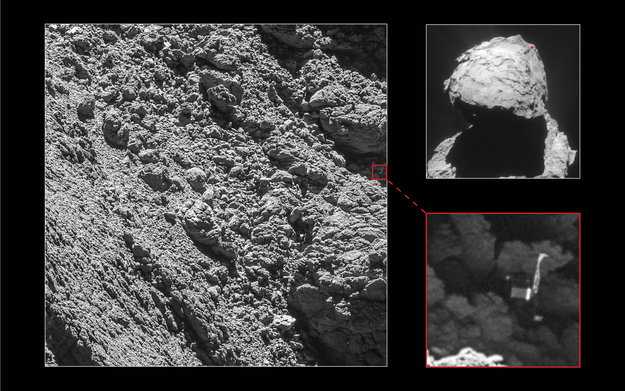
"Less than a month before the end of the mission, Rosetta’s high-resolution camera has revealed the Philae lander wedged into a dark crack on Comet 67P/Churyumov–Gerasimenko." (font: ESA)
"The solar system is littered with Ice. The bulk of this material orbits quietly in the outer Solar System, but sometimes, something disturbs the ice and the come plunging in toward the Sun. In this Hangout, we will discuss comets, how we explore them, and how they brought water to worlds like Earth." The educational scenario can be found here: http://portal.opendiscoveryspace.eu/community/chasing-comets-774702?msg_id=23134
A comet’s journey through the solar system is perilous and violent. A giant ejection of solar material from the sun could rip its tail off. Before it reaches Mars -- at some 230 million miles away from the sun -- the radiation of the sun begins to boil its water, the first step toward breaking apart. And, if it survives all this, the intense radiation and pressure as it flies near the surface of the sun could destroy it altogether. Right now, Comet ISON is making that journey. It began its trip from the Oort cloud region of our solar system and is now travelling toward the sun. The comet will reach its closest approach to the sun on Thanksgiving Day -- Nov. 28, 2013 -- skimming just 730,000 miles above the sun’s surface. If it comes around the sun without breaking up, the comet will be visible in the Northern Hemisphere with the naked eye, and from what we see now, ISON is predicted to be a particularly bright and beautiful comet. font: NASA More info: wikipedia
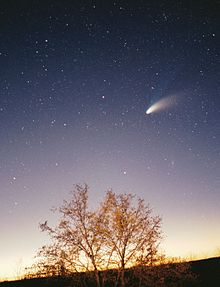
A comet is an icy small Solar System body (SSSB) that, when close enough to the Sun, displays a visible coma (a thin, fuzzy, temporary atmosphere) and sometimes also a tail. These phenomena are both due to the effects of solar radiation and the solar windupon the nucleus of the comet. Comet nuclei range from a few hundred meters to tens of kilometers across and are composed of loose collections of ice, dust, and small rocky particles. Comets have been observed since ancient times and have traditionally been considered bad omens.