Follow eufisica

Follow eufisica

Showing posts with label neutrino. Show all posts

Saturday, July 20, 2013

Muon Neutrinos Transform to Electron Neutrinos

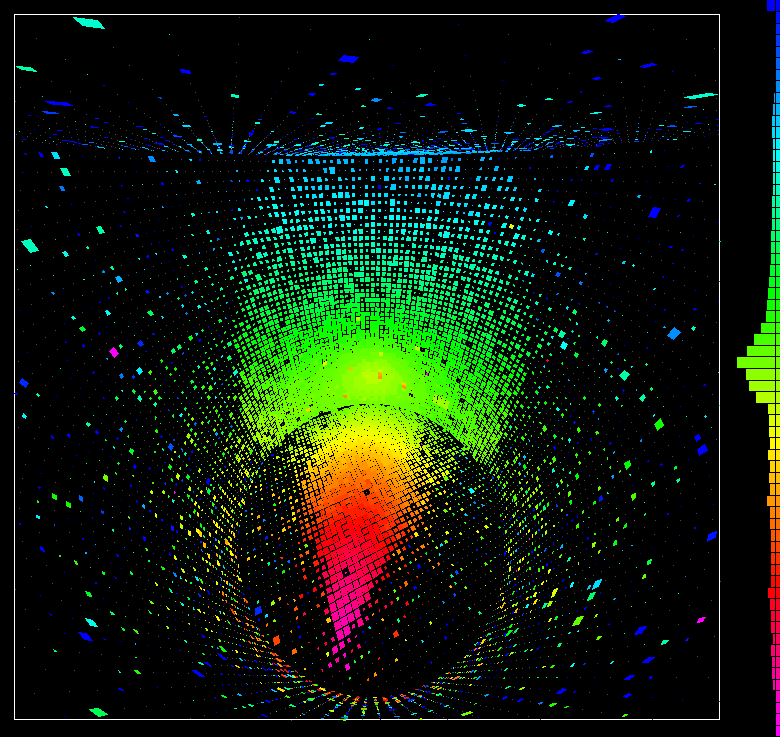
Super Kamiokande is the worldʼs largest underground neutrino detector,
and is located 1000 metres underground in Kamioka Mine, Hida, Gifu Precture, Japan.

Credit: Image courtesy of Stony Brook University

Yesterday at the European Physical Society meeting in Stockholm, the international T2K collaboration announced definitive observation of muon neutrino to electron neutrino transformation. In 2011, the collaboration announced the first indication of this process, a new type of neutrino oscillation, then; now with 3.5 times more data this transformation is firmly established. The probability that random statistical fluctuations alone would produce the observed excess of electron neutrinos is less than one in a trillion. Equivalently the new results exclude such possibility at 7.5 sigma level of significance. This T2K observation is the first of its kind in that an explicit appearance of a unique flavor of neutrino at a detection point is unequivocally observed from a different flavor of neutrino at its production point.

Tuesday, June 18, 2013

Neutrinos: What is it?

Neutrinos' Detection. Credit: spiff.rit.edu
Last year I published a couple of posts about neutrinos. After the conclusion that the problem of the Gran Sasso's experiment was in the time measure, this particles return to normal speed (bellow the speed of light).

Now, Fermilab create a great video about this curious particles:


Read this Detecting neutrinos with an ice cube

Friday, March 16, 2012

Neutrino's Saga - final chapter?

Time of flight difference between the speed of light and the arriving neutrinos. Observe a great difference between the two experiments. Now, we have to wait for the new results of the OPERA experiment, after the cable's problem.
The ICARUS experiment uploaded a paper to the arXiv website with a preprint paper about the neutrinos' velocity, in October 2011, defying the superluminal neutrinos. Now, after the assumption of a problem in a cable, by the OPERA team, ICARUS published a preprint paper that confirms the previous results that neutrinos doesn't travel with a speed superior that the speed of light. 
So, we have to wait for the OPERA results (we need a large number of events and it takes... days), to confirm that neutrinos aren't superluminal.
Here is the abstract:

Measurement of the neutrino velocity with the ICARUS detector at the CNGS beam


The CERN-SPS accelerator has been briefly operated in a new, lower intensity neutrino mode with ~10^12 p.o.t. /pulse and with a beam structure made of four LHC-like extractions, each with a narrow width of ~3 ns, separated by 524 ns. This very tightly bunched beam structure represents a substantial progress with respect to the ordinary operation of the CNGS beam, since it allows a very accurate time-of-flight measurement of neutrinos from CERN to LNGS on an event-to-event basis. The ICARUS T600 detector has collected 7 beam-associated events, consistent with the CNGS delivered neutrino flux of 2.2 10^16 p.o.t. and in agreement with the well known characteristics of neutrino events in the LAr-TPC. The time of flight difference between the speed of light and the arriving neutrino LAr-TPC events has been analysed. The result is compatible with the simultaneous arrival of all events with equal speed, the one of light. This is in a striking difference with the reported result of OPERA [1] that claimed that high energy neutrinos from CERN should arrive at LNGS about 60 ns earlier than expected from luminal speed. 
 Read more in DiscoverMagazine.com, CNet and Wired

Thursday, March 8, 2012

Daya Bay find new kind of neutrino transformation

Each antineutrino detector at the Daya Bay Reactor Neutrino Experiment is lined with photomultiplier tubes to catch the faint trace of antineutrino reactions in the scintillator fluids that fill the detectors. Credit: Roy Kaltschmidt, Lawrence Berkeley National Laboratory


(PhysOrg.com) The Daya Bay Reactor Neutrino Experiment, a multinational collaboration operating in the south of China, today reported the first results of its search for the last, most elusive piece of a long-standing puzzle: how is it that neutrinos can appear to vanish as they travel? The surprising answer opens a gateway to a new understanding of fundamental physics and may eventually solve the riddle of why there is far more ordinary matter than antimatter in the universe today.
Traveling at close to the speed of light, the three basic neutrino and their corresponding antineutrinos, mix together and oscillate (transform), but this activity is extremely difficult to detect. From Dec. 24, 2011, until Feb. 17, 2012, scientists observed tens of thousands of interactions of electron antineutrinos, and the data revealed for the first time the strong signal of the effect that the scientists were searching for, a so called "mixing angle" named theta one-three (written θ13). (adapted from PhysOrg)

Thursday, February 23, 2012

The Neutrino's Saga - Part 8


The saga of superluminal neutrinos seems to be coming to an end. Everything indicates that the results obtained by the OPERA Collaboration in Italy were due to an error in measuring instruments. According to a source connected to the experiment, the observed time discrepancy, 60 nanosecond that was measured, appears to be related to a poor connection between an optical fiber cable which connects the GPS receiver, which is used to correct the time of flight of neutrinos,and a circuit board of a computer.
Remember that the problem began in September 2011 when scientists were experimenting a flux of neutrinos from CERN (Geneva) to the Gran Sasso's laboratory in Italy (about 455 miles away), and reported results that seemed to indicate that the neutrinos traveled faster than the speed of light, reaching about 60 nanoseconds sooner than expected.
After the best tight connection, the researchers found that the time measured for the data running through the distance corresponding to length of optical fiber was less than 60 nanoseconds which had previously obtained, which would nullify the time difference obtained on the flight of the neutrinos. It seems therefore to be found a very simple explanation for the discrepancy of time that had been found in initial experiments. However, it is also necessary to obtain new data to confirm this situation.
It therefore indicates that the Einstein's Theory of Relativity once again winning out over a test of its validity. Since this theory has been confirmed many times in several experiments, most people suspected that there must be some error in the experiment had been conducted, which would escape to the researchers. This error appears to have been now found. It now remains to be confirmed.
You can read about this news here and here.

Wednesday, January 18, 2012

Cosmological Data could solved some problems in Physics

Decoding cosmological data could shed light on neutrinos, modified gravity
This Hubble Ultra-Deep Field image of the distant universe contains approximately 10,000 galaxies. Image credit: NASA and the ESA

(PhysOrg.com) -- Today’s most powerful telescopes collect huge amounts of data from the most distant locations of the universe – yet much of the information is simply discarded because it involves small length scales that are difficult to model. In an effort to waste less data from cosmological surveys, a team of scientists has developed a new technique that allows researchers to use otherwise unusable data by "clipping" some of the highest density peaks, which present the greatest challenge to models. This data could provide a way to address some unsolved problems in physics, including estimating the neutrino mass and investigating theories of modified gravity.

Tuesday, December 20, 2011

The Neutrino's Saga - Part 7

Artist's rendering of the KM3NeT array. (Marco Kraan/Property KM3NeT Consortium)

The next experiment in neutrinos will be the KM3NeT telescope.  

The KM3NeT array would encompass an area of several cubic kilometers – will be composed of lengths of cable holding optical modules on the ends of long arms. These modules will stare at the sea floor beneath the Mediterranean in an attempt to detect the impacts of neutrinos traveling down from deep space. 

It will be the highest structure under the water, with a length superior that 800 meters.


Detection principle
The combination of the relatively low flux of high energy cosmic neutrinos and their weak interaction with matter implies the need for a very massive detector (1012 kg). One solution is to instrument a large volume of deep sea water with a three-dimensional array of optical modules, i.e. photomultiplier tubes housed in transparent pressure vessels. The neutrinos can then be detected indirectly through detection of Cerenkov light produced by charged particles (muons) emerging from neutrino interactions in the sea water or sea bed.
in km3net.org

Read more in popsci.com

Tuesday, December 6, 2011

Fourth neutrino

(PhysOrg.com) -- Physicists know that neutrinos (and antineutrinos) come in three flavors: electron, muon, and tau. In several experiments, researchers have detected each of the neutrino flavors and even watched them “oscillate” back and forth between flavors. But starting in the early ‘90s, some experiments have also revealed a nagging anomaly: muon antineutrinos oscillate into electron antineutrinos at a 3% higher rate than predicted. Physicists can reconcile this discrepancy by adding a fourth neutrino with a specific mass, although such a move would require modifying the Standard Model, the theory of subatomic particles that has taken decades to build. In a new study, a team of physicists thinks it’s time to put the question of the fourth neutrino’s existence to the test.
Read entire article: PhysOrg

Image from: eurekalert.org

Saturday, November 19, 2011

The Neutrino's Saga - Part 6


Crédito: imgace.com

In opposition of what many people thought, the saga of the neutrinos is not over yet. 
I had already mentioned that these particles conducted between CERN and OPERA, reach the detector sooner than expected. And late last month, I wrote about the experience from ICARUS, whose results contradict those of the OPERA experiment. What is certain is that the team of OPERA has published the second version of this article on arXiv pre-print and the result is: it's the same. Well, almost the same! 

The experiment was repeated with a lower energy, resulting a time difference of 57.8 ns (1 ns = 10-9 s) against the 61.1 ns obtained previously (that's a difference of 3.3 ns). In addition, concerns about the use in the experiment of the Global Positioning System (GPS) to synchronize the clocks at each start and end of the neutrino beam, are unlikely to be so easily dispelled. The GPS, which was used in both experiments, is  inexperienced in the field of high energy physics and particles.  There are scientists who would like to see the measurement of time checked using another part of the OPERA detector.  This measurement requires a very precise analysis of the time and probably with another type of configuration, to be performed by other entities in future experience (including the MINUS experiment at Fermilab, which was mentioned in a previous post, and is preparing to conduct tests early next year). Still, CERN and Opera will also continue to conduct more experiments to see if there are faults in their calculus or equipment. 

So if you think you can throw the books in physics for the trash, think again. We'll have to wait  to see how this saga will end. 
Other publications: BBCScience MagWashington PostNatureUniverse Today
To learn more about particles can go to the website particleadventure
See how scientists caught subatomic particles traveling faster than light in this LiveScience.com infographic.


Source:LiveScience

Tuesday, October 18, 2011

The Neutrino's saga - turnaround

The results obtained by ICARUS' team says that neutrinos cannot have the speed equal to the speed of light. Indeed, it's smaller than that in three orders of magnitude.

"The saga of the superluminal neutrinos took a dramatic turn today, with the publication of a very simple yet definitive study by ICARUS, another neutrino experiment at the Gran Sasso Laboratories, who has looked at the neutrinos shot from CERN since 2010."
and
"They find that the energy spectrum of the detected neutrino interactions in ICARUS shows a very nice agreement with the expectation for well-behaved light-speed-moving neutrinos. A very dramatic distortion of that spectrum would instead be expected for the speed measured by OPERA, such that indeed ICARUS can place a very tight constraint on the superluminal speed of the CERN neutrinos: consistent with the speed of light, and not larger than that by more than four part in ten billionths. An order of magnitude looser than the limit obtained with the neutrinos from SN1987a, but still quite tight -and certainly excluding without argument the value of 50 millionths measured by OPERA."
Complete article in science20.com
Article (pré-print): arXiv.org

The Neutrino's Saga - Part 5

Light speed
It seems interesting how the scientific community try to explain the results of the OPERA experiment. See here, here, and here.


Here are the last results:


"But were the clocks perfectly synchronized?
Keeping time is again the domain of the GPS satellites which each broadcasting a highly accurate time signal from orbit some 20,000km overhead. But is it possible the team overlooked the amount of time it took for the satellite signals to return to Earth? In his statement, van Elburg says there is one effect that the OPERA team seems to have overlooked: the relativistic motion of the GPS clocks.
Sure, radio waves travel at the speed of light, so what difference does the satellite position make? The truth is, it doesn’t.. but the time of flight does. Here we have a scenario where one clock is on the ground while the other is orbiting. If they are moving relative to one another, this calculation needs to be included in the findings. The orbiting probes are positioned from West to East in a plane inclined at 55 degrees to the equator… almost directly in line with the neutrino flight path. This means the clock on the GPS is seeing the neutrino source and detector as changing."

"But there is an additional subtlety. Although the speed of light is does not depend on the the frame of reference, the time of flight does. In this case, there are two frames of reference: the experiment on the ground and the clocks in orbit. If these are moving relative to each other, then this needs to be factored in."
paper: http://arxiv.org/abs/1110.2685

"Hughes and Wilczek both guess that scientists will most likely approach the neutrino announcement with a variety of new experiments and do tests with different baselines.
“I would say there’s a 98 percent chance this is a systematic error,” Hughes said."


The recent news of neutrinos moving faster than light might have got everyone thinking about warp drive and all that, but really there is no need to imagine something that can move faster than 300,000 kilometres a second. Indeed, the whole idea is illogical.


(PhysOrg.com) -- A simple atomic nucleus could reveal properties associated with the mysterious phenomenon known as time reversal and lead to an explanation for one of the greatest mysteries of physics: the imbalance of matter and antimatter in the universe.

Wednesday, October 12, 2011

The Neutrino's Saga - Part 4

The OPERA detector
Light speed
The recent news of neutrinos moving faster than light might have got everyone thinking about warp drive and all that, but really there is no need to imagine something that can move faster than 300,000 kilometres a second. Indeed, the whole idea is illogical.

CERN and colliding theories
Findings that showed faster-than-light travel were released to the public too soon.

New theories emerge to disprove OPERA faster-than-light neutrinos claim
(PhysOrg.com) -- It's been just two weeks since the Oscillation Project with Emulsion-tRacking Apparatus (OPERA) team released its announcement claiming that they have been measuring muon neutrinos moving faster than the speed of light, causing an uproar in the physics community. Since that time, many papers (perhaps as many as 30 to the preprint server arXiv alone) have been published seeking ways to discredit the findings. Thus far though, only two seem credible.

Monday, September 26, 2011

The Neutrino's Saga - Part 3

The OPERA experiment

Roll over Einstein: Law of physics challenged (Update 3)
One of the very pillars of physics and Einstein's theory of relativity - that nothing can go faster than the speed of light - was rocked Thursday by new findings from one of the world's foremost laboratories.
in PhysOrg.com


"[...] As a spokesperson for the MINOS neutrino experiment told Ars yesterday, there are three potential sources of error in the timing measurements: distance errors, time-of-flight errors, and errors in the timing of neutrino production. The vast majority of both the paper and the lecture were dedicated to discussing how these errors were reduced (the actual detection of the neutrinos was only a small portion of the paper).
[...] There are a lot of potential sources of error they know about—the paper’s table lists a dozen of them. Small errors in each of these could add up to something more significant than their total error. Then there are the classic unknown unknowns.
 in wired.com

More in the news Reuters, PhysicsAbout

Attention at FermiLab: http://beaconnews.suntimes.com/news/7807816-418/physics-turned-on-its-ear-catches-attention-at-fermilab.html

See the video of the presentation in a seminar: http://cdsweb.cern.ch/record/1384486/

Friday, September 23, 2011

Interview with Spokeperson Antonio Ereditato & CNRS researcher Dario Aut...

The neutrino's saga continues


Physicists wary of junking light speed limit yet
(AP) -- Physicists on the team that measured particles traveling faster than light said Friday they were as surprised as their skeptics about the results, which appear to violate the laws of nature as we know them.


"Going faster than light is something that is just not supposed to happen, according to Einstein's 1905 . The speed of light - 186,282 miles per second (299,792 kilometers per second) - has long been considered a cosmic speed limit.
The team [...] fired a 454 miles (730 kilometers) underground from Geneva to Italy.
They found it traveled 60 nanoseconds faster than light."
Read entire article here.

The paper in arXiv repository:


Measurement of the neutrino velocity with the OPERA detector in the CNGS beam 
OPERA 
(Submitted on 22 Sep 2011)
The OPERA neutrino experiment at the underground Gran Sasso Laboratory has measured the velocity of neutrinos from the CERN CNGS beam over a baseline of about 730 km with much higher accuracy than previous studies conducted with accelerator neutrinos. The measurement is based on high-statistics data taken by OPERA in the years 2009, 2010 and 2011. Dedicated upgrades of the CNGS timing system and of the OPERA detector, as well as a high precision geodesy campaign for the measurement of the neutrino baseline, allowed reaching comparable systematic and statistical accuracies. An early arrival time of CNGS muon neutrinos with respect to the one computed assuming the speed of light in vacuum of (60.7 \pm 6.9 (stat.) \pm 7.4 (sys.)) ns was measured. This anomaly corresponds to a relative difference of the muon neutrino velocity with respect to the speed of light (v-c)/c = (2.48 \pm 0.28 (stat.) \pm 0.30 (sys.)) \times 10-5.
Subjects:High Energy Physics - Experiment (hep-ex)
Cite as:arXiv:1109.4897v1 [hep-ex]

Thursday, September 22, 2011

Faster than the speed of light

Roll over Einstein: Pillar of physics challenged (Update)
A pillar of physics - that nothing can go faster than the speed of light - appears to be smashed by an oddball subatomic particle that has apparently made a giant end run around Albert Einstein's theories.

It seems that the muon neutrinos from CERN traveled 730 km and arrived the Gran Sasso Lab, Italy, a billionths of a second earlier than expected (it means it traveled that distance faster than the speed of light).

Featured Post

IBSE about Light Pollution

Here is my presentation that happened in the Discover the Cosmos Conference (Volos, Greece - 2013). The presentation was an Inquiry Base...

Popular Posts