Follow eufisica

Follow eufisica

Showing posts with label space exploration. Show all posts

Friday, September 13, 2013

Voyager 1 reaches Interstellar Space

Artist's concept of Voyager's distances
You Are Here, Voyager: This artist's concept puts huge solar system distances in perspective. The scale bar is measured in astronomical units (AU), with each set distance beyond 1 AU representing 10 times the previous distance. Each AU is equal to the distance from the sun to the Earth. It took from 1977 to 2013 for Voyager 1 to reach the edge of interstellar space.
Image Credit: 
NASA/JPL-Caltech

"We have been cautious because we're dealing with one of the most important milestones in the history of exploration,” said Voyager Project Scientist Ed Stone of the California Institute of Technology in Pasadena.  “Only now do we have the data -- and the analysis -- we needed."
Basically, it was needed more data on plasma, which is ionized gas, the densest and slowest moving of charged particles in space. The plasma is the most important marker and show us that Voyager 1 is inside the solar bubble, known as the heliosphere, or in the interstellar space and surrounded by material ejected by the explosion of nearby giant stars millions of years ago. 
The two Voyager spacecraft were launched in 1977 and Voyager 1's plasma instrument, which measures the density, temperature and speed of plasma, stopped working in 1980. The science team detected the pressure of interstellar space on our heliosphere in 2004, they focused on the direction of the magnetic field as a proxy for source of the plasma. Since solar plasma carries the magnetic field lines emanating from the sun and interstellar plasma carries interstellar magnetic field lines, the directions of the solar and interstellar magnetic fields were expected to differ.
Then on April 9, 2013, it happened: Voyager 1's plasma wave instrument picked up local plasma oscillations. The oscillations increased in pitch through May 22 and indicated that Voyager was moving into an increasingly dense region of plasma. This plasma had the signatures of interstellar plasma, with a density more than 40 times that observed by Voyager 2 in the heliosheath.
NASA

Read the complete article here: NASA


Read the characteristics of Voyager 1 in Space.com
Thank you Lawrence Klaes for the links

Thursday, August 9, 2012

Curiosity photos


Here is a set of photos from Curiosity Mars Rover:


Gale Crater Vista

This is the first 360-degree panorama in color of the Gale Crater landing site taken by NASA's Curiosity rover. The panorama was made from thumbnail versions of images taken by the Mast Camera.
Image Credit: NASA/JPL-Caltech/MSSS


Self Portrait on deck
This full-resolution self-portrait shows the deck of NASA's Curiosity rover from the rover's 

Navigation cameras. The back of the rover can be seen at the top left of the image, and two of the rover's right side wheels can be seen on the left. Part of the pointy rim of Gale Crater forms the lighter color strip in the background. Bits of gravel, about 1 centimeter in size, are visible on the deck of the rover.


Seams between the images have been minimized, but a few are still visible. The wide field of view introduces some distortion at the edges of the mosaic.


The "augmented reality" or AR tag seen in the middle of the image can be used in the future with smart phones to obtain more information about the mission. 


Image Credit: NASA/JPL-Caltech 


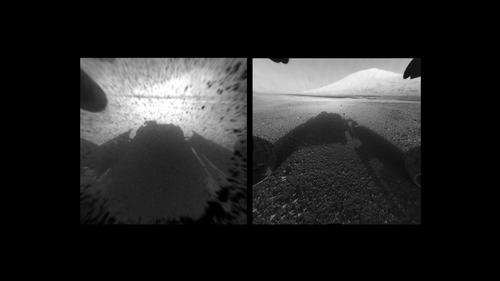
Clear Views on Mars
Clear Views on Mars
This image comparison shows a view through a Hazard-Avoidance camera on NASA's Curiosity rover before and after the clear dust cover was removed. 

Both images were taken by a camera at the front of the rover. Mount Sharp, the mission's ultimate destination, looms ahead.
The view on the left, with the dust cover on, is one quarter of full resolution, while the view on the right is full resolution. Full- resolution images taken with the dust cover still on are not available at this time. The only other instrument on Curiosity with a dust cover is the Mars Hand Lens Imager (or MAHLI), located on the rover's arm. In this case, the dust cover is not removed but will be opened when needed.
This way, the instrument is protected from dust that  may be generated from other tools on the rover's arm, in addition to wind-blown dust.

Image Credit: NASA/JPL-Caltech 

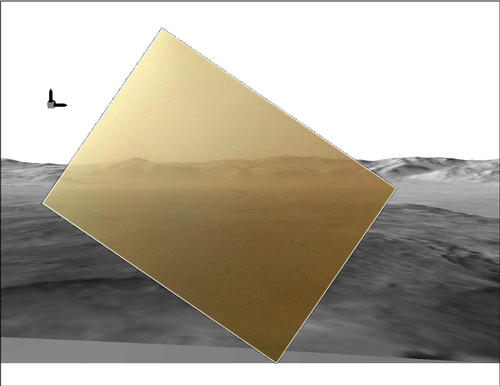
Curiosity's Landscape Portrait in ContextCuriosity's Landscape Portrait in Context

This picture of the Martian landing site of NASA's Curiosity rover puts a color view obtained by the rover in the context of a computer simulation derived from images acquired from orbiting spacecraft. The view looks north, showing a distant ridge that is the north wall and rim of Gale Crater. 
The MAHLI image was taken while the camera's transparent dust cover was still on. 
Curiosity's descent coated the cover with a thin film of dust.

The computer simulation is a digital elevation model that incorporates data from the High Resolution Imaging Science Experiment (HiRISE) and Context Camera on NASA's Mars Reconnaissance Orbiter and the High Resolution Stereo Camera on ESA's Mars Express. 

The peak seen on the left-side of the MAHLI image is about 24 kilometers distant with a height of about 1,150 meters high. The box with arrows at the upper left indicates direction. The arrow pointing up is 'up' with respect to the gravity of Mars. The arrow pointing to the right is east. North would be an arrow pointing into the image (that is, the MAHLI view is toward the north).

The main purpose of Curiosity's MAHLI camera is to acquire close-up, high-resolution views of rocks and soil at the rover's Gale Crater field site. The camera is capable of focusing on any target at distances of about 2.1 centimeters to infinity. This means it can, as shown here, also obtain pictures of the Martian landscape. 

Image Credit: NASA/JPL-Caltech/MSSS 

Image and text credits: NASA/JPL-Caltech (click to obtain more images and in high resolution)

Saturday, July 28, 2012

Sunday, January 8, 2012

Prof. Stephen Hawking's Lecture


Professor Stephen Hawking, that completes 70 years today, was the third in a series of NASA lectures (that's celebrating 50 years). Lectures about the benefits of space exploration, scientific discovery and aeronautics in our life.
The lecture can be read right here. The most important parts of the lecture:
“Why we should go into space? What is that justification for spending all that effort and money on getting a few lumps of moon rock? Aren't there better causes here on Earth? In a way, the situation was like that in Europe before 1492. People might well have argued that it was a waste of money to send Columbus on a wild goose chase. [...]
Spreading out into space will have an even greater effect. It will completely change the future of the human race and maybe determine whether we have any future at all. It won't solve any of our immediate problems on Planet Earth, but it will give us a new perspective on them and cause us to look outwards and inwards. Hopefully, it would unite us to face a common challenge. 
This would be a long-term strategy [...]. We could have a base on the Moon within 30 years or reach Mars in 50 years and explore the moons of the outer planets in 200 years. By "reach," I mean with man or, should I say, person space flight. 
[...] 
Going into space won't be cheap, but it will take only a small proportion of world resources. NASA's budget  has remained roughly constant in real terms since the time of the Apollo landings, but it has decreased from 0.3 percent of U.S. GDP in 1970 to 0.12 percent now. 
Even if we were to increase the international budget 20 times to make a serious effort to go into space, it would only be a small fraction of world GDP. 
There will be those who argue that it would be better to spend our money solving the problems of this planet, like climate change and pollution, rather than wasting it on a possibly fruitless search for a new planet. 
I am not denying the importance of fighting climate change and global warming, but we can do that and still spare a quarter of a percent of world GDP for space. Isn't our future worth a quarter of percent? 
[...]“
Read all the lecture, it continues with Prof. Hawking's arguments for invest in Aerospace Agencies, and also he talks about life in Earth, ETs, UFOs, and more.

Featured Post

IBSE about Light Pollution

Here is my presentation that happened in the Discover the Cosmos Conference (Volos, Greece - 2013). The presentation was an Inquiry Base...

Popular Posts