Monday, September 5, 2016
Our solar system in cm
In this new school year we can start to push students heads in how to calculate the distance of each planet to our Sun and the respective size.
Well, my fellow colleagues I prepared a spreadsheet.
You can download the spreadsheet from here: http://goo.gl/c6f6WM
Saturday, September 19, 2015
Sunday, March 16, 2014
How Big is the Solar System?
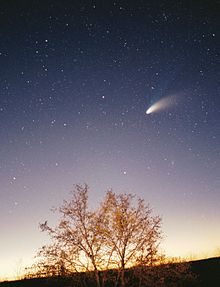
![]() | The image of the Solar System was made using real images of the planets. It is not to scale; the Solar System is so large with respect to the size of the planets, that to fit it on the screen, the planets would have to be small dots. Thus, some artistic license is involved. However, the planets are in the correct order. Also shown is comet Hale-Bopp, photographed by the author. |
While you are talking and introducing the idea of the model, it may be helpful (depending on the age of the audience) to build up on a blackboard something like this:
real in modelEarth's width 8,000 miles 8/100 inch Sun's width 800,000 miles 8 inches therefore scale is 100,000 miles 1 inch therefore 3,600,000 miles 36 inches or 1 yard and Sun-Earth distance 93,000,000 miles 26 yards
Read more: http://www.noao.edu/education/peppercorn/pcmain.html
Mercury is only 0.39 astronomical units from the Sun, while Jupiter orbits at a distance of 5.5 astronomical units. And Pluto is way out there at 39.2 astronomical units.That’s the equivalent of 5.9 billion kilometers.If you could drive your car at highway speeds, from the Sun all the way out to Pluto, it would take you more than 6,000 years to complete the trip.Read more: http://www.universetoday.com/104486/how-big-is-our-solar-system/#ixzz2wAOQhPOD
Friday, September 13, 2013
Voyager 1 reaches Interstellar Space
Read the characteristics of Voyager 1 in Space.com
Thank you Lawrence Klaes for the links
Thursday, September 12, 2013
Voyager 1 left the Solar System
![]() |
| An artist's concept shows the Voyager spacecraft traveling through space against a field of stars. Credit: NASA/JPL-Caltech. |
Friday, August 30, 2013
Monday, December 17, 2012
Pour Toutaties
NASA Radar Images Asteroid Toutatis
Friday, December 7, 2012
Why Are So Many Sun Grazing Comets Being Discovered? | NASA Space Science
Monday, December 3, 2012
NASA's Voyager 1 spacecraft has entered a new region
![]() |
| Credit: NASA/JPL-Caltech/The Johns Hopkins University Applied Physics Laboratory |
Read more at: http://phys.org/news/2012-12-voyager-encounters-region-deep-space.html#jCp
Wednesday, June 6, 2012
Transit of Venus in high definition
![]() |
| Poster about the Transit of Venus by Genie Lorenzo of Manila Observatory (click to enlarge) |
![]() |
| Credit: Eric Allen (SpaceWeather.com) |
Thursday, March 1, 2012
Saturday, February 25, 2012
Sunday, July 24, 2011
Fourth moon discovered around Pluto
![]() |
| Pluto and friends (Image: NASA/ESA/M. Showalter/SETI Institute) |
"The Hubble Space Telescope spotted the new moon, which has been designated P4 for the time being. Astronomers estimate it is between 13 and 34 kilometres across. "I find it remarkable that Hubble's cameras enabled us to see such a tiny object so clearly from a distance of more than 3 billion miles [5 billion kilometres]," says Mark Showalter of the SETI Institute in Mountain View, California, who led the observing team.
Three other moons of Pluto were already known. Charon, discovered in 1978, is by far the largest at about 1000 kilometres across. Nix and Hydra,discovered in Hubble images in 2005, are tiny by comparison: both are estimated to be between 32 and 113 kilometres in diameter."
Thursday, March 31, 2011
Solar System 3D model
Interactive 3D model of Solar System, Planets and Night Sky:
"Welcome to Solar System Scope space traveller,
SSS means Astronomy for Everybody. Whether you are a student, astronomy fan or an accidental browser, you are most welcome to play with our user-friendly application. It's full of space-art graphics, has easy-to-use interface with various settings and offers interesting information.
SSS will illustrate you real-time celestial positions with planets and constellations moving over the night sky.
But I can see you're not just a passive spectator - and that's good, because you can actively change parameters for a better understanding of happenings in our Solar System and the Universe." in www.solarsystemscope.com
Monday, February 7, 2011
Stereo Sun
Thus, we can know what happen simultaneously across all the Sun's surface.
Wednesday, August 25, 2010
Animation of the planetary system around Sun-like star HD 10180
Wednesday, January 21, 2009
Methane on Mars
- English version:
There are methane on Mars in the summer, will be a sign of life?
15.01.2009 - 19h32 Clara Barata, Reuters
The team is not the first to detect methane on Mars, but is the first to associate it to the time when the temperatures go up, the gas plume seems to arise in some areas, when the summer comes and were detected up to 19 tons of this gas in the atmosphere, using spectrometers. These instruments can measure the gases in the atmosphere by analyzing its signature feature in the electromagnetic spectrum.
Until now, there are no known natural processes on the surface of any planet to produce methane. “Therefore, the presence of significant amounts of methane would require the recent release of gas from reservoirs below the surface. But its origin may be biological or not,” the researchers write in Science.
However, it is underground on Mars that water, and perhaps there may be underground microbes that produce methane: on Earth there are millions of years ago.
- Versão Portuguesa:
A equipa não é a primeira a detectar metano em Marte, mas é a primeira a associá-lo ao momento em que sobem as temperaturas: o gás parece surgir em pluma, em algumas áreas, quando chega o Verão. Foram detectada até 19 mil toneladas deste gás na atmosfera, usando espectrómetros. Estes instrumentos podem medir os gases na atmosfera, analisando a sua assinatura característica no espectro electromagnético.
No entanto, é no subsolo de Marte que há água, e talvez possam existir micróbios subterrâneos que produzem metano: na Terra existem, há milhões de anos.
- Versión Española:
Hay metano en Marte en el verano, será de origen bacteriana?
15/01/2009 - 19h32 Clara Barata, Reuters
El equipo no es la primera que detecta el metano en Marte, pero es el primero en asociar el fenómeno a la época en que las temperaturas suben, cuando llegaba el verano se detectaron hasta 19 toneladas este gas en la atmósfera, utilizando espectrómetros. Estos instrumentos pueden medir los gases en la atmósfera a través del análisis de su firma característica en el espectro electromagnético. Hasta ahora, no se conocen los procesos naturales en la superficie de cualquier planeta para producir metano. “Por lo tanto, la presencia de cantidades significativas de metano requieren la liberación de los reservorios de gas por debajo de la superficie. Sin embargo, su origen puede ser biológico o no”, escriben los investigadores en Science.
traducido de Publico
Featured Post
IBSE about Light Pollution
Here is my presentation that happened in the Discover the Cosmos Conference (Volos, Greece - 2013). The presentation was an Inquiry Base...
Popular Posts
-
An artist's conception of a quasar, with a Chandra X-ray Observatory image of the quasar GB1508+5714 inset. The data reveal a jet of h...
-
X-radiation (composed of X-rays ) is a form of electromagnetic radiation . X-rays have a wavelength in the range of 10 to 0.01 nanomet...
-
Observed and expected exclusion limits for a Standard Model Higgs boson at the 95-percent confidence level for the combined CDF and DZero ...
-
The Moon is the only natural satellite of the Earth , and the fifth largest satellite in the Solar System . It is the largest na...