Follow eufisica

Follow eufisica

Showing posts with label MSL. Show all posts

Friday, September 28, 2012

Old streambed on martian surface

(Phys.org)—NASA's Curiosity rover mission has found evidence a stream once ran vigorously across the area on Mars where the rover is driving. There is earlier evidence for the presence of water on Mars, but this evidence—images of rocks containing ancient streambed gravels—is the first of its kind.

NASA's Mars rover Curiosity has discovered what appears to be an ancient streambed, suggesting that water once flowed in large volumes — perhaps hip-deep in places — across the Martian surface. (space.com)

PASADENA, Calif. -- NASA's Curiosity rover mission has found evidence a stream once ran vigorously across the area on Mars where the rover is driving. There is earlier evidence for the presence of water on Mars, but this evidence -- images of rocks containing ancient streambed gravels -- is the first of its kind.
Scientists are studying the images of stones cemented into a layer of conglomerate rock. The sizes and shapes of stones offer clues to the speed and distance of a long-ago stream's flow. (NASA)

Monday, August 6, 2012

First images from Mars Curiosity Rover

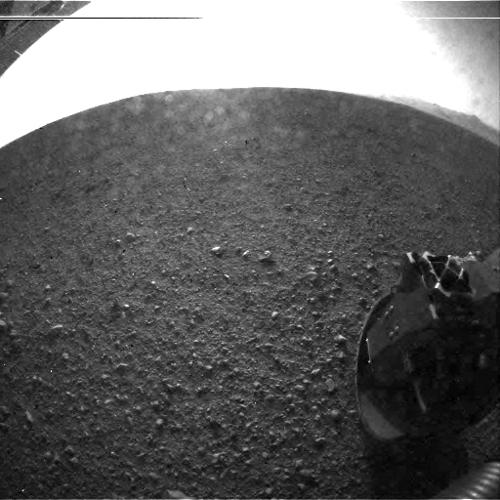
Curiosity Mars Rover has landed. Here is the first image from Mars Science Lab:
Credit: JPL/NASA

Curiosity's Surroundings

This is one of the first images taken by NASA's Curiosity rover, which landed on Mars the evening of Aug. 5 PDT (morning of Aug. 6 EDT).
"This is one of the first images taken by NASA's Curiosity rover, which landed on Mars the evening of Aug. 5 PDT (morning of Aug. 6 EDT). It was taken through a "fisheye" wide-angle lens on the left "eye" [...]. The clear dust cover that protected the camera during landing has been sprung open. Part of the spring that released the dust cover can be seen at the bottom right, near the rover's wheel.
On the top left, part of the rover's power supply is visible.
Some dust appears on the lens even with the dust cover off.
The cameras are looking directly into the sun, so the top of the image is saturated. Looking straight into the sun does not harm the cameras. The lines across the top are an artifact called "blooming" that occurs in the camera's detector because of the saturation. 
As planned, the rover's early engineering images are lower resolution. Larger color images from other cameras are expected later in the week [...]."

Image Credit: NASA/JPL-Caltech
Text credit: NASA/JPL

Featured Post

IBSE about Light Pollution

Here is my presentation that happened in the Discover the Cosmos Conference (Volos, Greece - 2013). The presentation was an Inquiry Base...

Popular Posts