
Showing posts with label space. Show all posts
Showing posts with label space. Show all posts
Thursday, October 13, 2016

Mars arrival orbits
This animation shows the relative orbital paths of ESA's ExoMars Trace Gas Orbiter (TGO), the Schiaparelli Entry, descent and landing
Sunday, December 22, 2013
Thursday, September 12, 2013
Voyager 1 left the Solar System
 |
| An artist's concept shows the Voyager spacecraft traveling through space against a field of stars. Credit: NASA/JPL-Caltech. |
University of Iowa space physicist Don Gurnett says there is solid evidence that NASA's Voyager 1 spacecraft has become the first manmade object to reach interstellar space, more than 11 billion miles distant and 36 years after it was launched.
Read more at: phys.org
After streaking through space for nearly 35 years, NASA's robotic Voyager 1 probe finally left the solar system in August 2012, a study published today (Sept. 12) in the journal Science reports.
Monday, February 25, 2013
How Big is the Universe?
"No one knows if the universe is infinitely large, or even if ours is the only universe there is."
Read the document from Harvard website.

Throughout history, humans have used a variety of techniques and methods to help them answer the questions 'How far?' and 'How big?' Generations of explorers have looked deeper and deeper into the vast expanse of the universe. And the journey continues today, as new methods are used, and new discoveries are made.It was knowing this fundamental distance from the Earth to the Sun that helped us find the true scale of the entire Solar system for the first time.When we leave the solar system, we find our star and its planets are just one small part of the Milky Way galaxy. The Milky Way is a huge city of stars, so big that even at the speed of light, it would take 100,000 years to travel across it.The further away a star is, the fainter it looks. Astronomers use this as a clue to figure out the distance to stars that are very far away.Beyond our own galaxy lies a vast expanse of galaxies. The deeper we see into space, the more galaxies we discover. We see them not as they are today, but as they looked long before there was any life on Earth.Finding the distance to these very distant galaxies is challenging, but astronomers can do so by watching for incredibly bright exploding stars called supernovae. Some types of exploding stars have a known brightness so we can figure out how far they are by measuring how bright they appear to us, and therefore how far away it is to their home galaxy.
Adapted from NASA website
Friday, November 2, 2012
NASA | Atomic Interferometry
An Atom interferometer is an interferometer based on exploiting the wave character of atoms. Interferometers are often used to make high-precision comparisons of distances. This can be used to constrain fundamental constants like the Gravitational Constant or possibly to detect Gravitational Waves.
Tuesday, May 22, 2012
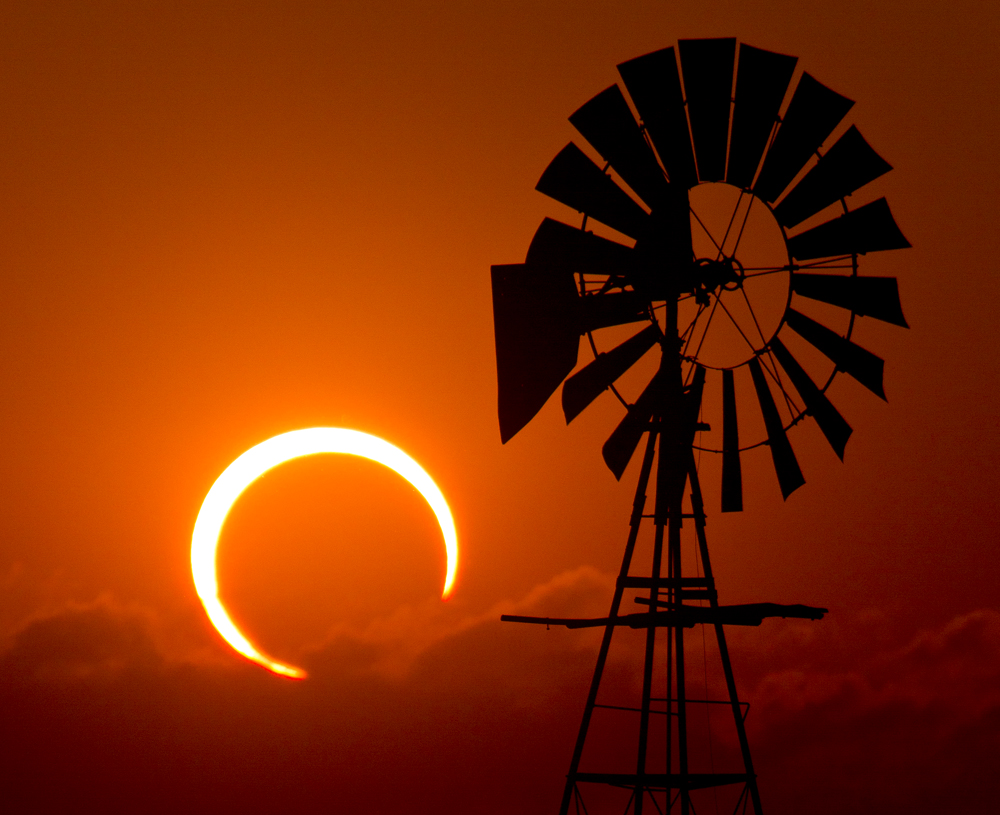
Annular Solar Eclipse, May 2012
Watch this images and videos about the Annular Solar Eclipse occurred last Sunday.


Monday, May 14, 2012
HST: 22 years

The Hubble Space Telescope (HST) is a space telescope that was carried into orbit by a Space Shuttle in 1990 and remains in operation. A 2.4-meter (7.9 ft) aperture telescope in low Earth orbit, Hubble's four main instruments observe in the near ultraviolet, visible, and near infrared.
Many Hubble observations have led to breakthroughs in astrophysics, such as accurately determining the rate of expansion of the universe.
The HST is one of the largest and most versatile space telescope and is well known as both a vital research tool and a public relations boon for astronomy. The HST was built by the United States space agency (NASA), with contributions from the European Space Agency (ESA).
Launched in 1990, scientists found that the main mirror had been ground incorrectly, compromising the telescope's capabilities. The telescope was restored to its intended quality by a servicing mission in 1993.
Hubble is the only telescope designed to be serviced in space by astronauts. The telescope is expected to function until at least 2014. Its scientific successor, the James Webb Space Telescope (JWST), is to be launched in 2018 or possibly later.
adapted from wikipedia
A gallery of HST can be found here.
A video to celebrate the 22nd anniversary of HST, enjoy it:
Thursday, April 26, 2012
Sunday, March 18, 2012
Wednesday, March 7, 2012
Saturday, January 21, 2012
Tuesday, January 3, 2012
Problem in Mars
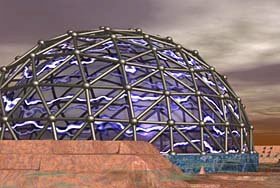
I put this problem to my Physics students (K12) a few years ago:
Problem
Assuming that a team of astronauts on Mars is within a dome, and has a problem in the air supply, how long will it take to exhaust the oxygen?
Answer
To solve this problem, we first have to know the volume of air that exists within the dome. Here is where many of my student give up because they don't know the dimensions of the dome. Now, it's time to your imagination, try to give those dimensions (don't exaggerate too much). For example, I assume a dome with 5 m radius. I think with that dimension, our astronauts will have enough space for them and their equipment (if not, just redo the calculations for a dome with larger radius). Oh, another detail: How many astronauts? Well, a trip to the red planet should not be more astronauts than those who go to the ISS. However, suppose a journey with five astronauts.
Now, let's calculate the volume of air inside the dome. The volume of the sphere is given by the following mathematical expression:
Vsphere = 4/3 π R3 [1]
For our dome (half of the sphere) using [1], will be:
Vdome = Vsphere /2 <=> Vdome = 1/2(4/3 π R3) <=>
<=>
Vdome = 2/3 π R3 [2]
Substituting in the equation [2] and performing the calculations, we have the volume of the dome with the approximate value of 262
m3 .
Each cubic meter has 1000 liters of air capacity, then we have 262 thousand liters of fresh air.
The air has about 21% of oxygen and by 17.5% should be enough to leave the dome to the evacuation craft (obviously exist an emergency spacecraft). To get from breathing fresh air to an absolutely suffocating air, we make the difference between 21 percent of 262 thousand liters and 17.5 percent of 262 thousand liters. This gives us 9170 liters of passing through oxygen.
The next step is to determine how much oxygen does a human consume. It was difficult to find a reliable source. This article, about the installation in 2006 of a new system of oxygen in the International Space Station, provides a clue:
"During normal operations, it will provide 5 kg per day, enough to support six crew members."
Let us assume that astronauts, and with the stress situation, need about 900 g of oxygen per day, or 0.9 kg/day. How many liters represents that value? Oxygen has a molecular weight of 16 g/mol. So the oxygen gas, which is formed by molecules of O2 , has a mass of 32 grams per mole. One mole of gas, at normal temperature and pressure conditions, occupies 22.4 liters (we assume that the conditions in dome are the same conditions as we have in Earth). That is:
0.9 kg x (1000 g / 1 kg) x (1 mol O2 / 32 g O2) x (22.4 L / 1 mole of O2)
This gives an oxygen consumption of 630 liters per person per day. Let's use a more reasonable rate:
(630 L / day) x (1 day / 24 hours) x (1 hour / 60 mins)
Now we have the rate of oxygen consumption usable 0.4375 liters per minute. We're almost there.
Then fill the dome with the astronauts. The five occupants consume 2.1875 liters per minute. Thus, for the final calculation:
9179 L x (1 minute / 2.1875 L)
It will take about 4196 minutes, or 69 hours and 56 minutes, to the suffocating air. In other words, the astronauts will have less than three days to restore the oxygen provided by the air supply or escape to the emergency ship.
Monday, January 2, 2012
Friday, November 11, 2011
EPL paper from Space
Euro Physics Letters received its first paper from space.
Concerned with the properties of complex plasma in almost zero gravity conditions, the paper represents collaborative research of 29 individual missions performed over the last 10 years by German and Russian researchers aboard the International Space Station (ISS).
Concerned with the properties of complex plasma in almost zero gravity conditions, the paper represents collaborative research of 29 individual missions performed over the last 10 years by German and Russian researchers aboard the International Space Station (ISS).
To read the full article and download (for free) the papers, visit: PhysOrg.com
Thursday, September 1, 2011
Galaxy Evolution: James Webb Space Telescope
Watch how the James Webb Space Telescope's ability to look farther into space than ever before will bring newborn galaxies into view. Credit: NASA/GSFC
Friday, July 15, 2011
The Great Escape
The Great Escape: How Exoplanets and Smaller Bodies Desert Dying Stars. (arXiv:1107.1239v1 [astro-ph.EP])
(Submitted on 6 Jul 2011)
Mounting discoveries of extrasolar planets orbiting post-main sequence stars motivate studies aimed at understanding the fate of these planets.[...]
Friday, July 8, 2011
Last mission to shuttle
 |
| Credit: NASA |
NASA send this friday, the Atlantis Shuttle to the ISS. You can follow the live coverage of the mission in NASATV
"Atlantis and its four astronauts left Earth for the final space shuttle mission, which will cap off an amazing 30-year program of exploration, which launched great observatories, built an International Space Station, and taught us more about how humans can live and work in space.
With the International Space Station flying 220 miles high and east of Christchurch, New Zealand, Atlantis left Launch Pad 39A at NASA's Kennedy Space Center in Florida at 11:29 a.m. EDT. There was a slight delay at T-31 seconds while retraction of the Gaseous Oxygen Vent Arm, or "Beanie Cap," was verified. Atlantis will dock with the space station on Sunday."
font: NASA website
Tuesday, June 7, 2011
Next MPCV

NASA's future capsule will be the next generation for transport astronauts and cargo to the ISS.
See bellow the info-graphic from space.com.
Friday, May 20, 2011
Orphan Planets

Software developed by a Massey University computer scientist and astrophysicist has led to the discovery of free-floating ‘orphan’ planets – once the subject of science fiction.
Versão portuguesa.
Subscribe to:
Posts (Atom)
Popular Posts
-
This is a theoretical problem on a Mars habitat and the astronauts have to move it from the planet. Check the full reading:
-
Recently I discovered or someone gave me the link with a great websites. Let's talk about this two sites: 1) http://www.malakfunsci...
-
Observed and expected exclusion limits for a Standard Model Higgs boson at the 95-percent confidence level for the combined CDF and DZero ...
-
 Standard Model - Source: Wikipedia The Standard Model of particle physics is the theoretical framework that describes the fundamental bu...


