
Showing posts with label Einstein. Show all posts
Showing posts with label Einstein. Show all posts
Tuesday, August 21, 2012

Saturday, May 12, 2012
Mass - Energy equivalence
In physics, mass–energy equivalence is the concept that the mass of a body is a measure of its energy content. This means, for example, that the total internal energy E of a body at rest is equal to the product of its rest mass m and a suitable conversion factor to transform from units of mass to units of energy. Albert Einstein proposed mass–energy equivalence in 1905. The equivalence is described by the famous equation:

where E is energy, m is mass, and c is the speed of light in a vacuum. The equation E = mc2 indicates that energy always exhibits relativistic mass in whatever form the energy takes. Mass–energy equivalence does not imply that mass may be "converted" to energy, but it allows for matter to be converted to energy. Through all such conversions, mass remains conserved, since it is a property of matter and any type of energy. In physics, mass must be differentiated from matter. Matter, when seen as certain types of particles, can be created and destroyed (as in particle annihilation or creation), but the system of precursors and products of such reactions, as a whole, retain both the original mass and energy, with each of these system properties remaining unchanged (conserved) throughout the process. Simplified, this means that the total amount of energy (E) before the experiment is equal to the amount of energy after the experiment. Letting the m in E = mc2 stand for a quantity of "matter" (rather than mass) may lead to incorrect results, depending on which of several varying definitions of "matter" are chosen.
Einstein was not the first to propose a mass–energy relationship. However, Einstein was the first scientist to propose the E = mc2 formula and the first to interpret mass–energy equivalence as a fundamental principle that follows from the relativistic symmetries of space and time.
adapted from Wikipedia
Friday, April 27, 2012
Albert Einstein
|
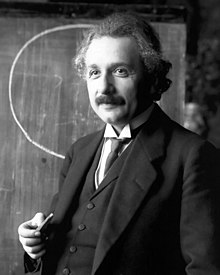
| Albert Einstein in 1921. Credit: Wikimedia Commons |
Near the beginning of his career, Einstein thought that Newtonian mechanics was no longer enough to reconcile the laws of classical mechanics with the laws of the electromagnetic field. This led to the development of his special theory of relativity. He realized, however, that the principle of relativity could also be extended to gravitational fields, and with his subsequent theory of gravitation in 1916, he published a paper on the general theory of relativity. He continued to deal with problems of statistical mechanics and quantum theory, which led to his explanations of particle theory and the motion of molecules. He also investigated the thermal properties of light which laid the foundation of the photon theory of light. In 1917, Einstein applied the general theory of relativity to model the structure of the universe as a whole.
The History Channel video:
You can watch more videos here.
Tuesday, March 20, 2012
Einstein Archive

The Hebrew University of Jerusalem started uploading digitized documents from its massive Einstein archive.
The archive contains over 80,000 documents, and includes scientific correspondences, letters that Einstein wrote to family members and even love letters.
Thursday, February 23, 2012
The Neutrino's Saga - Part 8

The saga of superluminal neutrinos seems to be coming to an end. Everything indicates that the results obtained by the OPERA Collaboration in Italy were due to an error in measuring instruments. According to a source connected to the experiment, the observed time discrepancy, 60 nanosecond that was measured, appears to be related to a poor connection between an optical fiber cable which connects the GPS receiver, which is used to correct the time of flight of neutrinos,and a circuit board of a computer.
Remember that the problem began in September 2011 when scientists were experimenting a flux of neutrinos from CERN (Geneva) to the Gran Sasso's laboratory in Italy (about 455 miles away), and reported results that seemed to indicate that the neutrinos traveled faster than the speed of light, reaching about 60 nanoseconds sooner than expected.
After the best tight connection, the researchers found that the time measured for the data running through the distance corresponding to length of optical fiber was less than 60 nanoseconds which had previously obtained, which would nullify the time difference obtained on the flight of the neutrinos. It seems therefore to be found a very simple explanation for the discrepancy of time that had been found in initial experiments. However, it is also necessary to obtain new data to confirm this situation.
It therefore indicates that the Einstein's Theory of Relativity once again winning out over a test of its validity. Since this theory has been confirmed many times in several experiments, most people suspected that there must be some error in the experiment had been conducted, which would escape to the researchers. This error appears to have been now found. It now remains to be confirmed.
You can read about this news here and here.
Saturday, November 19, 2011
The Neutrino's Saga - Part 6
 |
| Crédito: imgace.com |
In opposition of what many people thought, the saga of the neutrinos is not over yet.
I had already mentioned that these particles conducted between CERN and OPERA, reach the detector sooner than expected. And late last month, I wrote about the experience from ICARUS, whose results contradict those of the OPERA experiment.
What is certain is that the team of OPERA has published the second version of this article on arXiv pre-print and the result is: it's the same. Well, almost the same!
The experiment was repeated with a lower energy, resulting a time difference of 57.8 ns (1 ns = 10-9 s) against the 61.1 ns obtained previously (that's a difference of 3.3 ns).
In addition, concerns about the use in the experiment of the Global Positioning System (GPS) to synchronize the clocks at each start and end of the neutrino beam, are unlikely to be so easily dispelled. The GPS, which was used in both experiments, is inexperienced in the field of high energy physics and particles.
There are scientists who would like to see the measurement of time checked using another part of the OPERA detector.
This measurement requires a very precise analysis of the time and probably with another type of configuration, to be performed by other entities in future experience (including the MINUS experiment at Fermilab, which was mentioned in a previous post, and is preparing to conduct tests early next year).
Still, CERN and Opera will also continue to conduct more experiments to see if there are faults in their calculus or equipment.
So if you think you can throw the books in physics for the trash, think again. We'll have to wait to see how this saga will end.
To learn more about particles can go to the website particleadventure

Source:LiveScience
Monday, September 26, 2011
The Neutrino's Saga - Part 3
 |
| The OPERA experiment |
Roll over Einstein: Law of physics challenged (Update 3)
One of the very pillars of physics and Einstein's theory of relativity - that nothing can go faster than the speed of light - was rocked Thursday by new findings from one of the world's foremost laboratories.
in PhysOrg.com
"[...] As a spokesperson for the MINOS neutrino experiment told Ars yesterday, there are three potential sources of error in the timing measurements: distance errors, time-of-flight errors, and errors in the timing of neutrino production. The vast majority of both the paper and the lecture were dedicated to discussing how these errors were reduced (the actual detection of the neutrinos was only a small portion of the paper).
[...] There are a lot of potential sources of error they know about—the paper’s table lists a dozen of them. Small errors in each of these could add up to something more significant than their total error. Then there are the classic unknown unknowns.in wired.com
More in the news Reuters, PhysicsAbout
Attention at FermiLab: http://beaconnews.suntimes.com/news/7807816-418/physics-turned-on-its-ear-catches-attention-at-fermilab.html
See the video of the presentation in a seminar: http://cdsweb.cern.ch/record/1384486/
Friday, September 23, 2011
The neutrino's saga continues

Physicists wary of junking light speed limit yet
(AP) -- Physicists on the team that measured particles traveling faster than light said Friday they were as surprised as their skeptics about the results, which appear to violate the laws of nature as we know them.
"Going faster than light is something that is just not supposed to happen, according to Einstein's 1905 special theory of relativity. The speed of light - 186,282 miles per second (299,792 kilometers per second) - has long been considered a cosmic speed limit.Read entire article here.
The team [...] fired aneutrino beam 454 miles (730 kilometers) underground from Geneva to Italy.
They found it traveled 60 nanoseconds faster than light."
The paper in arXiv repository:
Measurement of the neutrino velocity with the OPERA detector in the CNGS beam
OPERA
(Submitted on 22 Sep 2011)
The OPERA neutrino experiment at the underground Gran Sasso Laboratory has measured the velocity of neutrinos from the CERN CNGS beam over a baseline of about 730 km with much higher accuracy than previous studies conducted with accelerator neutrinos. The measurement is based on high-statistics data taken by OPERA in the years 2009, 2010 and 2011. Dedicated upgrades of the CNGS timing system and of the OPERA detector, as well as a high precision geodesy campaign for the measurement of the neutrino baseline, allowed reaching comparable systematic and statistical accuracies. An early arrival time of CNGS muon neutrinos with respect to the one computed assuming the speed of light in vacuum of (60.7 \pm 6.9 (stat.) \pm 7.4 (sys.)) ns was measured. This anomaly corresponds to a relative difference of the muon neutrino velocity with respect to the speed of light (v-c)/c = (2.48 \pm 0.28 (stat.) \pm 0.30 (sys.)) \times 10-5.
Thursday, September 22, 2011
Faster than the speed of light
Roll over Einstein: Pillar of physics challenged (Update)
A pillar of physics - that nothing can go faster than the speed of light - appears to be smashed by an oddball subatomic particle that has apparently made a giant end run around Albert Einstein's theories.
It seems that the muon neutrinos from CERN traveled 730 km and arrived the Gran Sasso Lab, Italy, a billionths of a second earlier than expected (it means it traveled that distance faster than the speed of light).
A pillar of physics - that nothing can go faster than the speed of light - appears to be smashed by an oddball subatomic particle that has apparently made a giant end run around Albert Einstein's theories.
It seems that the muon neutrinos from CERN traveled 730 km and arrived the Gran Sasso Lab, Italy, a billionths of a second earlier than expected (it means it traveled that distance faster than the speed of light).
Monday, June 13, 2011
Applying Einstein's General Theory of Relativity to Superconducting Circuits
ScienceDaily (June 11, 2011) — In recent years, UC Santa Barbara scientists showed that they could reproduce a basic superconductor using Einstein's general theory of relativity. Now, using the same theory, they have demonstrated that the Josephson junction could be reproduced. The results are explained in a recent issue of the journal Physical Review Letters.
Read complete article in Science Daily
Thursday, May 5, 2011
NASA's Gravity Probe B Confirms Two Einstein Space-Time Theories
 |
| Image credit: PhysOrg.com |
NASA's Gravity Probe B (GP-B) mission has confirmed two key predictions derived from Albert Einstein's general theory of relativity, which the spacecraft was designed to test.The experiment, launched in 2004, used four ultra-precise gyroscopes to measure the hypothesized geodetic effect, the warping of space and time around a gravitational body, and frame-dragging, the amount a spinning object pulls space and time with it as it rotates.GP-B determined both effects with unprecedented precision by pointing at a single star, IM Pegasi, while in a polar orbit around Earth. If gravity did not affect space and time, GP-B's gyroscopes would point in the same direction forever while in orbit. But in confirmation of Einstein's theories, the gyroscopes experienced measurable, minute changes in the direction of their spin, while Earth's gravity pulled at them. (NASA)
Source: NASA
Read more in PhysOrg.com
Subscribe to:
Posts (Atom)
Popular Posts
-
This is a theoretical problem on a Mars habitat and the astronauts have to move it from the planet. Check the full reading:
-
Recently I discovered or someone gave me the link with a great websites. Let's talk about this two sites: 1) http://www.malakfunsci...
-
Observed and expected exclusion limits for a Standard Model Higgs boson at the 95-percent confidence level for the combined CDF and DZero ...
-
 Standard Model - Source: Wikipedia The Standard Model of particle physics is the theoretical framework that describes the fundamental bu...


