Follow eufisica

Follow eufisica

Showing posts with label scales. Show all posts

Monday, April 6, 2026

The Scale of the Universe

Scales in the Universe - Created with Gemini AI


 The scale of the universe is so vast that our everyday units of measurement completely break down. To comprehend it, physicists and astronomers look at the universe across orders of magnitude, moving from the microscopic quantum realm up to the edge of everything we can see.

1. The Microscopic Limit: Quantum Scale

Before looking outward, understanding the absolute smallest limits of space helps frame the true extremes of scale.

  • The Planck Length (1.6 x 10⁻³⁵ m): The theoretical smallest possible distance in physics. Below this scale, the traditional concept of space and time ceases to exist.

  • Subatomic Particles (10-18 m to 10-15 m): Quarks and electrons have no measurable size, but a proton or neutron spans about 1 femtometer (10-15 m.

  • The Atom (10-10 m): An atom is roughly 0.1 nanometers across. If an atom were magnified to the size of a massive sports stadium, its nucleus would only be the size of a marble in the center.

2. The Human and Planetary Scale

Moving up to lengths we can physically perceive, objects grow exponentially as we exit Earth's atmosphere.

  • Humans (100 m): Positioned roughly in the middle of the cosmic scale between the Planck length and the observable universe.

  • Earth (1.27 x 10⁷ m): With a diameter of roughly 12,742 km.

  • The Sun (1.39 x 10⁹ m): Approximately 109 times the diameter of Earth. You could fit about 1.3 million Earths inside it.

3. The Cosmic Scale: Light-Years and Parsecs

Once we leave the Solar System, the meter becomes too small to be practical. Instead, we measure distances by how far light travels in a year (one light-year, or ~ 9.46 x 10¹⁸ m).

  • Solar System & Neighborhood: The distance from Earth to the Sun is 1 Astronomical Unit (a.u.)}. The nearest star system to us, Alpha Centauri, is about 4.37 light-years away.

  • The Milky Way (1021 m): Our home galaxy is a spiral disk roughly 100,000 light-years across, containing hundreds of billions of stars.

  • The Local Group & Superclusters (1023 m): The Milky Way belongs to a small cluster called the Local Group (spanning 10 million light-years), which itself is a tiny branch of the massive Laniakea Supercluster, home to over 100,000 galaxies.

4. The Observable Universe

The observable universe is a spherical region centered on Earth, encompassing everything we can theoretically detect because its light has had time to reach us since the Big Bang.

  • The Diameter: While the universe is about 13.8 billion years old, the expansion of space means the edge of the observable universe has stretched farther away. Its current diameter is estimated to be roughly 93 billion light-years (8.8 x 1026 m).

  • The Content: It contains up to 2 trillion galaxies and an estimated 1024 stars—more stars than there are grains of sand on all of Earth's beaches.

  • Beyond the Observable: Because cosmic inflation expanded space faster than the speed of light during the earliest moments of the Big Bang, the entire universe is likely far larger than what we can observe—and it may well be infinite.

Would you like to explore a specific realm of this scale further, such as the math behind cosmological expansion, or how we measure these immense distances using standard candles?

How Big is The Universe?

This video provides an excellent visual journey zooming out from Earth to the edges of the observable universe to help contextualize these massive cosmic distances.


Take a look in this website: http://scaleofuniverse.com/

Sunday, December 12, 2021

Build your thermo scale


Do you want to know more about thermometers?
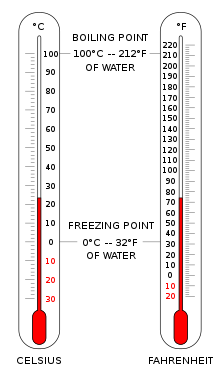
Well check this website, choose your scale and see how it's the formula (see the image below).
Update (12-12-2021): You need to download the file (right click with your mouse and select "save link as...") and you can run in your computer (you need Adobe Flash Player installed in your computer).


Thermometers
Developed during the 16th and 17th centuries, a thermometer (from the Greek θερμός (thermos) meaning "warm" and meter, "to measure") is a device that measures temperature or temperature gradient using a variety of different principles. A thermometer has two important elements: the temperature sensor (e.g. the bulb on a mercury thermometer) in which some physical change occurs with temperature, plus some means of converting this physical change into a numerical value (e.g. the scale on a mercury thermometer).
Read more in Wikipedia.


Farenheit Scale
Fahrenheit is the temperature scale proposed in 1724 by, and named after, the German physicist Daniel Gabriel Fahrenheit (1686–1736). Within this scale, the freezing of water into ice is defined at 32 degrees, while the boiling point of water is defined to be 212 degrees. The temperature scale was replaced by the Celsius scale in most countries during the mid to late 20th century, but it remains the official scale of the United StatesCayman Islands and Belize.
Read more in Wikipedia.

Celsius Scale
Celsius is a scale and unit of measurement for temperature. It is named after the Swedish astronomer Anders Celsius (1701–1744), who developed a similar temperature scale two years before his death. The degree Celsius (°C) can refer to a specific temperature on the Celsius scale as well as a unit to indicate a temperature interval, a difference between two temperatures or an uncertainty. The unit was known until 1948 as "centigrade" from the Latin "centum" translated as 100 and "gradus" translated as "steps".
Credit: uoregon.edu
From 1744 until 1954, 0 °C was defined as the freezing point of water and 100 °C was defined as the boiling point of water, both at a pressure of one standard atmosphere with mercury being the working material. Although these defining correlations are commonly taught in schools today, by international agreement the unit "degree Celsius" and the Celsius scale are currently defined by two different temperatures: absolute zero, and the triple point of VSMOW (specially-purified water). This definition also precisely relates the Celsius scale to the Kelvin scale, which defines the SI base unit of thermodynamic temperature with symbol K. Absolute zero, the lowest temperature possible at which matter reaches minimum entropy, is defined as being precisely 0 K and −273.15 °C. The temperature of the triple point of water is defined as precisely 273.16 K and 0.01 °C.
This definition fixes the magnitude of both the degree Celsius and the kelvin as precisely 1 part in 273.16 (approximately 0.00366) of the difference between absolute zero and the triple point of water. Thus, it sets the magnitude of one degree Celsius and that of one kelvin as exactly the same. Additionally, it establishes the difference between the two scales' null points as being precisely 273.15 degrees Celsius (−273.15 °C = 0 K and 0 °C = 273.15 K).
Read more in Wikipedia.


Rankine Scale
Rankine is a thermodynamic (absolute) temperature scale named after the Glasgow University engineer and physicistWilliam John Macquorn Rankine, who proposed it in 1859. (The Kelvin scale was first proposed in 1848.)
The symbol for degrees Rankine is R[1] (or Ra if necessary to distinguish it from the Rømer and Réaumur scales). Zero on both the Kelvin and Rankine scales is absolute zero, but the Rankine degree is defined as equal to one degreeFahrenheit, rather than the one degree Celsius used by the Kelvin scale. A temperature of −459.67 °F is exactly equal to 0 R.
Some engineering fields in the U.S. measure thermodynamic temperature using the Rankine scale.[2] However, throughout the entire scientific world thermodynamic temperature is measured in Kelvin.[2] The US National Institute of Standards and Technology does not recommend using degrees Rankine in NIST publications.
Read more in Wikipedia.


Another temperature scales:
The Delisle Scale, the Newton Scale, the Réaumur Scale, the Rømer Scale.
And here is the conversion formulae:


Monday, September 5, 2016

Our solar system in cm


In this new school year we can start to push students heads in how to calculate the distance of each planet to our Sun and the respective size.

Well, my fellow colleagues I prepared a spreadsheet.


You can download the spreadsheet from here: http://goo.gl/c6f6WM

Thursday, September 17, 2015

Monday, March 31, 2014

Cosmos Calendar

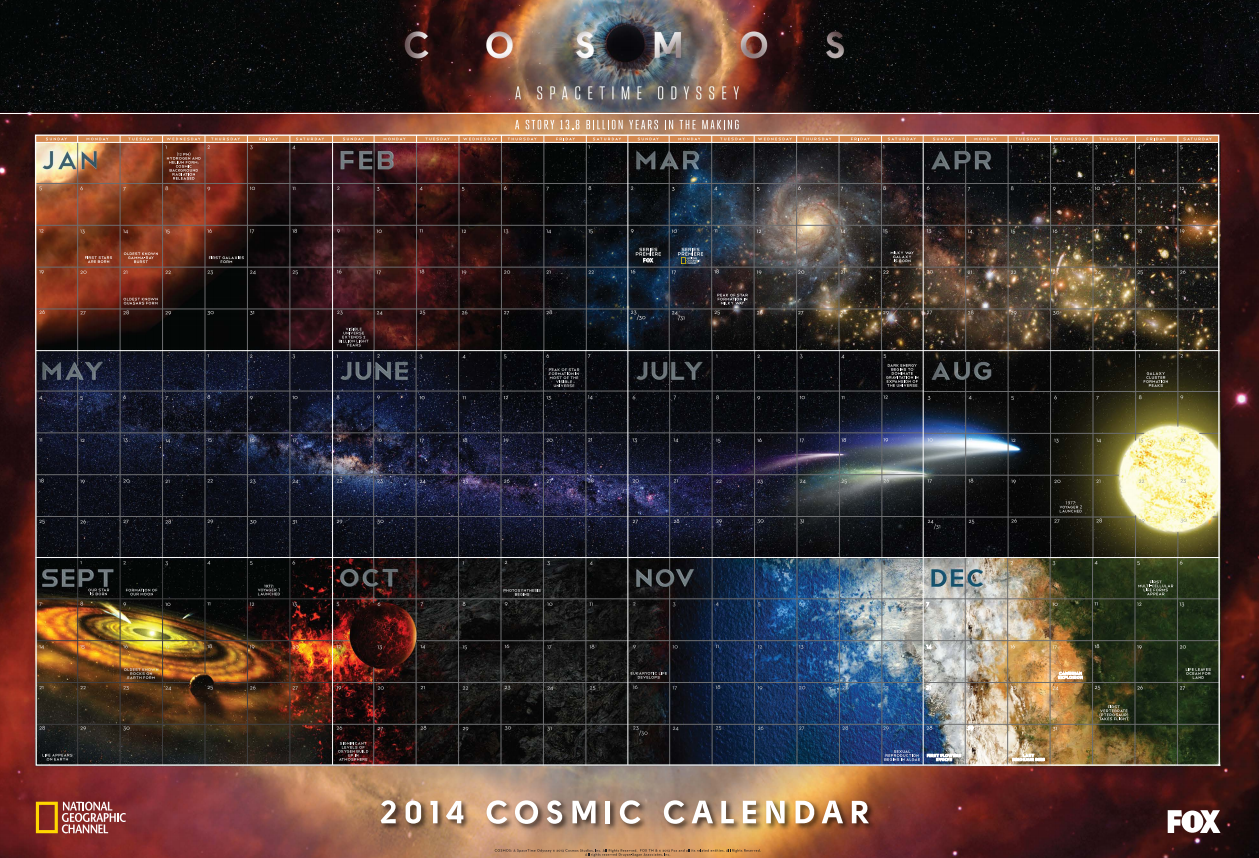
Do you want the COSMOS Calendar?
You can foun it in astroPT website and download it in pdf or png :)
Screen-Shot-2014-03-11-at-12.07.02-AM

Sunday, March 16, 2014

How Big is the Solar System?

solar systemThe image of the Solar System was made using real images of the planets. It is not to scale; the Solar System is so large with respect to the size of the planets, that to fit it on the screen, the planets would have to be small dots. Thus, some artistic license is involved. However, the planets are in the correct order. Also shown is comet Hale-Bopp, photographed by the author.
One way to help visualize the relative distances in the solar system is to imagine a model in which the solar system is reduced in size by a factor of a billion (109). The Earth is then about 1.3 cm in diameter (the size of a grape). The Moon orbits about a foot away. The Sun is 1.5 meters in diameter (about the height of a man) and 150 meters (about a city block) from the Earth. Jupiter is 15 cm in diameter (the size of a large grapefruit) and 5 blocks away from the Sun. Saturn (the size of an orange) is 10 blocks away; Uranus and Neptune (lemons) are 20 and 30 blocks away. A human on this scale is the size of an atom; the nearest star would be over 40,000 km away!


While you are talking and introducing the idea of the model, it may be helpful (depending on the age of the audience) to build up on a blackboard something like this:
real in model
Earth's width 8,000 miles 8/100 inch Sun's width 800,000 miles 8 inches therefore scale is 100,000 miles 1 inch therefore 3,600,000 miles 36 inches or 1 yard and Sun-Earth distance 93,000,000 miles 26 yards
Read more: http://www.noao.edu/education/peppercorn/pcmain.html
Mercury is only 0.39 astronomical units from the Sun, while Jupiter orbits at a distance of 5.5 astronomical units. And Pluto is way out there at 39.2 astronomical units.
That’s the equivalent of 5.9 billion kilometers.
If you could drive your car at highway speeds, from the Sun all the way out to Pluto, it would take you more than 6,000 years to complete the trip.
Read more: http://www.universetoday.com/104486/how-big-is-our-solar-system/#ixzz2wAOQhPOD


You can watch and download an infographic here: http://ripetungi.com/the-size-of-the-universe/

Monday, May 7, 2012

Magnifying the Universe

Magnifying the Universe is an interactive infographic that illustrates the scale of over 100 items. From galaxies to insects, nebulae and stars to molecules and atoms. And more...
Click to view in full screen and start using it:

Featured Post

IBSE about Light Pollution

Here is my presentation that happened in the Discover the Cosmos Conference (Volos, Greece - 2013). The presentation was an Inquiry Base...

Popular Posts