Follow eufisica

Follow eufisica

Showing posts with label APOD. Show all posts

Thursday, September 22, 2016

Zooming in on Star Cluster Terzan 5


Published on Sep 18, 2016
Credit: Nick Risinger (skysurvey.org)/DSS/Hubble/NASA
Music: Johan B. Monell

Details: http://apod.nasa.gov/apod/ap160921.html

Wednesday, March 14, 2012

Great Sun spot

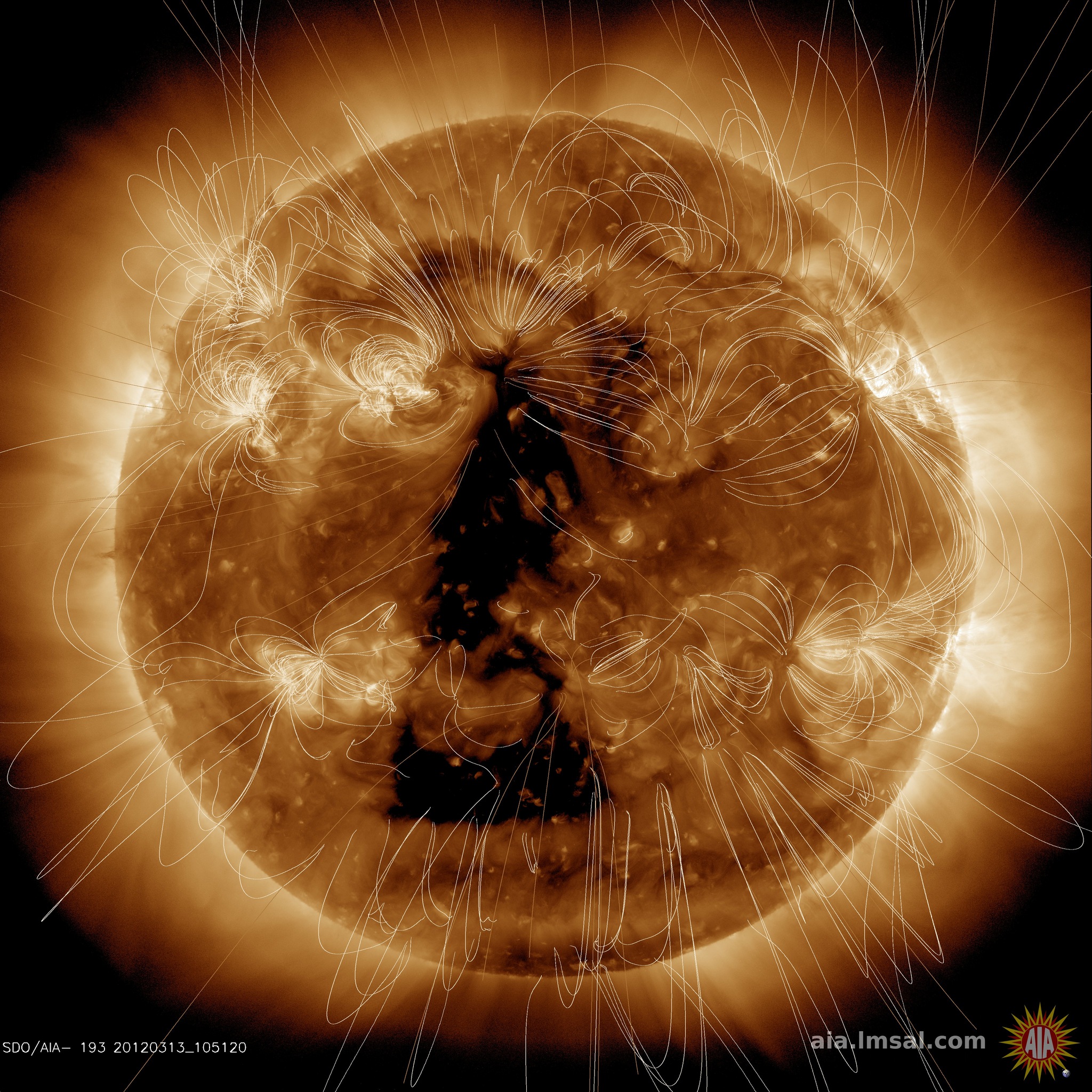
The Solar Dynamics Observatory has been witnessing the last days of the slow movement of a large coronal hole above the surface of the Sun. That hole is opening its huge presence of a gap in the structure of the magnetic field of the crown, allowing the escape of a rapid and dense flow of charged particles into interplanetary space. At this time, the coronal hole is directed towards the Earth, so that an expected increase in activity over the next days due to geomagnetic interaction with the terrestrial magnetic field, will be intense because solar wind. 
Coronal hole observed yesterday by Solar Dynamics Observatory in the ultraviolet extreme region (193 Å). It's also represented the magnetic field lines in the coronal solar (representation obtained from the calculus in the base model PFSS).
Credit: SDO(NASA)/AIA consortium/Helioviewer. 
The plasma density inside the coronal holes is typically 100 times lower than other regions of the crown. Typically, the gas crown is superheated to temperatures exceeding one million °C, that makes them particularly bright on the images taken in the extreme ultraviolet band. Because of their low density, coronal holes are relatively cool and therefore darker in the area of the electromagnetic spectrum.
During periods of low solar activity, coronal holes tend to be confined to the polar regions of the Sun to occur at lower latitudes will become more common as the solar cycle approaches its peak, so its presence these regions of the solar disk at this stage of the current cycle is a perfectly normal phenomenon. 

translated from astropt.org

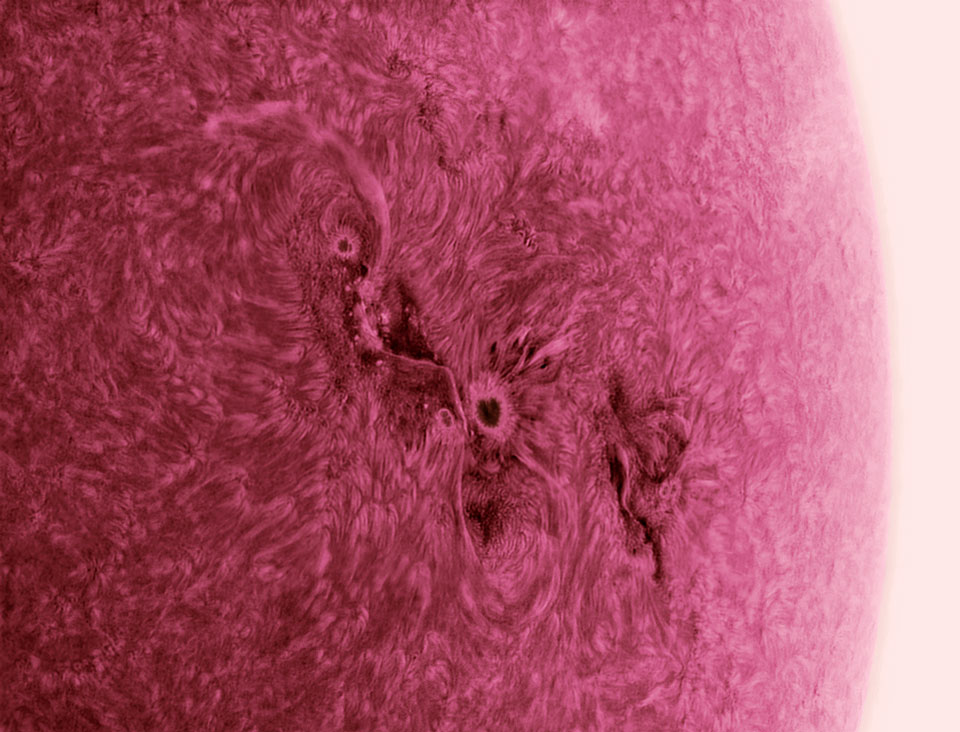
Angry Sun Erupting 
Image Credit & Copyright: Alan Friedman (Averted Imagination) 
Explanation: It's one of the baddest sunspot regions in years. Active Region 1429 may not only look, to some, like an angry bird -- it has thrown off some of the most powerful flares and coronal mass ejections of the current solar cycle. The extended plumes from these explosions have even rained particles on the Earth's magnetosphere that have resulted in colorful aurorasPictured above, AR 1429 was captured in great detail in the Sun's chromosphere three days ago by isolating a color of light emitted primarily by hydrogen. The resulting image is shown in inverted false color with dark regions being the brightest and hottest. Giant magnetically-channeled tubes of hot gas, some longer than the Earth, are known as spicules and can be seen carpeting the chromosphere. The light tendril just above AR 1429 is a cool filament hovering just over the active sunspot region. As solar maximum nears in the next few years, the increasingly wound and twisted magnetic field of the Sun may create even more furious active regions that chirp even more energetic puffs of solar plasma into our Solar System. 
in APOD

Tuesday, September 28, 2010

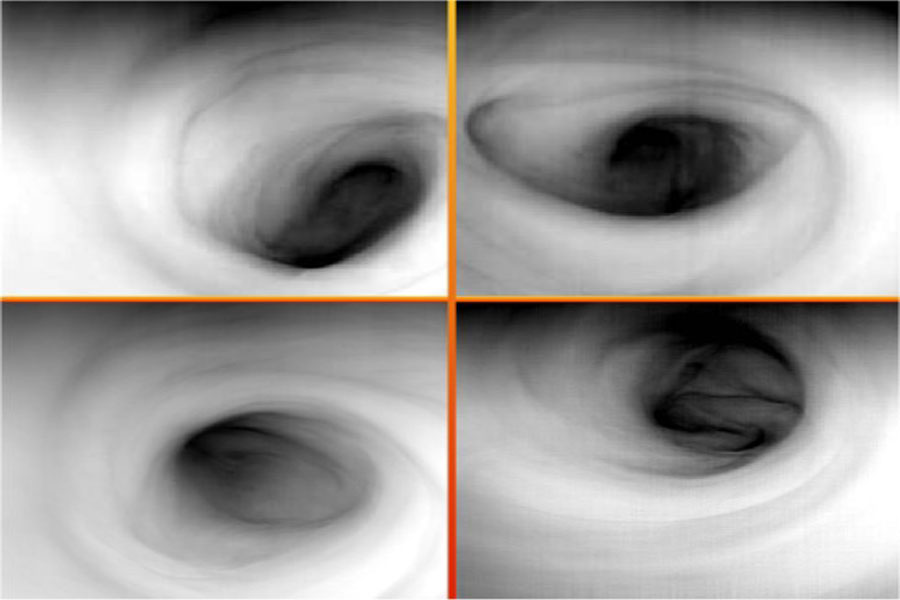
APOD: 2010 September 28 - Venus South Polar Vortex

APOD: 2010 September 28 - Venus South Polar Vortex

See Explanation.  Clicking on the picture will download  the highest resolution version available.
"Explanation: What's happening over the South Pole of Venus? To find out, scientists have been studying images taken by the robotic Venus Express spacecraftwhen it passes over the lower spin axis of Earth's overheated twin. Surprisingly, recent images from Venus Express do not confirm previous sightings of a double storm system there, but rather found a single unusual swirling cloud vortex. In the above recently released image sequence taken in infrared light and digitally compressed, darker areas correspond to higher temperatures and hence lower regions of Venus' atmosphere. Also illuminating are recently releasedmovies, which show similarities between Venus' southern vortex and the vortex that swirls over the South Pole of Saturn. Understanding the peculiar dynamics of why, at times, two eddies appear, while at other times a single peculiar eddy appears, may give insight into how hurricanes evolve on Earth, and remain a topic of research for some time. In three months, the European Venus Express spacecraft will be joined around Venus by the Japanese Akatsuki satellite.
NASA APOD

Featured Post

IBSE about Light Pollution

Here is my presentation that happened in the Discover the Cosmos Conference (Volos, Greece - 2013). The presentation was an Inquiry Base...

Popular Posts