Follow eufisica

Follow eufisica

Showing posts with label technology. Show all posts

Tuesday, January 1, 2019

New CERN technology transfer

The new MediPix3 aims to produce better images from our body.
Check this image about color X-Rays:
A 3D image of a wrist with a watch showing part of the finger bones in white and soft tissue in red. (Image: MARS Bioimaging Ltd)
MARS’ solution couples the spectroscopic information generated by the Medipix3 enabled detector with powerful algorithms to generate 3D images. The colours represent different energy levels of the X-ray photons as recorded by the detector hence identifying different components of body parts such as fat, water, calcium, and disease markers.
Source: https://medipix.web.cern.ch/news/first-3d-colour-x-ray-human-using-cern-technology 

Friday, February 22, 2013

Solar cell efficiency goal

Image from: http://www.observatorynano.eu/project/document/2016/
The efficiency of solar cells with multijunction concentrators is increasing since 1988. In the image we can see a great development of the Three-junction solar cell.
Now, scientist has designed a new multijunction solar cell, with am efficiency of 51.8 %.

Multijunction solar cell could exceed 50% efficiency goal
Credit: Marina S. Leite, et al. ©2013 American Institute of Physics
(Phys.org)—Scientists have designed a new multijunction solar cell that, in simulations, can achieve an efficiency of 51.8%. This high performance exceeds the current goal of 50% efficiency in multijunction solar cell research as well as the current world record of 43.5% for a 3-junction solar cell.

Read more at: http://phys.org/news/2013-02-multijunction-solar-cell-efficiency-goal.html#jCp

Friday, November 30, 2012

New type of heating for ITER


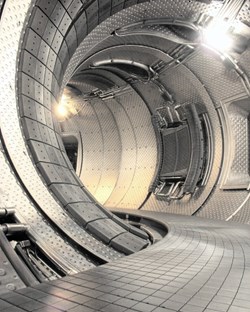
In a tokamak, blanket modules coat the inside of the chamber and directly face the hot plasma. In ITER, certain modules will be used to test tritium breeding concepts. Photo: Tore Supra Tokamak, CEA Cadarache. (Click to view larger version...)(Phys.org)—Tests for the heating that is to bring the plasma of the ITER international fusion test reactor to a temperature of many million degrees can go ahead from today: After three years of construction, Max Planck Institute for Plasma Physics (IPP) at Garching bei München has officially commissioned the ELISE test rig – the world's largest device of its kind and part of a four-million euro research contract of the "Fusion for Energy" European ITER Agency. Corepiece of the device is an innovative high-frequency ion source developed at IPP. On the ELISE test rig it will now be adapted to the high requirements of ITER.
ITER (originally an acronym of International Thermonuclear Experimental Reactor) is an international nuclear fusion research and engineering project, which is currently building the world's largest and most advanced experimental tokamak nuclear fusion reactor at the Cadarache facility in the south of France.
More info here: www.iter.org
Read more articles here: ITER

Thursday, November 8, 2012

Ultra efficient solar cell

Ben-Gurion University develops side-illuminated ultra-efficient solar cell designs

Researchers at Ben-Gurion University of the Negev (BGU) have developed a radically new design for a concentrator solar cell that, when irradiated from the side, generates solar conversion efficiencies which rival, and may eventually surpass, the most ultra-efficient photovoltaics.

Thursday, May 31, 2012

News in NanoCarbon TeK

This week in PhysOrg the recent news in nanocarbon technology:

'Unzipped' carbon  nanotubes  could  help  energize  fuel  cells,  batteries

'Unzipped' carbon nanotubes could help energize fuel cells, batteries
This drawing shows the damaged outer wall of a carbon nanotube with nanosized graphene pieces (white patches), which facilitate the formation of catalytic sites made of iron (yellow) and nitrogen (red) atoms. The catalyst reduces oxygen to water. Credit: Guosong Hong
Multi-walled carbon nanotubes riddled with defects and impurities on the outside could replace some of the expensive platinum catalysts used in fuel cells and metal-air batteries, according to scientists at Stanford University. Their findings are published in the May 27 online edition of the journal Nature Nanotechnology(here)

Scientists  take  steps  toward  creating  artificial  graphene

(Phys.org) -- Researchers first observed graphene in 2004 by extracting the single-atom-thick sheets of carbon from bulk graphite. While graphene’s electrical and optical properties have proven to have extraordinary potential for many applications, creating atomically precise structures out of graphene remains challenging. In an effort to improve graphene’s usability, scientists have been searching for a way to fabricate artificial graphene, which could serve as a helpful structure where devices can be easily tested before their implementation with natural graphene. Now in a new study, scientists have identified all the main criteria required to make artificial graphene, which could provide a guide for experimentally realizing the material. (here)


Researchers  find  new  properties  of  the  carbon  material  graphene

Graphene has caused a lot of excitement among scientists since the extremely strong and thin carbon material was discovered in 2004. Just one atom thick, the honeycomb-shaped material has several remarkable properties combining mechanical toughness with superior electrical and thermal conductivity. (here)

Tuesday, February 7, 2012

Benefits of NASA technologies


Here is the Spinoff 2011 by NASA: Presentation and Report.

NASA spinoffs - Interview with Dan Lockney:


Tuesday, January 24, 2012

Nanostructures could make high-efficiency solar cells easier to fabricate

Showing data from four different crescent-shaped nanostructures, this figure demonstrates the strong dependence of SP excitations on crescent shape. Most significantly, the study shows that nanostructures can have a continuous light absorption spectrum even when having blunt edges, greatly simplifying fabrication requirements. Image credit: Yu Luo, et al. ©2012 American Physical Society
(PhysOrg.com) -- One of the most promising methods for increasing the efficiency of solar cells consists of coating the cells’ surfaces with a thin layer of metal nanoparticles. The nanoparticles scatter incoming light in different directions, which allows the solar cells to absorb more light than they otherwise would. The scattering occurs when the incoming light stimulates the nanoparticles’ surface plasmons (SPs), which are coherent electron oscillations in the metal atoms that can reach a resonance mode when the electrons’ frequency matches the photons’ frequency. Under these conditions, the resulting “surface plasmon resonance” induces light scattering and enhances the light absorption of the surface.
in PhysOrg

Sunday, January 15, 2012

Can NASA give us cold fusion?

In NASA web page there is a comment about progress in 'cold fusion' research and a link to the slides used in a September 2011 presentation (PDF) which talks about LENR research. NASA has also released a video describing the great benefits we will get from NASA LENR research.  Would it be the next domestic energy sources (about 10 kW) based on his E-Cat system (a Low Energy Nuclear Reaction or Cold Fusion energy source)? There's a rumor that it will begging shipping this year. We'll see about that.
font Slashdot

Touch Screens & Quantum Tunnelling - Sixty Symbols

Time to look at the latest touch screen technology and how it uses the strange phenomenon of quantum tunnelling.


Saturday, January 14, 2012

Step forward to control Nuclear Fusion


Using a heating system, physicists have succeeded for the first time in preventing the development of instabilities in an efficient alternative way relevant to a future nuclear fusion reactor. It’s an important step forward in the effort to build the future ITER reactor.

 is an attempt to reproduce the energy like the Sun does in an Earth-based reactor. The gas is heated to several million degrees, and creates a plasma. Sometimes in the plasma, an instability will appear and grow large enough to perturb the plasma. The challenge is to reduce the instabilities deep within in the interior of the plasma so that they don’t amplify, while at the same time allowing the reactor to continue to function normally.
The physicists uses antennas that are used as part of the system to heat the plasma. The simulations and the tests showed that heating and instability suppression can be combined, by aiming the radiation slightly off-center in the plasma.
(Adapted from  PhysOrg )
These improvements can then be implemented in the ITER fusion reactor.
Watch this movie here to know more about ITER.
Check more about fusion.

Monday, December 19, 2011

Google driverless car

Image from Gnarld.com

(PhysOrg.com) -- News surfaced this week that Google has won a patent for driverless car technology. Google filed the patent in May this year. The application is titled “Transitioning a Mixed-mode Vehicle to Autonomous Mode.” The patent presents a method listing numerous “embodiments” suggested, for a vehicle that switches from being driven by a human to moving, stopping, and parking autonomously.
Entire article in PhysOrg.com


Sebastian Thrun: Google's driverless car (TED)


Quantum dot TV


The quantum dots will be in use for ultra thin, light flat screen TVs by the end of next year, and, in another three years, will be used in flexible screens rolled up like paper or used as wall coverings.
Entire article in PhysOrg.com


Tuesday, December 6, 2011

airless tire concept

Bridgestone goes airless in tire concept for Tokyo show(PhysOrg.com) -- Visitors to the 42nd Tokyo Motor Show are to witness a new breed of airless tires from Bridgestone. Interest in the general press is already humming because of the material, design, and features of the Bridgestone debut on show. The concept tires use recycled thermoplastic, outside tread included. Fittingly colored green, the tires are being promoted for their green advantage of being completely recyclable.


Read more in PhysOrg


Tuesday, August 16, 2011

Carbon nanotube structure changes


Carbon nanotube structures changed by 'attack' from within, researchers discover
(PhysOrg.com) -- A team of researchers involving scientists from The University of Nottingham has shown for the first time that chemical reactions at the nano-level which change the structure of carbon nanotubes can be sparked by an 'attack' from within.

"The discovery challenges previous scientific thinking that the internal surface of the hollow nanostructures is chemically unreactive, largely restricting their use to that of an inert container or a ‘nano-reactor’ inside which other chemical reactions can take place.
Their research, published in the journal Nature Chemistry, shows that carbon nanotubes that have had their structures changed are exciting new materials that could be useful in the development of new technologies for gas storage devices, chemical sensors and parts of electronic devices such as transistors."
Read full article in PhysOrg.com

Tuesday, August 9, 2011

OLEDs more efficient

OLED structure. Credit: HowStuffWorks
Like a LED, an OLED is a solid-state semiconductor device with 100 to 500 nanometers thick (it means about 200 times smaller than a human hair). You can read more about OLEDs in howstuffworks.


Highly efficient organic light-emitting diodes
(PhysOrg.com) -- Organic light-emitting diodes (OLEDs) are seen as a promising replacement for the liquid-crystal displays (LCDs) used in many flat-screen televisions because they are cheaper to mass-produce. Zhikuan Chen at the A*STAR Institute of Materials Research and Engineering and co-workers have now shown how meticulous engineering of fluorescent molecules can dramatically increase OLED efficiency.

Friday, May 20, 2011

Eurocopter X3

Eurocopter X3: The world's fastest copter
(PhysOrg.com) -- If you asked a child how they would make a helicopter go faster, they would probably tell you to add another engine. The answer would be Zen simple and dead right. The engineers at Eurocopter also seem to have that same mentality and it worked.

"The X3’s speed milestone was reached on May 12 during stable, level flight – with the hybrid demonstrator maintaining a true airspeed of 232 kts. (430 km./hr.) for several minutes. This occurred during only the third mission after a scheduled upgrade that integrated the X3’s definitive gearboxes, enabling it to operate at full power." (font: eurocopter.com)

Wednesday, April 20, 2011

Electric cars must charge at night

More evidence suggests electric cars need night time charging
(PhysOrg.com) -- Researchers in America have shown that ozone -- a known pollutant at low levels in the earth's atmosphere, causing harmful effects on the respiratory system and sensitive plants -- can be reduced, on average, when electric vehicle charging is done at night time.

Monday, April 11, 2011

Windows that block heat

Windows that block heat only on hot days: New research brings us closer
UB's Sarbajit Banerjee with a scanning electron microscopy image of tungsten-doped vanadium-oxide nanowires, which have a phase transition temperature close to room temperature
Windows that block heat only on hot days: New research brings us closer
(PhysOrg.com) -- New materials science research from the University at Buffalo could hasten the creation of "smart" windows that reflect heat from the sun on hot summer days but let in the heat in colder weather.
"By preparing vanadium oxide as a nanomaterial instead of in bulk, the scientists managed to lower the compound's trigger point from 153 degrees Fahrenheit to 90. Doping vanadium oxide  with tungsten brought the temperature down further, to 7 degrees Fahrenheit.  doping had a similar but smaller effect."
read complete article in PhysOrg.com

Featured Post

IBSE about Light Pollution

Here is my presentation that happened in the Discover the Cosmos Conference (Volos, Greece - 2013). The presentation was an Inquiry Base...

Popular Posts