The Large Hadron Collider (LHC) is great for the discovery of particles, bit it isn't so precise.
So, scientist are thinking about this precision and it can be possible with a linear collider.
The International Linear Collider could be the next collider. The collisions will be between electrons and protons. The only problem is the global crisis.

Showing posts with label collider. Show all posts
Showing posts with label collider. Show all posts
Monday, December 17, 2012

Thursday, April 5, 2012
The Standard Model of Particle Physics
LHC physics data taking gets underway at new record collision energy of 8TeV


(font CERN)At 0:38 CEST this morning, the LHC shift crew declared ‘stable beams’ as two 4 TeV proton beams were brought into collision at the LHC’s four interaction points. This signals the start of physics data taking by the LHC experiments for 2012. The collision energy of 8 TeV is a new world record, and increases the machine’s discovery potential considerably.
- Press Release: LHC physics data taking gets underway at new record collision energy of 8TeV
- Video: CERN News - Physics restarts in the LHC at new record energy
- CERN: LHC bate novo recorde mundial de energia
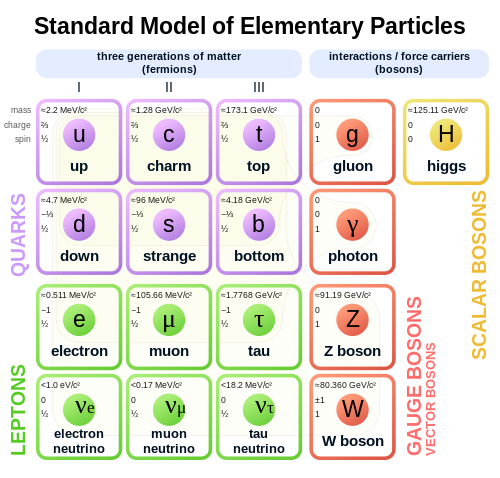
The Standard Model of particle physics is a theory concerning the electromagnetic, weak, and strong nuclear interactions, which mediate the dynamics of the known subatomic particles.
Still, the Standard Model falls short of being a complete theory of fundamental interactions because it does not incorporate the physics of dark energy nor of the full theory of gravitation as described by general relativity. The theory does not contain any viable dark matter particle that possesses all of the required properties deduced from observational cosmology. It also does not correctly account for neutrino oscillations (and their non-zero masses). Although the Standard Model is believed to be theoretically self-consistent, it has several apparently unnatural properties giving rise to puzzles like the strong CP problem and the hierarchy problem.
Nevertheless, the Standard Model is important to theoretical and experimental particle physicists alike. For theorists, the Standard Model is a paradigmatic example of a quantum field theory, which exhibits a wide range of physics including spontaneous symmetry breaking, anomalies, non-perturbative behavior, etc. It is used as a basis for building more exotic models which incorporate hypothetical particles, extra dimensions and elaborate symmetries (such as supersymmetry) in an attempt to explain experimental results at variance with the Standard Model, such as the existence of dark matter and neutrino oscillations. In turn, experimenters have incorporated the Standard Model into simulators to help search for new physics beyond the Standard Model.
Recently, the Standard Model has found applications in fields besides particle physics, such as astrophysics, cosmology, and nuclear physics.
(in Wikipedia)
You can read another posts about particles and Higgs in my blog. Now, watch this videos about Standard Model:
Saturday, February 11, 2012
Better understanding of why meson particles disappear
 |
| The PHENIX detector at the Relativistic Heavy Ion Collider. Credit: 2012 Brookhaven National Laboratory |
(PhysOrg) - For several years, physicists at the Relativistic Heavy Ion Collider (RHIC) at Brookhaven National Laboratory (BNL), USA, have studied an unusual state of matter called the quark–gluon plasma, which they believe mimics the hot, dense particle soup that existed immediately after the big bang. Now, the PHENIX collaboration at RHIC reports findings about a particle called the J/ψ meson that will help physicists distinguish the properties of the quark–gluon plasma (QGP) from those of normal matter.in PhysOrg
Watch the table of mesons here,
and video from CERN (Measurement of Bs mixing parameters from Bs → J/&psi φ decays at CDF and D∅).
Friday, April 22, 2011
New record for the Large Hadron Collider
Amplify’d from www.physorg.com
Large Hadron Collider sets world record beam intensity

See this Amp at http://bit.ly/gk9jSc
Monday, March 28, 2011
The antihelium was discover

The antihelium
Physics of the Relativistic Heavy Ion Collider (RHIC) in New York claim that they created nuclei of antihelium-4 for the first time – the heaviest antimatter element ever seen on Earth.
Antimatter nuclei are made from antiprotons and antineutrons but, with all the types of combinations of two and three quarks that can appear in the particle collisions, it is rare that multiple antiprotons and antineutrons appear close enough to each other to form anti-nuclei. Although the first antiprotons and antineutrons were discovered in 1950s, the construction of heavier nuclei has been very difficult and each additional anti-nucleon makes the anti-nuclei 1000 less probable to appear in a collision of particles. Until now, the heaviest anti-nuclei observed was limited to three anti-nucleons. But with RHIC experiment and the new detectors of STAR was possible to detect such anti-nuclei.
read more in: physicsworld.com
Versão Portuguesa: em astroPT ou eufisica.com
Thursday, October 2, 2008
Inauguração Oficial do LHC
Conseguida a primeira circulação de feixes de protões no LHC em 10 de Setembro, o maior e mais complexo instrumento científico será oficialmente inaugurado no CERN no dia 21 de Outubro de 2008. Representantes dos governos Membros do CERN (incluindo Portugal), estados observadores and outras nações participantes foram convidados.
Wednesday, September 10, 2008
LHC
LHC
LHC First Beam on 10 September 2008
Primeira experiência do LHC
Geneva, 10 de Setembro de 2008. O primeiro teste com um feixe de milhões de protões no acelerador LHC (Large Hadron Collider) do Laboratório Europeu de Física de Partículas (CERN) foi bem sucedido, percorrendo os 27 quilómetros às 10h28min desta manhã. Este evento histórico marca um momento chave na transição, com mais de duas décadas de preparação, para uma nova era de descobertas científicas.
Para saber mais visite:
First beam in the LHC - accelerating science
Geneva, 10 September 2008. The first beam test, with millions of protons, in the Large Hadron Collider (LHC) at CERN was successfully. The beam covered a distance around the full 27 kilometres at 10h28 this morning. This historic event marks a key moment in the transition to a new era of scientific discovery.
(in CERN)
Subscribe to:
Posts (Atom)
Popular Posts
-
 Standard Model - Source: Wikipedia The Standard Model of particle physics is the theoretical framework that describes the fundamental bu...
 -
 Eggnaut protection created with Gemini One of the students’ favorite challenges is the Eggnaut experiment. In this activity, they use the ...
 -
 This post (from 2010!) explained the Physics behind a fake video. There wasn't AI to try to explain the phenomenom. But we have it tod...
 -
Andrew Fraknoi made a catalog with Astronomy applications for your mobile and you can found it here (most applications is for iPhone...

