Follow eufisica

Follow eufisica

Showing posts with label LHC. Show all posts

Saturday, February 27, 2016

Virtual Visit to CMS at CERN (2016)

On February 24, 2016, at 15 hours, 55 students and 5 teachers in Escola Secundária Dr. Júlio Martins (Portuguese high school), made a virtual visit to CMS at CERN.


The activity was promoted by the European Project Inspiring Science Education (ISE), and it was made, for the second time, with a total of five portuguese schools: Escola Secundária Dr. Júlio Martins (Chaves); Escola Secundária Paços de Ferreira (Paços de Ferreira); Escola Secundária de Loulé (Faro), Agrupamento de Escolas Dra. Laura Ayres (Quarteira); Escola Secundária Adolfo Portela (Águeda).
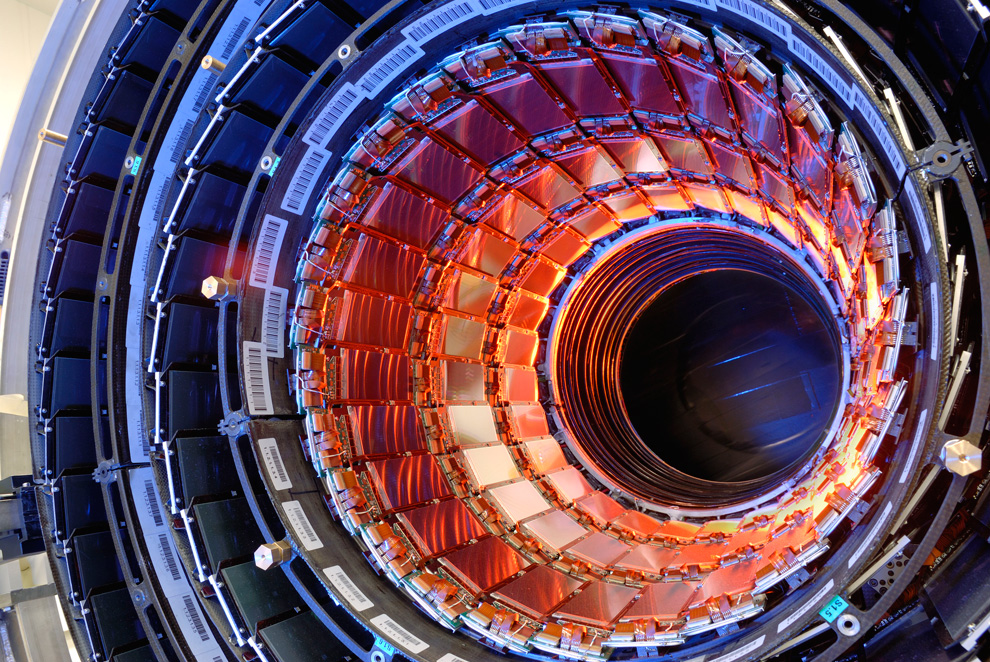
The students saw the control room, the cavern of CMS (Compact Muon Solenoid) experiment, installed in LHC (Large Hadron Collider) and asked some questions to the scientists.
The students made a contact with Portuguese scientists, Pedro da Silva, André David Mendes and José Carlos da Silva, with technical support of Angelos Alexopoulos, Noemi Beni e Zoltan Zsillasi. They drove our students through CMS control room, and explained all the graphics in their computers, to the CMS cavern, 100 meters deep, and they explained all the objects observed, how it works and characteristics.

Thursday, March 12, 2015

Virtual Visit to CMS at CERN

On February 25, 2015, at 15 hours, 150 students and 10 teachers in Escola Secundária de Penafiel (Portuguese high school), made a virtual visit to CMS at CERN.

The activity was promoted by the European Project Open Discovery Space (ODS), and it was made, for the first time, with a total of five portuguese schools: Escola Secundária de Penafiel (Penafiel); Escola Secundária Ferreira Dias (Sintra); Escola Secundária José Saramago (Mafra), Agrupamento de Escolas Dra. Laura Ayres (Quarteira); Escola Secundária Adolfo Portela (Águeda).
The students saw the control room, the cavern of CMS (Compact Muon Solenoid) experiment, installed in LHC (Large Hadron Collider) and asked some questions to the scientists.
The students made a contact with portuguese scientists, Pedro da Silva, André David Mendes and José Carlos Silva, with technical support of Angelos Alexopoulos, Noemi Beni e Zoltan Zsillasi. They drove our students through CMS control room, and explained all the graphics in their computers, to the CMS cavern, 100 meters deep, and they explained all the objects observed, how it works and characteristics.


We achieved a total of 553 students in this virtual visit, and it was established a new record of students participating in a same session. All the students were pleased to visit virtually this especial science center.


Some feedback from our students:
Hello teacher, I would like to thank you the opportunity to participate in something unique. For students that study Physics, CERN is the epicenter of investigation and knowledge. I loved the fact that we made contact with scientists and it was so fun how they present the detector and technologies provided by CERN. It was useful to extend the knowledge of tiny world despite the fact that we need such a huge machine, like CMS, to discover that world. To see all of this visit in real time image was exceptional...
Thanks to all, specially people at CERN and our teachers to make this happened.” - André Queirós

"Hello teacher, I'm written this email about our virtual visit to CERN. It was a visit that arises our interest and curiosity to know better CERN and the experiments made by scientist. The simple language used by scientists helps us to understand the experiments, and kept students' attention.
I liked to thank the availability and I hope someday to know CERN even better." - Ana Catarina Moreira

"Hello teacher, I like to thank you for the visit, even virtually, it was very good and educative. I hope to perform another visit, but this time a live one. I was curious on CERN center and LHC detectors, and the explanation of both made by site scientists.
I wish a year full of success and with new discoveries!" - João Pereira.

"Hello teacher, the virtual visit was very interesting, now I understand what happen in there and what scientists do, how do they do it and the level to acquire such performance in science and technology. It was important to see the detector and jobs possibilities to students. Thank you so much for this opportunity" -  Tiago Carvalho

Acknowledgements:
CERN: Angelos Alexopoulos, André David, José Silva, Pedro Silva, Noemi Beni and Zoltan Zsillasi.
School’s pilot teachers: Cristina Pinho, Marília Peres, Miguel Neta, Álvaro Folhas and José Gonçalves.
ODS support: Rosa Doran and José Gonçalves.
Schools: To our students, teachers, directors and IT technicians.

On the web:
CERN event - https://indico.cern.ch/event/365946/ (with video)


Friday, July 19, 2013

Rare particle decay detected at LHC

Protons collide in the CMS detector, producing a Bs particle that 
decays into two muons (red lines) in this event display from 2012 (Image: CMS)
New results to be presented today at the European Physical Society's High Energy Physics conference (EPS-HEP 2013) in Stockholm, Sweden, have put the Standard Model of particle physics to one of its most stringent tests to date. The CMS and LHCbexperiments at CERN’s Large Hadron Collider (LHC) will present measurements of one of the rarest measureable processes in physics: the decay of a Bs (pronounced B-sub-s) particle into two muons.
The new measurements show that only a handful of Bs particles per billion decay into pairs of muons. Because the process is so rare, it is an extremely sensitive probe for new physics beyond the Standard Model. Any divergence from the Standard Model prediction would be a clear sign of something new.
Both experiments will present results to a very high level of statistical significance (over 4 sigma for each experiment). These results are in good agreement with the Standard Model.
Font: CERN
Read more:
"A very rare decay has been seen by CMS- CMS collaboration 

Sunday, May 6, 2012

The Higgs Boson explained

The world of particles is very attractive to physicist. I written several posts about it.
But, PHD Comics made a simple video that explain all of it and how LHC tray to find Higgs Boson. Watch it:

The Higgs Boson Explained from PHD Comics on Vimeo.

Friday, April 27, 2012

Observation of an excited Xi(b) baryon

Schematic diagram of the decay chain explored in this analysis.
The CMS experiment has submitted a paper for publication describing the firstobservation of a new, excited beauty baryon known as the Ξ*b0, with a statistical significance of more than 5 standard deviations (5σ) above the expected background. The mass is measured to be 5945.0 ± 2.8 MeV.
in PhysOrg 


Observation of an excited Xi(b) baryon

The observation of an excited b baryon via its strong decay into Xi(b)^- pi^+ (plus charge conjugates) is reported. The measurement uses a data sample of pp collisions at sqrt(s) = 7 TeV collected by the CMS experiment at the LHC, corresponding to an integrated luminosity of 5.3 inverse femtobarns. The known Xi(b)^- baryon is reconstructed via the decay chain Xi(b)^- to J/psi Xi^- to mu^+ mu^- Lambda^0 pi^-, with Lambda^0 to p pi^-. A peak is observed in the distribution of the difference between the mass of the Xi(b)^- pi^+ system and the sum of the masses of the Xi(b)^- and pi^+, with a significance exceeding five standard deviations. The mass difference of the peak is 14.84 +/- 0.74 (stat.) +/- 0.28 (syst.) MeV. The new state most likely corresponds to the Xi(b)^{*0} baryon, the J^P=3/2^+ excitation of the Xi(b)^0.
in arXiv
read more in CERN and Quantum Diaries

Thursday, April 5, 2012

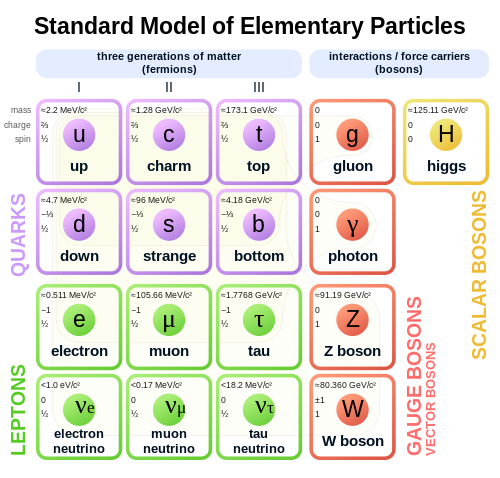
The Standard Model of Particle Physics

LHC physics data taking gets underway at new record collision energy of 8TeV
At 0:38 CEST this morning, the LHC shift crew declared ‘stable beams’ as two 4 TeV proton beams were brought into collision at the LHC’s four interaction points. This signals the start of physics data taking by the LHC experiments for 2012.  The collision energy of 8 TeV is a new world record, and increases the machine’s discovery potential considerably.
(font CERN)


The Standard Model of particle physics is a theory concerning the electromagneticweak, and strong nuclear interactions, which mediate the dynamics of the known subatomic particles.
Still, the Standard Model falls short of being a complete theory of fundamental interactions because it does not incorporate the physics of dark energy nor of the full theory of gravitation as described by general relativity. The theory does not contain any viable dark matter particle that possesses all of the required properties deduced from observational cosmology. It also does not correctly account for neutrino oscillations (and their non-zero masses). Although the Standard Model is believed to be theoretically self-consistent, it has several apparently unnatural properties giving rise to puzzles like the strong CP problem and the hierarchy problem.
Nevertheless, the Standard Model is important to theoretical and experimental particle physicists alike. For theorists, the Standard Model is a paradigmatic example of a quantum field theory, which exhibits a wide range of physics including spontaneous symmetry breakinganomalies, non-perturbative behavior, etc. It is used as a basis for building more exotic models which incorporate hypothetical particlesextra dimensions and elaborate symmetries (such as supersymmetry) in an attempt to explain experimental results at variance with the Standard Model, such as the existence of dark matter and neutrino oscillations. In turn, experimenters have incorporated the Standard Model into simulators to help search for new physics beyond the Standard Model.
Recently, the Standard Model has found applications in fields besides particle physics, such as astrophysics, cosmology, and nuclear physics.
(in Wikipedia)
You can read another posts about particles and Higgs in my blog. Now, watch this videos about Standard Model:

Thursday, December 22, 2011

Higgs boson still missing, but we have new particle


Credit: CERN

Scientists still looking for the Higgs Boson, and they have just found the LHC's first new particle: Chi-b 3P.
It's actually another type of boson — an excited version of the Chi particles already seen in other collision experiments. This particles are made up of a 'beauty quark' and a 'beauty anti-quark', which are bound together. The way that the two quarks are held together reveals more information about the strong nuclear force — and that should help in identifying the Higgs boson. Prof. Roger Jones, who works on the Atlas detector at the LHC, told to BBC:
"The better we understand the strong force, the more we understand a large part of the data that we see, which is quite often the background to the more exciting things we are looking for, like the Higgs. So, it's helping put together that basic understanding that we have and need to do the new physics."
More in arXivBBC, The Verge, Gizmodo.


Want to know more about Higgs boson? Watch this video:

Tuesday, August 16, 2011

Update from the LHC


The CMS detector at the LHC weighs in at 14,000 metric tons. [Credit: Boreham, S; Brice, M; Ginter, P; Marcelloni, C; Collaboration, CMS]


A hint of Higgs: An update from the LHC
The physics world was abuzz with some tantalizing news a couple of weeks ago. At a meeting of the European Physical Society in Grenoble, France, physicists -- including some from Caltech -- announced that the latest data from the Large Hadron Collider (LHC) might hint at the existence of the ever-elusive Higgs boson.

Monday, May 9, 2011

Testing new particles: technicolor physics


(PhysOrg.com) -- As the Large Hadron Collider (LHC) ramps up the rate and impact of its collisions, physicists hope to witness the emergence of the Higgs boson, an anticipated, but as-yet-unseen, fundamental particle that scientists believe gives mass to matter.


We mentioned before here, that Fermilab a mistery signal.

Image: An example of simulated data modeled for the Compact Muon Solenoid (CMS) particle detector on the Large Hadron Collider. Here, following a collision of two protons, a Higgs boson is produced which decays into two jets of hadrons and two electrons. DeGrand's theories represent an alternative to the standard model. Credit: TACC

Friday, April 22, 2011

New record for the Large Hadron Collider

Amplify’d from www.physorg.com

Large Hadron Collider sets world record beam intensity

Large Hadron Collider
A person stands in front of the huge ATLAS detector, one of six detectors that are part of the Large Hadron Collider near Geneva. (Credit: Maximilien Brice, CERN)
(PhysOrg.com) -- Around midnight this night CERN's Large Hadron Collider set a new world record for beam intensity at a hadron collider when it collided beams with a luminosity of 4.67 x 1032cm-2s-1. This exceeds the previous world record of 4.024 x 1032cm-2s-1, which was set by the US Fermi National Accelerator Laboratory's Tevatron collider in 2010, and marks an important milestone in LHC commissioning.
Read more at www.physorg.com

Friday, April 8, 2011

Mystery signal at Fermilab hints at 'technicolour' force - physics-math - 07 April 2011 - New Scientist

Continue reading page |1 |2
The physics world is buzzing with news of an unexpected sighting at Fermilab's Tevatron collider in Illinois – a glimpse of an unidentified particle that, should it prove to be real, will radically alter physicists' prevailing ideas about how nature works and how particles get their mass.
The candidate particle may not belong to the standard model of particle physics, physicists' best theory for how particles and forces interact. Instead, some say it might be the first hint of a new force of nature, called technicolour, which would resolve some problems with the standard model but would leave others unanswered.
The observation was made by Fermilab's CDF experiment, which smashes together protons and antiprotons 2 million times every second. The data, collected over a span of eight years, looks at collisions that produce a W boson, the carrier of the weak nuclear force, and a pair of jets of subatomic particles called quarks.
Physicists predicted that the number of these events – producing a W boson and a pair of jets – would fall off as the mass of the jet pair increased. But the CDF data showed something strange (see graph): a bump in the number of events when the mass of the jet pair was about 145 GeV.

Tuesday, November 9, 2010

First image from lead ions' collisions

First collisions of lead ions seen by the ALICE experiment on 07.11.2010 recorded by its innermost detector, the Inner Tracking System.
The shaded structures represent a perspective view of the detector elements. The lines are the reconstructed particle trajectories and the colour scale indicates the energy of the particles.

Such collisions produce an unprecedented number of particles, reaching thousands per collision.

Credits: ALICE experiment, CERN
More images: http://aliceinfo.cern.ch/Public/en/Chapter1/fhied.html

Friday, October 1, 2010

LHC detecta interligações inéditas entre partículas

LHC detecta interligações inéditas entre partículas


LHC detecta interligações inéditas entre partículas
Imagem de uma colisão próton-próton captada pelo experimento CMS, que produziu mais de 100 partículas carregadas.[Imagem: Cern]

Retirado de inovacaotecnologica (clique no link para ler a notícia completa)
"Interligação entre partículas
Depois de quase seis meses de operação, as experiências no LHC estão começando a ver "sinais de efeitos potencialmente novos e interessantes".
Nos resultados divulgados pelos cientistas do experimento CMS, um dos quatro grandes detectores do LHC, foram observadas correlações até agora desconhecidas entre as partículas, que foram geradas durante colisões próton-próton realizadas a uma energia de 7 TeV.
[...]
As análises revelaram que algumas das partículas se espalham seguindo o mesmo ângulo, o que pode demonstrar que elas estão intimamente interligadas, de uma forma nunca antes vista em colisões de prótons."

Saturday, May 22, 2010

Thursday, October 2, 2008

Inauguração Oficial do LHC

Conseguida a primeira circulação de feixes de protões no LHC em 10 de Setembro, o maior e mais complexo instrumento científico será oficialmente inaugurado no CERN no dia 21 de Outubro de 2008. Representantes dos governos Membros do CERN (incluindo Portugal), estados observadores and outras nações participantes foram convidados.

Wednesday, September 10, 2008

LHC

LHC

LHC First Beam on 10 September 2008

Primeira experiência do LHC

Geneva, 10 de Setembro de 2008. O primeiro teste com um feixe de milhões de protões no acelerador LHC (Large Hadron Collider) do Laboratório Europeu de Física de Partículas (CERN) foi bem sucedido, percorrendo os 27 quilómetros às 10h28min desta manhã. Este evento histórico marca um momento chave na transição, com mais de duas décadas de preparação, para uma nova era de descobertas científicas.

Para saber mais visite:


First beam in the LHC - accelerating science

Geneva, 10 September 2008. The first beam test, with millions of protons, in the Large Hadron Collider (LHC) at CERN was successfully. The beam covered a distance around the full 27 kilometres at 10h28 this morning. This historic event marks a key moment in the transition to a new era of scientific discovery.

(in CERN)


Featured Post

IBSE about Light Pollution

Here is my presentation that happened in the Discover the Cosmos Conference (Volos, Greece - 2013). The presentation was an Inquiry Base...

Popular Posts