Follow eufisica

Follow eufisica

Showing posts with label standard model. Show all posts

Sunday, June 28, 2026

The Standard Model

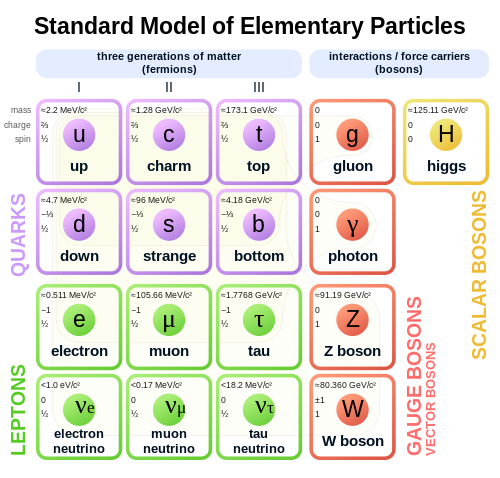
Standard Model - Source: Wikipedia


 The Standard Model of particle physics is the theoretical framework that describes the fundamental building blocks of the universe and the forces through which they interact. It is one of the most successful and rigorously tested theories in modern physics.

Here is a breakdown of how the universe is put together according to the Standard Model.

1. The Building Blocks: Matter Particles (Fermions)

All tangible matter in the universe is made up of particles called fermions, which have half-integer spin (e.g., 1/2). These are divided into two main categories, each split into three "generations" of increasing mass.

Quarks

Quarks are heavy particles that experience the strong nuclear force. They combine to form composite particles called hadrons (like protons and neutrons).

  • Generation 1: Up (u), Down (d) — These make up ordinary stable matter.

  • Generation 2: Charm (c), Strange (s)

  • Generation 3: Top (t), Bottom (b)

Leptons

Leptons do not feel the strong nuclear force.

  • Generation 1: Electron (e-), Electron Neutrino (νe)

  • Generation 2: Muon (μ), Muon Neutrino (νμ)

  • Generation 3: Tau (τ), Tau Neutrino (ντ)

Note: For every matter particle, there is a corresponding antimatter particle with the same mass but opposite electric charge (e.g., the positron is the antielectron).

2. The Messengers: Force Carriers (Gauge Bosons)

Particles interact by exchanging force-carrier particles called gauge bosons, which have integer spin (e.g., 1). The Standard Model accounts for three of the four fundamental forces of nature:

ForceDescriptionGauge Boson (Carrier)Mass / Range
ElectromagnetismGoverns atomic structure, light, and chemical reactions.Photon (γ)Massless / Infinite
Strong Nuclear ForceBinds quarks inside protons/neutrons and holds atomic nuclei together.Gluon ($g$)Massless / Short-range
Weak Nuclear ForceResponsible for radioactive decay (like beta decay) and initiating solar fusion.W+ / W- and Z0 BosonsVery heavy / Ultra short-range

3. The Mass Giver: The Higgs Boson

The Higgs Boson (H) is a scalar boson (spin 0) associated with the Higgs field, which permeates the entire universe.

  • Mechanism: As fundamental particles move through this field, they interact with it. The strength of this interaction determines the particle's inertial mass.

  • Particles like the top quark interact strongly and are very heavy; photons do not interact with it at all and remain massless.

  • Its discovery at CERN's Large Hadron Collider (LHC) in 2012 was the final piece confirming the Standard Model's framework.

What the Standard Model Left Out

While incredibly robust, the Standard Model is known to be an incomplete theory of nature because it fails to explain a few massive cosmological puzzles:

  • Gravity: It does not include general relativity. The hypothetical carrier of gravity, the graviton, has not been incorporated mathematically into the quantum framework.

  • Dark Matter & Dark Energy: The model only accounts for about 5% of the energy-mass composition of the observable universe. The remaining 95% is completely unaccounted for.

  • Neutrino Mass: In the original mathematical formulation of the Standard Model, neutrinos are massless. However, oscillation experiments have proved they possess tiny, non-zero masses.

  • Matter-Antimatter Asymmetry: It doesn't fully explain why the universe today is overwhelmingly made of matter, even though the Big Bang should have produced equal amounts of matter and antimatter.


Tuesday, July 21, 2015

Interactive Standard Model

Image credit: Simmetry Magazine

Symmetry Magazine post a great interactive information about the particles in the Standard model.
You can take a look here: http://www.symmetrymagazine.org/standard-model/

Wednesday, April 25, 2012

What particle... ?

Sean Carroll (theoretical physicist at California Institute of Technology) create a great diagram called "What particle are you?", a funny way to learn more about the Standard Model.

Credit: Sean Carroll

Monday, April 9, 2012

The Standard Model

I found this good presentation about the Standard ModelTo the standard model - Ion Cotaescu
View more PowerPoint from SEENET-MTP
Another interesting reading:

The Standard Model in Physics - Infography
(click image to view in full size)

Credit: CPEPweb.org

Credit: CPEPweb.org


Thursday, April 5, 2012

The Standard Model of Particle Physics

LHC physics data taking gets underway at new record collision energy of 8TeV
At 0:38 CEST this morning, the LHC shift crew declared ‘stable beams’ as two 4 TeV proton beams were brought into collision at the LHC’s four interaction points. This signals the start of physics data taking by the LHC experiments for 2012.  The collision energy of 8 TeV is a new world record, and increases the machine’s discovery potential considerably.
(font CERN)


The Standard Model of particle physics is a theory concerning the electromagneticweak, and strong nuclear interactions, which mediate the dynamics of the known subatomic particles.
Still, the Standard Model falls short of being a complete theory of fundamental interactions because it does not incorporate the physics of dark energy nor of the full theory of gravitation as described by general relativity. The theory does not contain any viable dark matter particle that possesses all of the required properties deduced from observational cosmology. It also does not correctly account for neutrino oscillations (and their non-zero masses). Although the Standard Model is believed to be theoretically self-consistent, it has several apparently unnatural properties giving rise to puzzles like the strong CP problem and the hierarchy problem.
Nevertheless, the Standard Model is important to theoretical and experimental particle physicists alike. For theorists, the Standard Model is a paradigmatic example of a quantum field theory, which exhibits a wide range of physics including spontaneous symmetry breakinganomalies, non-perturbative behavior, etc. It is used as a basis for building more exotic models which incorporate hypothetical particlesextra dimensions and elaborate symmetries (such as supersymmetry) in an attempt to explain experimental results at variance with the Standard Model, such as the existence of dark matter and neutrino oscillations. In turn, experimenters have incorporated the Standard Model into simulators to help search for new physics beyond the Standard Model.
Recently, the Standard Model has found applications in fields besides particle physics, such as astrophysics, cosmology, and nuclear physics.
(in Wikipedia)
You can read another posts about particles and Higgs in my blog. Now, watch this videos about Standard Model:

Featured Post

IBSE about Light Pollution

Here is my presentation that happened in the Discover the Cosmos Conference (Volos, Greece - 2013). The presentation was an Inquiry Base...

Popular Posts