This animation shows the relative orbital paths of ESA's ExoMars Trace Gas Orbiter (TGO), the Schiaparelli Entry, descent and landing

Showing posts with label orbits. Show all posts
Showing posts with label orbits. Show all posts
Thursday, October 13, 2016

Friday, May 11, 2012
Look at the Sun
The science behind observing our star
The governing laws
The motion of objects is governed by Newton's laws. The same simple laws that govern the motion of objects on earth also extend to the motion of planets, moons, and other satellites. The mathematics that describes a satellite's motion is the same mathematics presented for circular motion described here.
So, the velocity, acceleration and ratio between period and radius can be acquired.
The period, speed and acceleration of a satellite are only dependent upon the radius of orbit and the mass of the central body that the satellite is orbiting.
The Lagrangian points [1]
The Lagrangian points are the five positions in an orbital configuration where a small object affected only by gravity can theoretically be stationary relative to two larger objects (such as a satellite with respect to the Earth and Moon). The Lagrange points mark positions where the combined gravitational pull of the two large masses provides precisely the centripetal force required to rotate with them.
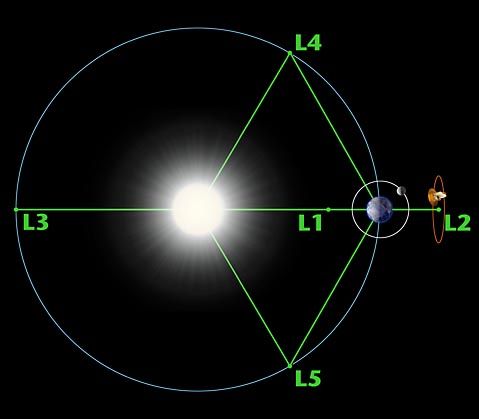 Lagrangian points are the stationary solutions of the circular restricted three-body problem. For example, given two massive bodies in circular orbits around their common center of mass, there are five positions in space where a third body, of comparatively negligible mass, could be placed so as to maintain its position relative to the two massive bodies. As seen in a rotating reference frame with the same period as the two co-orbiting bodies, the gravitational fields of two massive bodies combined with the satellite's circular motion are in balance at the Lagrangian points, allowing the third body to be stationary with respect to the first two bodies.
There is an individual description of lagrangian points in ESA website.
STEREO and SOHO
Two of the most important satellites that are observing our Sun is STEREO and SOHO
STEREO (Solar TErrestrial RElations Observatory) is the third mission in NASA's Solar Terrestrial Probes program (STP). The mission, launched in October 2006, has provided a unique and revolutionary view of the Sun-Earth System. The two nearly identical observatories - one ahead of Earth in its orbit, the other trailing behind - have traced the flow of energy and matter from the Sun to Earth. STEREO has revealed the 3D structure of coronal mass ejections; violent eruptions of matter from the sun that can disrupt satellites and power grids, and help us understand why they happen. STEREO is a key addition to the fleet of space weather detection satellites by providing more accurate alerts for the arrival time of Earth-directed solar ejections with its unique side-viewing perspective. (NASA)
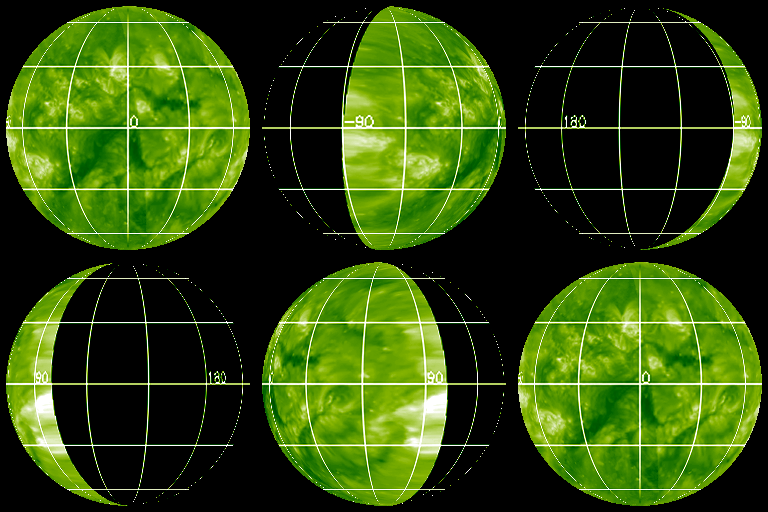
SOHO, the Solar & Heliospheric Observatory, is a project of international collaboration between ESA and NASA to study the Sun from its deep core to the outer corona and the solar wind. (NASA)
Now lets watch trajectories and lagrange points in action [2]:
[1] text from wikipedia: http://en.wikipedia.org/wiki/Lagrangian_point (May 11, 2012)
[2] video shared by my friend Manel Rosa Martins.
[2] video shared by my friend Manel Rosa Martins.
Subscribe to:
Posts (Atom)
Popular Posts
-
Here is a little infografic about the year of the discover of each particle: Particles Physics | Create Infographics
-
 Scales in the Universe - Created with Gemini AI The scale of the universe is so vast that our everyday units of measurement completely bre...
 -
A single Neutron Decay A free neutron will decay with a half-life of about 10.3 minutes but it is stable if combined into a nuc...
-
" A research team led by Yves Couder at the Université Paris Diderot recently discovered that it's possible to make a tiny f...
-
Não é novo que a física seja uma intermediária para conseguir recordes olímpicos. Cada vez mais é reconhecida a importância da física, quer ...

