
Showing posts with label CERN. Show all posts
Showing posts with label CERN. Show all posts
Tuesday, April 14, 2020

Tuesday, January 1, 2019
New CERN technology transfer
The new MediPix3 aims to produce better images from our body.
Check this image about color X-Rays:
MARS’ solution couples the spectroscopic information generated by the Medipix3 enabled detector with powerful algorithms to generate 3D images. The colours represent different energy levels of the X-ray photons as recorded by the detector hence identifying different components of body parts such as fat, water, calcium, and disease markers.
Source: https://medipix.web.cern.ch/news/first-3d-colour-x-ray-human-using-cern-technology
Check this image about color X-Rays:
 |
| A 3D image of a wrist with a watch showing part of the finger bones in white and soft tissue in red. (Image: MARS Bioimaging Ltd) |
Source: https://medipix.web.cern.ch/news/first-3d-colour-x-ray-human-using-cern-technology
Saturday, February 27, 2016
Virtual Visit to CMS at CERN (2016)
On February 24, 2016, at 15 hours, 55 students and 5 teachers in Escola Secundária Dr. Júlio Martins (Portuguese high school), made a virtual visit to CMS at CERN.
 The activity was promoted by the European Project Inspiring Science Education (ISE), and it was made, for the second time, with a total of five portuguese schools: Escola Secundária Dr. Júlio Martins (Chaves); Escola Secundária Paços de Ferreira (Paços de Ferreira); Escola Secundária de Loulé (Faro), Agrupamento de Escolas Dra. Laura Ayres (Quarteira); Escola Secundária Adolfo Portela (Águeda).
The students saw the control room, the cavern of CMS (Compact Muon Solenoid) experiment, installed in LHC (Large Hadron Collider) and asked some questions to the scientists.
The students made a contact with Portuguese scientists, Pedro da Silva, André David Mendes and José Carlos da Silva, with technical support of Angelos Alexopoulos, Noemi Beni e Zoltan Zsillasi. They drove our students through CMS control room, and explained all the graphics in their computers, to the CMS cavern, 100 meters deep, and they explained all the objects observed, how it works and characteristics.
- CMS virtual visit https://indico.cern.ch/event/502813/overview
- Miguel Neta website http://www.miguelneta.pt/pt/atividades/93-cms-virtual-visit-2016
- EUFISICA blog http://blog.eufisica.com/2016/02/visita-virtual-ao-cms-no-cern-2016.html
Thursday, March 12, 2015
Virtual Visit to CMS at CERN
On February 25,
2015, at 15 hours, 150 students and 10 teachers in Escola Secundária de
Penafiel (Portuguese high school), made a virtual visit to CMS at CERN.
The activity was
promoted by the European Project Open Discovery Space (ODS), and it was made,
for the first time, with a total of five portuguese schools: Escola Secundária
de Penafiel (Penafiel); Escola Secundária Ferreira Dias (Sintra); Escola
Secundária José Saramago (Mafra), Agrupamento de Escolas Dra. Laura Ayres
(Quarteira); Escola Secundária Adolfo Portela (Águeda).
The students saw
the control room, the cavern of CMS (Compact Muon Solenoid) experiment,
installed in LHC (Large Hadron Collider) and asked some questions to the
scientists.
The students made a contact with
portuguese scientists, Pedro da Silva, André David Mendes and José Carlos
Silva, with technical support of Angelos Alexopoulos, Noemi Beni e Zoltan
Zsillasi. They drove our students through CMS control room, and explained all the
graphics in their computers, to the CMS cavern, 100 meters deep, and they
explained all the objects observed, how it works and characteristics.

We achieved a
total of 553 students in this virtual visit, and it was established a new
record of students participating in a same session. All the students were
pleased to visit virtually this especial science center.
Some feedback
from our students:
“Hello teacher, I would like to thank you the
opportunity to participate in something unique.
For students that study Physics, CERN is the epicenter of investigation and
knowledge. I loved the fact that we made contact with scientists and it was so
fun how they present the detector and technologies provided by CERN. It was
useful to extend the knowledge of tiny world despite the fact that we need such
a huge machine, like CMS, to discover that world. To see all of this visit in
real time image was exceptional...
Thanks to all, specially people at CERN and our
teachers to make this happened.” - André Queirós
"Hello teacher, I'm written this email about
our virtual visit to CERN. It was a visit that arises our interest and
curiosity to know better CERN and the experiments made by scientist. The simple
language used by scientists helps us to understand the experiments, and kept
students' attention.
I liked to thank the availability and I hope someday
to know CERN even better." - Ana Catarina Moreira
"Hello teacher, I like to thank you for the
visit, even virtually, it was very good and educative. I hope to perform
another visit, but this time a live one. I was curious on CERN center and LHC
detectors, and the explanation of both made by site scientists.
I wish a year full of success and with new
discoveries!" - João Pereira.
"Hello teacher, the virtual visit was very
interesting, now I understand what happen in there and what scientists do, how
do they do it and the level to acquire such performance in science and
technology. It was important to see the detector and jobs possibilities to
students. Thank you so much for this opportunity" - Tiago Carvalho

CERN:
Angelos Alexopoulos, André David, José Silva, Pedro Silva, Noemi
Beni and Zoltan Zsillasi.
School’s
pilot teachers: Cristina Pinho, Marília Peres, Miguel Neta, Álvaro Folhas and
José Gonçalves.
ODS support: Rosa Doran and José
Gonçalves.
Schools: To our students, teachers,
directors and IT technicians.
On the web:
CERN event - https://indico.cern.ch/event/365946/
(with video)
Portal
do Astrónomo - http://www.portaldoastronomo.org/noticia.php?id=969
Escola
Sec. Adolfo Portela - http://www.esap.edu.pt/informacoes/735-201503-visitacern
Friday, November 21, 2014
two new particles

"Today the collaboration for the LHCb experiment at CERN1’s Large Hadron Collider announced the discovery of two new particles in the baryon family. The particles, known as the Xi_b'- and Xi_b*-, were predicted to exist by the quark model but had never been seen before. A related particle, the Xi_b*0, was found by the CMS experiment at CERN in 2012. The LHCb collaboration submitted a paper reporting the finding to Physical Review Letters." Source: CERN
Read more:
Tuesday, January 21, 2014
first-ever beam of antihydrogen atoms
CERN announced that its ASACUSA experiment has produced the world's first-ever beam of antihydrogen atoms. Such beams will make possible a couple of tests that seek to answer one of the biggest questions in physics: Why is there more matter than antimatter?

"The ASACUSA experiment at CERN has succeeded for the first time in producing a beam of antihydrogen atoms. In a paper published today in Nature Communications, the ASACUSA collaboration reports the unambiguous detection of 80 antihydrogen atoms 2.7 metres downstream of their production, where the perturbing influence of the magnetic fields used initially to produce the antiatoms is small. This result is a significant step towards precise hyperfine spectroscopy of antihydrogen atoms." in CERN Press Office
Wednesday, October 9, 2013
The 2013 Nobel Prize in Physics
The Nobel Prize in Physics 2013 was awarded jointly to François Englert and Peter W. Higgs "for the theoretical discovery of a mechanism that contributes to our understanding of the origin of mass of subatomic particles, and which recently was confirmed through the discovery of the predicted fundamental particle, by the ATLAS and CMS experiments at CERN's Large Hadron Collider"

Photo: Pnicolet via Wikimedia Commons
François Englert

Photo: G-M Greuel via Wikimedia Commons
Peter W. Higgs
The Scientific background paper can be found here. (font: nobelprize.org website)
You can find the complete investigation conducted at CERN in the official website.
Interview with François Englert (credit: CERN)
You can find the complete investigation conducted at CERN in the official website.
Interview with François Englert (credit: CERN)
Interview with Peter Higgs (credit: CERN)
Friday, July 19, 2013
Rare particle decay detected at LHC
 |
| Protons collide in the CMS detector, producing a Bs particle that decays into two muons (red lines) in this event display from 2012 (Image: CMS) |
New results to be presented today at the European Physical Society's High Energy Physics conference (EPS-HEP 2013) in Stockholm, Sweden, have put the Standard Model of particle physics to one of its most stringent tests to date. The CMS and LHCbexperiments at CERN’s Large Hadron Collider (LHC) will present measurements of one of the rarest measureable processes in physics: the decay of a Bs (pronounced B-sub-s) particle into two muons.
The new measurements show that only a handful of Bs particles per billion decay into pairs of muons. Because the process is so rare, it is an extremely sensitive probe for new physics beyond the Standard Model. Any divergence from the Standard Model prediction would be a clear sign of something new.
Both experiments will present results to a very high level of statistical significance (over 4 sigma for each experiment). These results are in good agreement with the Standard Model.
Font: CERN
Read more:
"A very rare decay has been seen by CMS" - CMS collaboration
"Measurement of the B0s→μμ branching fraction and search for B0→μμ decays at the LHCb experiment" - LHCb collaboration
- Physics paper on arXiv (CMS collaboration)
- LHCb-PAPER-2013-046 (LHCb collaboration)
Sunday, July 7, 2013
Thursday, July 4, 2013

Friday, May 3, 2013
What happened to antimatter? - Rolf Landua
 |
| Me and Rolf Landua holding the antimatter container of DaVinci's Code |
Do you remember the antimatter bomb in the DaVinci's Code movie?
In my journey at CERN, Rolf Landua gave a lecture about antimatter. Basically the topics in the lecture was this questions: What is it? Where is it create? How can be created? What is the mystery behind it? How can we study it? Can we use it as a energy font or a bomb? Is any antimatter in our daylife?
In particle physics, antimatter is material composed of antiparticles, which have the same mass as particles of ordinary matter but have opposite charge and quantum spin. Antiparticles bind with each other to form antimatter in the same way that normal particles bind to form normal matter. For example, a positron (the antiparticle of the electron, with symbol e+) and an antiproton (symbol p) can form an antihydrogen atom. Furthermore, mixing matter and antimatter can lead to the annihilation of both, in the same way that mixing antiparticles and particles does, thus giving rise to high-energy photons (gamma rays) or other particle–antiparticle pairs. The end result of antimatter meeting matter is a release of energy proportional to the mass as the mass-energy equivalence equation, E=mc2 shows.
At this time, the apparent asymmetry of matter and antimatter in the visible universe is one of the greatest unsolved problems in physics.
Antimatter is created in the LHC, and the LHCb is the detector responsible to detect particles in the antiprotons' collisions. The antiprotons' production is achieved with the collisions between protons and nucleus of Iridium, Cupper, and others. The antiprotons are decelerated and keep trapped with a combination of electric and magnetic fields (so it doesn't touch matter). In this way, the resultant material is detected by the detector before the annihilation. That event is one of the biggest mysteries of the Big Bang, and scientist are trying to answer it: the domination of the matter over the antimatter.
 |
| FDG is a glucose molecule, with fluorine-18 attached |
This antimatter cannot be used as energy or weapon because we need energy to create it. Imagine that we want to produce 0.5 g of antimatter. Well, we need 22 kton (22,000 ton) of TNT (almost the same value of the Hiroshima's bomb), to produce 0.5 g of matter and antimatter. The energy in this process is about 4.5 x 10¹³ J. The total energy that we need (because the efficiency is 10-9 %) will be 4,5 x 10²² J. Even with CERN's discount made by French Electric Company [1 kwh = 3,6 x 10⁶ J= 0,1 €], the total cost will be 1 x 10⁸ € and it will be take a billion years to produce and supply this production to CERN.
But, antimatter is used in our body for PET scan detection. The glucose has a fluorine-18 attached that will emit positrons when that molecule travels in our body, and the scanner detects where the positrons go.
The next step that scientist at CERN are trying to develop is to use positrons and antiprotons as therapy in some deceases.
References:
- Antimatter - Wikipedia
- Having a Pet Scan
- Antimatter presentation - Rolf Landua, CERN
TEDxCERN
 |
| Credit: CERN |
Going beyond particle physics, TEDxCERN will provide a stage for the expression of science in multiple dimensions and disciplines, unveiling a world in which physics intersects with other multi-dimensional disciplines and thought. TEDxCERN will take place on 3 May 2013 at CERN, near Geneva, Switzerland, and will be webcast live throughout many of CERN's member institutes.
Go here to watch: http://tedxcern.web.cern.ch/
Saturday, April 13, 2013
ScienceCasts: A Whiff of Dark Matter on the ISS
In astronomy and cosmology, dark matter is a type of matter hypothesized to account for a large part of the total mass in the universe. Dark matter cannot be seen directly with telescopes; evidently it neither emits nor absorbs light or other electromagnetic radiation at any significant level. Instead, its existence and properties are inferred from its gravitational effects on visible matter, radiation, and the large-scale structure of the universe. According to the Planck mission team, and based on the standard model of cosmology, the total mass–energy of the universe contains 4.9% ordinary matter, 26.8% dark matter and 68.3% dark energy. Thus, dark matter is estimated to constitute 84.5% of the total matter in the universe.
On 3 April 2013, NASA scientists reported that hints of dark matter may have been detected by the Alpha Magnetic Spectrometer on the International Space Station. According to the scientists, "The first results from the space-borne Alpha Magnetic Spectrometer confirm an unexplained excess of high-energy positrons in Earth-bound cosmic rays."
font: wikipedia
To know more about dark matter and dark energy follow this link: http://home.web.cern.ch/about/physics/dark-matter

CERN press release:
Geneva 3 April 2013. The international team running the Alpha Magnetic Spectrometer (AMS) today announced the first results in its search for dark matter. The results, presented by AMS spokesperson Professor Samuel Ting (...). They report the observation of an excess of positrons in the cosmic ray flux.
The AMS results are based on some 25 billion recorded events, including 400,000 positrons with energies between 0.5 GeV and 350 GeV, recorded over a year and a half. This represents the largest collection of antimatter particles recorded in space. The positron fraction increases from 10 GeV to 250 GeV, with the data showing the slope of the increase reducing by an order of magnitude over the range 20-250 GeV. The data also show no significant variation over time, or any preferred incoming direction. These results are consistent with the positrons originating from the annihilation of dark matter particles in space, but not yet sufficiently conclusive to rule out other explanations. [...]
Thursday, March 28, 2013
LHC Consolidations
LHC had stopped its work to made an updated to operate a higher energy.
Here is the main consolidations (credit CERN).

Here is the main consolidations (credit CERN).
Saturday, July 28, 2012
HST2012, CERN - The End
First of all I would like to apologize to our readers for not giving news in recent days at CERN, it was absolutely impossible. Here is the balance of the last week of the HST program 2012:
Wednesday, July 11, 2012
HST2012, CERN - Day 11
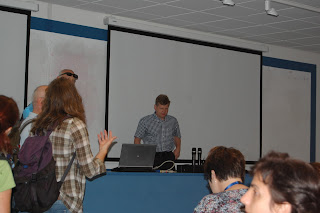
Today we had a lecture in "Introduction to Particle Detectors"by Frank Hartmann (CERN and KIT - Karlsruhe Institute of Technology)

Before to build the detector we need to know the interactions (photon, charged particles, hadronic interactions, and neutrinos) and what properties we want to measure (energy, momentum, charge, life time, decay modes). How can we separably measure? Creating a detector with various combinations: a tracker, an electromagnetic calorimeter, a hadronic calometer, and a muon system.
The electrons leaves traces in the tracker and in the electromagnetic calorimeter (and stops). The fotons leaves traces in the electromagnetic calorimeter (and stops). The hadrons leaves traces in the tracker, the electromagnetic calorimeter and in the hadronic calorimeter (and stops). The muons leaves traces in all of them.
The principal function of tracking detectors is measure
the tracks of emerging particles; determine charge and momentum in connection with a magnetic field; tracks
are reconstructed from measured space-points.
HST2012, CERN - Day 10
 Today we had the first lecture about Accelerators by Simone Gilardoni.
He explained why we need accelerators and how it works. Especially the function of the quadrupoles and dipoles, that confine the beam and gives the correct vibration.
At launch we meet a Nobel Prize Physicist Carlo Rubbia. The Nobel Prize was for the work leading to the discovery of the W and Z particles at CERN
 |
| Carlo Rubbia at CERN (today) |
At launch also talked with Greg and Dave from Perimeter Institute.
These guys are rock, they know how to teach Modern Physics in a new way. Follow them at twitter.
Also Greg is a good soccer player.
 |
| Dave, Me and Greg |
After lunch we had the first lecture about Medical Applications from Physics by Manjit Dosanjh.
She talked about accelerators, detectors and how it changes our medical care: accelerators for tumor target and detectors for medical imaging.
 |
| Mick Storr and Manjit Dosanjh |
Monday, July 9, 2012
HST2012, CERN - Day 9
Today we met Dave and Greg from the Perimeter Institute.
They gave us new perspectives on the teaching of physics, especially on experiential activities that we do in class.
We did experiments about dark matter, double slit experiment, and more.
The materials and videos can be found here.
They gave us new perspectives on the teaching of physics, especially on experiential activities that we do in class.
We did experiments about dark matter, double slit experiment, and more.
The materials and videos can be found here.
 |
| Greg (left) and Dave (right) |
 |
| Dark Matter experiment |
 |
| Gravity and Relativity experiment |
Subscribe to:
Posts (Atom)
Popular Posts
-
 Standard Model - Source: Wikipedia The Standard Model of particle physics is the theoretical framework that describes the fundamental bu...
 -
 Eggnaut protection created with Gemini One of the students’ favorite challenges is the Eggnaut experiment. In this activity, they use the ...
 -
Andrew Fraknoi made a catalog with Astronomy applications for your mobile and you can found it here (most applications is for iPhone...
-
 In the past, I posted about the Physics of Spiderman 3 , Superman . Today, I present in this blog a paper about Physics and Superheroes.

