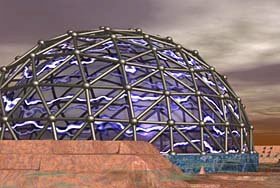
I put this problem to my Physics students (K12) a few years ago:
Problem
Assuming that a team of astronauts on Mars is within a dome, and has a problem in the air supply, how long will it take to exhaust the oxygen?
Answer
To solve this problem, we first have to know the volume of air that exists within the dome. Here is where many of my student give up because they don't know the dimensions of the dome. Now, it's time to your imagination, try to give those dimensions (don't exaggerate too much). For example, I assume a dome with 5 m radius. I think with that dimension, our astronauts will have enough space for them and their equipment (if not, just redo the calculations for a dome with larger radius). Oh, another detail: How many astronauts? Well, a trip to the red planet should not be more astronauts than those who go to the ISS. However, suppose a journey with five astronauts.
Now, let's calculate the volume of air inside the dome. The volume of the sphere is given by the following mathematical expression:
Vsphere = 4/3 π R3 [1]
For our dome (half of the sphere) using [1], will be:
Vdome = Vsphere /2 <=> Vdome = 1/2(4/3 π R3) <=>
<=>
Vdome = 2/3 π R3 [2]
Substituting in the equation [2] and performing the calculations, we have the volume of the dome with the approximate value of 262
m3 .
Each cubic meter has 1000 liters of air capacity, then we have 262 thousand liters of fresh air.
The air has about 21% of oxygen and by 17.5% should be enough to leave the dome to the evacuation craft (obviously exist an emergency spacecraft). To get from breathing fresh air to an absolutely suffocating air, we make the difference between 21 percent of 262 thousand liters and 17.5 percent of 262 thousand liters. This gives us 9170 liters of passing through oxygen.
The next step is to determine how much oxygen does a human consume. It was difficult to find a reliable source. This article, about the installation in 2006 of a new system of oxygen in the International Space Station, provides a clue:
"During normal operations, it will provide 5 kg per day, enough to support six crew members."
Let us assume that astronauts, and with the stress situation, need about 900 g of oxygen per day, or 0.9 kg/day. How many liters represents that value? Oxygen has a molecular weight of 16 g/mol. So the oxygen gas, which is formed by molecules of O2 , has a mass of 32 grams per mole. One mole of gas, at normal temperature and pressure conditions, occupies 22.4 liters (we assume that the conditions in dome are the same conditions as we have in Earth). That is:
0.9 kg x (1000 g / 1 kg) x (1 mol O2 / 32 g O2) x (22.4 L / 1 mole of O2)
This gives an oxygen consumption of 630 liters per person per day. Let's use a more reasonable rate:
(630 L / day) x (1 day / 24 hours) x (1 hour / 60 mins)
Now we have the rate of oxygen consumption usable 0.4375 liters per minute. We're almost there.
Then fill the dome with the astronauts. The five occupants consume 2.1875 liters per minute. Thus, for the final calculation:
9179 L x (1 minute / 2.1875 L)
It will take about 4196 minutes, or 69 hours and 56 minutes, to the suffocating air. In other words, the astronauts will have less than three days to restore the oxygen provided by the air supply or escape to the emergency ship.