Follow eufisica

Follow eufisica

Showing posts with label HST. Show all posts

Friday, April 19, 2013

A whole new view of the Horsehead Nebula


In this episode of the Hubblecast celebrates 23 years of the NASA/ESA Hubble Space Telescope, by unveiling a beautiful and striking new image of the Horsehead nebula. 

Dr Joe Liske (aka Dr J) explains the secrets of nebulae, cosmic clouds of gas and dust that have been the subjects of some of Hubble's most striking astronomical images. The Horsehead nebula is one of the most distinctive, and is now shown in a whole new light thanks to a stunning new infrared image — revealing the delicate wisps of gas that are normally hidden by the thick dust that makes up the Horsehead's famous and familiar shape.

More information and download-options:

Credit: ESA/Hubble


Saturday, July 28, 2012

HST2012, CERN - The End

First of all I would like to apologize to our readers for not giving news in recent days at CERN, it was absolutely impossible. Here is the balance of the last week of the HST program 2012:
The last week at CERN basically we develop and finalize the work group. Also, we visited the CERN Control Centre (we were the first teachers inside the room, after the glass door) and the AMS Control Center that is connected directly to the International Space Station. We visited, finally, the CMS detector, where we could see the numerous computers and cables that are connected to the detector, and the security door that requires a retinal scan to be able to get inside the tunnel where is the LHC pipes.

One of the Bósimon cards. This game promises.
On the last day we carried out presentations about our work group. All teachers (42 in total) participated in the presentation within your group. My group created a game called Bósimon, consisting of a mixture of Pókemon cards with our well-known game of "go fish" on the particle physics topic. The game is so addictive that even the organizers were delighted. What they thought impossible, our group became a reality. The next step will be to test it in the classroom environment, with high school students.
In short, I believe that my coming to CERN was positive, as well as making good friends, I got more knowledge (especially on the operation of the detectors), realized team work (which is the spirit of CERN), lived within the physics major events.
Let me give a big thanks to the team that organized the HST2012, to scientists, to workers and to the General Director for having treated us so well, just like equals. Never in my life I felt the real love, respect, value and attention as that demonstrated by CERN to teachers.
And now ... will be more adventures to come?

Sunday, July 15, 2012

HST2012, CERN - Day 12


Rolf Landua and ME holding the antimatter bottle.
During this day we had two lectures and we continued into work group
The first lecture was the continuation about Accelerators. We leaved the technical details and we got into the Physics: energy, number of events, luminosity, etc.


It was emphasized that in the LHC does not circulate a steady stream of protons, they are sent in bunches and compressed by existing dipoles and quadrupoles in the accelerator. The curvature and focal power we use in optics is applied here at the LHC in terms of the strength of the different magnets. The magnetic field created at the LHC is 8.33 T, in the Earth is situated between 24 mT and 66 mT. There are approximately 6000 magnets in the LHC.

The second lecture was about Antimatter, performed by Rolf Landua based on the movie Angels and Demons. Basically, we tried to respond to seven questions related to the subject: What is it? Where is it created? How is it created? What is the mystery behind this? How to study it? Can be used as energy source or a bomb? There antimatter in our day-to-day?
Antimatter is real and is composed of antiparticles. For example, the hydrogen atom is formed by a proton and an electron, in the version of the antimatter, antihydrogen consists of a positron and antiproton. Antimatter is created in the LHC, the LHCb is the detector for those particles. 
To create antiprotons, LHC collide protons with cores of Iridium, copper, etc. .. Antiprotons are created, retarded and maintained as "prisoners" in a combination of electric and magnetic fields. Thus the material before the resulting annihilation is captured by the detector. 
This annihilation is one of the great mysteries of the Big Bang that scientists try to answer (the conversion of antimatter to matter in this dominance). 
This antimatter can not be used as energy or weapon because it requires a lot of energy to produce it. To have an idea, we use the following example: Let's try to create 0.5 g of antimatter. Therefore, it is necessary 22 kton (kilo ton) of TNT (approximately the same as Hiroshima's bomb) to produce a half gram of matter and antimatter. The energy associated with 0.5 g of antimatter is  4,5 x 10¹³ J. The total energy required (efficiency ~10-9 %) would be  4,5 x 1022 J. Even with the CERN discount given by the French electricity company [1 kWh = 3.6 x 10⁶ J = 0.1 €], the cost would be  1 x 10€  and would take one billion years deliver it.
Finally, it should be noted that antimatter is used in the body, where a proton is replaced by a positron in the glucose molecule to be detected by PET (Positron Emission Tomography) used in medicine. The next step for the scientists will be create a therapy using positrons.
 About the work we are developing in groups I will talk about later.

Wednesday, July 11, 2012

HST2012, CERN - Day 11

Today we had a lecture in "Introduction to Particle Detectors"by Frank Hartmann (CERN and KIT - Karlsruhe Institute of Technology)

Before to build the detector we need to know the interactions (photon, charged particles, hadronic interactions, and neutrinos) and what properties we want to measure (energy, momentum, charge, life time, decay modes). How can we separably measure? Creating a detector with various combinations: a tracker, an electromagnetic calorimeter, a hadronic calometer, and a muon system.

The electrons leaves traces in the tracker and in the electromagnetic calorimeter (and stops). The fotons leaves traces in the electromagnetic calorimeter (and stops). The hadrons leaves traces in the tracker, the electromagnetic calorimeter and in the hadronic calorimeter (and stops). The muons leaves traces in all of them.
The principal function of  tracking detectors is measure the tracks of emerging particles; determine charge and momentum in connection with a magnetic field; tracks are reconstructed from measured space-points.

HST2012, CERN - Day 10

Today we had the first lecture about Accelerators by Simone Gilardoni.
He explained why we need accelerators and how it works. Especially the function of the quadrupoles and dipoles, that confine the beam and gives the correct vibration. 


At launch we meet a Nobel Prize Physicist Carlo Rubbia. The Nobel Prize was for the work leading to the discovery of the W and Z particles at CERN
Carlo Rubbia at CERN (today)

At launch also talked with Greg and Dave from Perimeter Institute.
These guys are rock, they know how to teach Modern Physics in a new way. Follow them at twitter.
Also Greg is a good soccer player.
Dave, Me and Greg


After lunch we had the first lecture about Medical Applications from Physics by Manjit Dosanjh.
She talked about accelerators, detectors and how it changes our medical care: accelerators for tumor target and detectors for medical imaging.
Mick Storr and  Manjit Dosanjh


Monday, July 9, 2012

HST2012, CERN - Day 9

Today we met Dave and Greg from the Perimeter Institute.
They gave us new perspectives on the teaching of physics, especially on experiential activities that we do in class.
We did experiments about dark matter, double slit experiment, and more.
The materials and videos can be found here.
Greg (left) and Dave (right)

Dark Matter experiment

Gravity and Relativity experiment

HST2012, CERN - Day 7 and 8

In days 7 and 8, we made a pause from the program and we visit Lousanne and Genève.
Two great places to visit and get some culture.
The Cathedral in Lausanne
S. Peter's Cathedral in Genève
In Genève we watched the Science Festival. It is a big Festival in a park near the lake, made by high schools and Universities to the population of this city.
One tend at the Science Festival

Friday, July 6, 2012

HST2012, CERN - Day 6

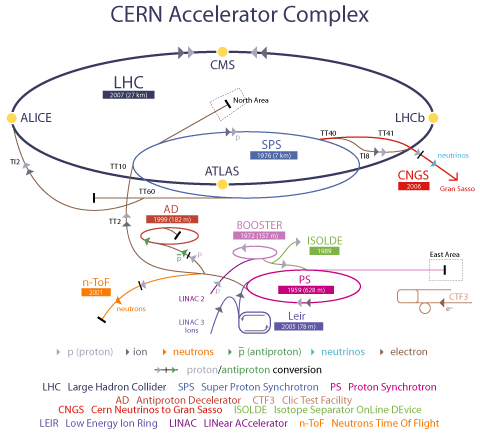
CERN Accelerator ComplexIn this day we had two lectures. One lecture was about the latest discoveries (top quark, bottom quark and tau neutrino); the second lecture was about the Principle of Uncertainty. I don't want to bored you with this stuff. So lets talk about our first visit: LINAC 2. We went to the restricted area with radiation control and watch the place where Physics started. Everything started with a tiny Hydrogen bottle. The H2 goes to a chamber where the electrons are retain and protons are "synchronized". After that the protons are injected to a linear accelerator and goes to LEIR. Look here:


Thursday, July 5, 2012

HST2012, CERN - Day 5


Today we made a Cloud Chamber or Wilson Chamber.
Credit:  scifun.ed
Basically consists of a closed environment which has inside it an isopropyl alcohol 100%. 
When a charged particle (examples, an alpha or beta particle) interacts with the mixture, it will ionize it. The resulting ions act as condensation nuclei, around which will form in the mist (because the mixture is in the dew point).
This type of particle detector (used for cosmic rays) had a prominent role in particle physics experiments between 1920s and 1950s. The findings of the positron in 1932 and the kaon in 1953 were made by using this type of detectors.

HST2012, CERN - Day 4


Today was a big day. You can imagine how happy we are.
First I feel that I contributed just a little bit, and also all people around the world, for this historical milestone, with my computer time to run data using LHC@home.
About what they said today at the conference is that there's a new boson over there.
In the 60's of the last century, independently, Peter Higgs, Francois Englert, Robert Brout, Gerald Guralnik, Dick Hagen y Tom Kibble, they proposed that the Universe was full filled with a field, and later was called the HIGGS fieldThe interactions between the particles and this field makes that acquire massWe can imagine the full scope of these virtual particles (Higgs bosons) that interact with the particles causing some "trouble" to their move. This means that particles acquire mass and inertia
But we can not measure directly the Higgs. We must therefore resort to colliding particles to observe. For that we have a large number of events and statistically significant results, because everything happens fast in the LHC detectors.


The particles after a collision will rapidly decay into other particles. One of decay is the formation of a pair of fotons. What now occurred, the detection of that pair with a statistical significance of five standard deviations (more than expected by scientists who predicted 4.7 standard deviations).

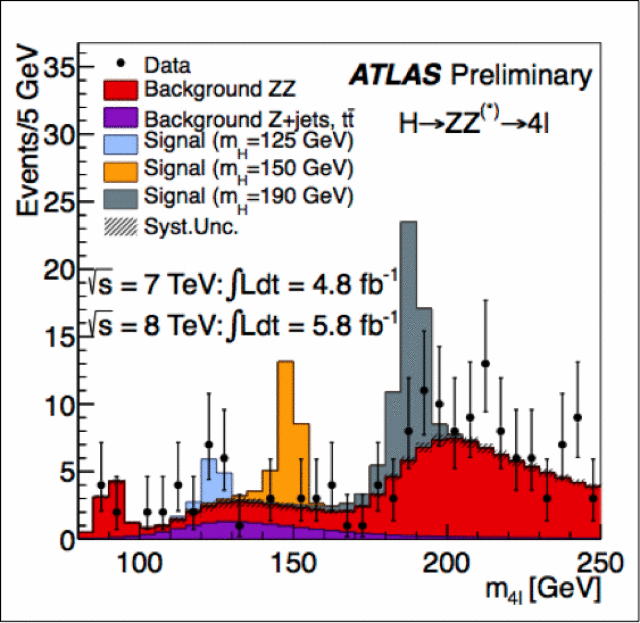
The region where could be the Higgs boson was outlined in 2011. See the peak in the region of 125 GeV in the following figures:
Data (dots), region where could be found the boson (blue, dark yellow and grey). The dots at the right are fluctuations.
Now, take a look at the 2012 results:
Now the combination of the to decays H -> ZZ -> 4I and H -> γγ (2011+2012):
Detector ATLAS
Detector CMS
So, right now I identified a person so far in my sight of view, it seems familiar to me. Now, I have to getting close to be sure that person is what I thought.


More info can be found:
  • Artigo do Público (em Português.
  • Press release CERN (em Inglês).
  • Artigo de LHC-closer (em Espanhol).

Wednesday, July 4, 2012

Tuesday, July 3, 2012

HST2012, CERN - Day 3

Ok, this day was more harder.
We started in the morning with a lecture about Inquiry Learning and all the teachers exchanged they experience. 
It's a circle process where the kids (adapted to a different levels):


ask -> investigate -> discuss -> co-create -> discuss -> reflect -> ask (...)


The 5 features of Inquiring Learning and Teaching are:

  1. Students try to explain a scientific topic, event or phenomenon;
  2. Students explores ideas;
  3. Students gather evidence from observations and clarify concepts and explanations;
  4. Students extends their understanding and identify applications of their findings to other situations;
  5. Students communicate what they have learned and how they have learned it.
After this lecture we had a special section with Professor Peter Higgs. Of course, we were so curious but we can't tell you right now what happen here (we don't know ;))


After lunch we had two lectures in particle physics to prepare tomorrow's presentation.
I will talk about later.


Tomorrow you can try to see the webcast in the next post and follow my twitter post in this blog (can you can see it after the head section).

HST2012, CERN - Day 2


During this second day I learned about CERN history. If you want to know you can read it here.
Also, I visited the Microcosm, a great place for students know more about particles, force carriers, accelerators, and more.
And today I met professor Higgs and he explains at dinner the Physics behind the lecture that he wrote about particles, energy and how all of this fits together.
Professor Peter Higgs and me.

Monday, May 14, 2012

HST: 22 years

The Hubble Space Telescope (HST) is a space telescope that was carried into orbit by a Space Shuttle in 1990 and remains in operation. A 2.4-meter (7.9 ft) aperture telescope in low Earth orbit, Hubble's four main instruments observe in the near ultraviolet, visible, and near infrared.
Many Hubble observations have led to breakthroughs in astrophysics, such as accurately determining the rate of expansion of the universe.
The HST is one of the largest and most versatile space telescope and is well known as both a vital research tool and a public relations boon for astronomy. The HST was built by the United States space agency (NASA), with contributions from the European Space Agency (ESA).
Launched in 1990, scientists found that the main mirror had been ground incorrectly, compromising the telescope's capabilities. The telescope was restored to its intended quality by a servicing mission in 1993.
Hubble is the only telescope designed to be serviced in space by astronauts. The telescope is expected to function until at least 2014. Its scientific successor, the James Webb Space Telescope (JWST), is to be launched in 2018 or possibly later.
adapted from wikipedia
A gallery of HST can be found here.
A video to celebrate the 22nd anniversary of HST, enjoy it:

Featured Post

IBSE about Light Pollution

Here is my presentation that happened in the Discover the Cosmos Conference (Volos, Greece - 2013). The presentation was an Inquiry Base...

Popular Posts