Follow eufisica

Follow eufisica

Showing posts with label gravity. Show all posts

Saturday, October 3, 2015

Escape Velocity

In physics, escape velocity is the minimum speed needed for an object to "break free" from the gravitational attraction of a massive body. More particularly, escape velocity is the velocity (speed traveled away from the starting point) at which the sum of an object's kinetic energy and its gravitational potential energy is equal to zero. At escape velocity the object will move away forever from the massive body, without additional acceleration applied to the object. As the object moves away from the massive body, the object will continually slow and asymptotically approach zero speed as the object's distance approaches infinity.
For a spherically symmetric massive body such as a (non-rotating) star or planet, the escape velocity at a given distance is calculated by the formula
v_e = \sqrt{\frac{2GM}{r}},
where G is the universal gravitational constant (G = 6.67×10⁻¹¹ m3 kg−1 s−2), M the mass of the body to be escaped, and r the distance from the center of mass of the mass M to the object. Notice that the relation is independent of the mass of the object escaping the mass body M. Conversely, a body that falls under the force of gravitational attraction of mass M from infinity, starting with zero velocity, will strike the mass with a velocity equal to its escape velocity.
In this equation atmospheric friction (air drag) is not taken into account.
Source: Wikipedia

In hyperPhysics website you can input some data and it gives the escape velocity: http://hyperphysics.phy-astr.gsu.edu/hbase/vesc.html

See the escape velocity of Earth and Mars here: http://bit.ly/1iThICI

full computaion here http://wolfr.am/7ijFlEcl

Listen about escaping probes in this Astronomy Cast:


Wednesday, February 26, 2014

Balance

Credit: wiki.brown.edu

Center of Gravity if an interesting concept that children can explore at home and classroom.
Check the video:


More:
Balance & Center of Gravity
http://www.algarcia.org/AnimationPhysics/BalanceTutorial.pdf
http://web.mit.edu/jabbott/www/physicsofbalance.html
Equilibrium & Torque
http://www.physicsclassroom.com/class/vectors/u3l3c
http://hyperphysics.phy-astr.gsu.edu/hbase/torq.html

Sunday, December 22, 2013

Gravity Visualized

Two-dimensional analogy of spacetime distortion generated by the mass of an object. Matter changes the geometry of spacetime, this (curved) geometry being interpreted as gravity. White lines do not represent the curvature of space but instead represent the coordinate system imposed on the curved spacetime, which would berectilinear in a flat spacetime. Credit: Wikipedia
Newton's law for gravitational force is described by: F = G MA MB / r2


Where G is the gravitational constant, M is the mass of the body, and r is the vector position between the object with mass A and the other object with mass B. This force is a vector that increase with the mass of each object and decrease with the square of the distance between them.
Now you can see a great experiment about it.


I recommend the reading of this article: Why does gravity get weaker with distance?

Thursday, July 25, 2013

Black-Body Radiation and Gravity

Blackbody radiation induces attractive force stronger than gravity
Artistic visualization of the interaction between an atom and a Black-Body. Due to the atractive force of the Black-Body, the atom is pulled to the direction of this body. Credit: M. Sonnleitner, et al. ©2013 American Physical Society
The black-body objects are perfect not-reflectors that produce constant radiation when they are at a uniform temperature. Thus, the properties of a black-body depends on its temperature, thinking that this radiation would have a repulsive effect. Now a new, scientists have demonstrated theoretically that black-body radiation induces a second force in atoms and molecules that are near its surface which is attractive and stronger than the repulsive radiation pressure. Consequently, the atoms and molecules are pulled to the surface of the black-body by a force which may be greater than gravity. The new attractive force - what scientists describe as "black-body force" - suggests that a variety of astrophysical scenarios need to be revisited.
blackbody_radn_curves_Swinburne University of Technology
À medida que a temperatura diminui, o pico da curva da radiação de um corpo negro se desloca para menores intensidades e maiores comprimentos de onda.
Scientist identify a few interesting results in their formulation. First, this force decays with the third power of the distance to the black-body (F ∝ 1/r3). Second, it is more stronger for small objects. Third, the force is more stronger for warmer objects. Above a few thousand degrees Kelvin, the force of attraction changes to repulsion.
In their study, scientists demonstrated that the strength of the black-body in a grain of dust, at a temperature of 100 K, is much stronger than the gravitational force in this grain. However, for a massive star at a temperature of 6000 K black-body force is much weaker than the gravitational force.
Scientific Article: M. Sonnleitner, et al. “Attractive Optical Forces from Blackbody Radiation.” PRL 111, 023601 (2013). DOI: 10.1103/PhysRevLett.111.023601

Thursday, December 6, 2012

GRAIL's Gravity Tour of the Moon

Variations in the lunar gravity field
This image shows the variations in the lunar gravity field as measured by NASA's Gravity Recovery and Interior Laboratory (GRAIL) during the primary mapping mission from March to May 2012.
Credit: 
NASA/JPL-Caltech/MIT/GSFC

The gravitational field of the Moon has been determined by the tracking of radio signals emitted by orbiting spacecraft. The principle used depends on the Doppler effect, whereby the line-of-sight spacecraft acceleration can be measured by small shifts in frequency of the radio signal, and the measurement of the distance from the spacecraft to a station on Earth. Since the gravitational field of the Moon affects the orbit of a spacecraft, it is possible to use these tracking data to invert for gravity anomalies. However, because of the Moon's synchronous rotation it is not possible to track spacecraft much over the limbs of the Moon, and the far-side gravity field is thus only poorly characterized. The gravitational acceleration on the surface of the Moon is 1.6249 m/s2, about 16.7% that on Earth's surface (it means 1/6 of Earth gravity). Over the entire surface, the gravity variation is about is ~0.0253 m/s2 (1.6% of the gravity acceleration). Because weight is directly dependent upon gravitational acceleration, things on the Moon will weigh only 16.7% of what they weigh on the Earth.
Gravity acceleration at the surface of the Moon in m/s2. Near side on the left, far side on the right. Map from Lunar Gravity Model 2011
The major characteristic of the Moon's gravitational field is the presence of mascons, which are large positive gravity anomalies associated with some of the giant impact basins. These anomalies greatly influence the orbit of spacecraft about the Moon, and an accurate gravitational model is necessary in the planning of both manned and unmanned missions. They were initially discovered by the analysis of Lunar Orbiter tracking data, since navigation tests prior to the Apollo program experienced positioning errors much larger than mission specifications.
The origin of mascons are in part due to the presence of dense mare basaltic lava flows that fill some of the impact basins. However, lava flows by themselves cannot explain the entirety of the gravitational variations, and uplift of the crust-mantle interface is required as well. Based on Lunar Prospector gravitational models, it has been suggested that some mascons exist that do not show evidence for mare basaltic volcanism. The huge expanse of mare basaltic volcanism associated with Oceanus Procellarum does not possess a positive gravity anomaly.
fontWikipedia


This movie shows the variations in the lunar gravity field as measured by NASA's Gravity Recovery and Interior Laboratory (GRAIL) during the primary mapping mission from March to May 2012. Very precise microwave measurements between two spacecraft, named Ebb and Flow, were used to map gravity with high precision and high spatial resolution. The field shown resolves blocks on the surface of about 12 miles (20 kilometers) and measurements are three to five orders of magnitude improved over previous data. Red corresponds to mass excesses and blue corresponds to mass deficiencies. The map shows more small-scale detail on the far side of the moon compared to the nearside because the far side has many more small craters. Image credit: NASA/JPL-Caltech/MIT/GSFC

Saturday, February 18, 2012

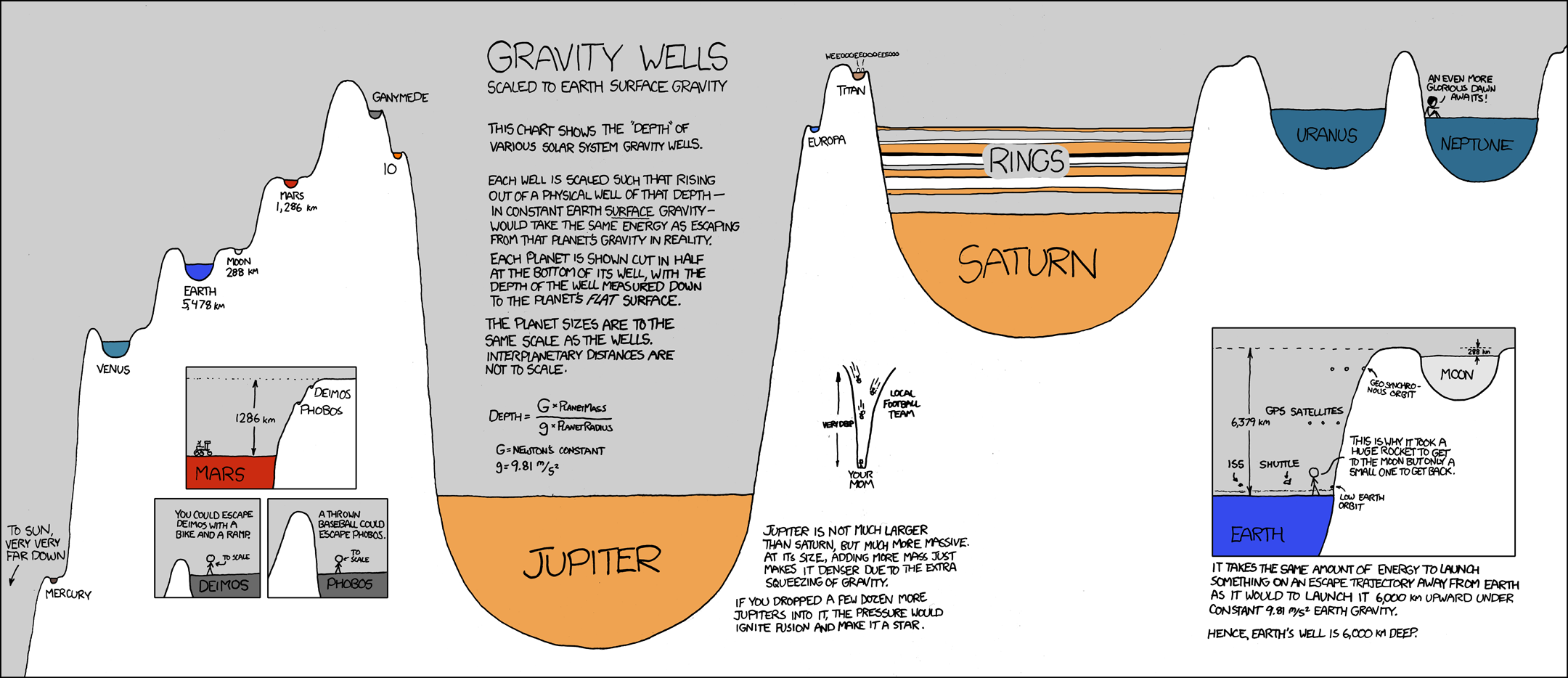
Gravity wells


Click the image to view in full size.
Watch this video comparing Earth and Moon gravity wells:

Wednesday, February 1, 2012

Repulsive gravity as an alternative to dark energy


(PhysOrg.com) -- When scientists discovered in 1998 that the Universe is expanding at an accelerating rate, the possibility that dark energy could explain the observation was intriguing. But because there has been little progress in figuring out exactly what dark energy is, the idea has since become more of a problem than a solution for some scientists. One physicist, Massimo Villata of the National Institute for Astrophysics (INAF) in Pino Torinese, Italy, describes dark energy as “embarrassing,” saying that the concept is an ad hoc element to standard cosmology and is devoid of any physical meaning. Villata is one of many scientists who are looking for new explanations of the Universe’s accelerating expansion that involve some form of repulsive gravity. In this case, the repulsive gravity could stem from antimatter hiding in voids.

(PhysOrg.com) -- During the past few years, CERN physicist Dragan Hajdukovic has been investigating what he thinks may be a widely overlooked part of the cosmos: the quantum vacuum. He suggests that the quantum vacuum has a gravitational charge stemming from the gravitational repulsion of virtual particles and antiparticles. Previously, he has theoretically shown that this repulsive gravity can explain several observations, including effects usually attributed to dark matter. Additionally, this additional gravity suggests that we live in a cyclic Universe (with no Big Bang) and may provide insight into the nature of black holes and an estimate of the neutrino mass. In his most recent paper, published in Astrophysics and Space Science, he shows that the quantum vacuum could explain one more observation: the Universe’s accelerating expansion, without the need for dark energy. 

Wednesday, January 18, 2012

Cosmological Data could solved some problems in Physics

Decoding cosmological data could shed light on neutrinos, modified gravity
This Hubble Ultra-Deep Field image of the distant universe contains approximately 10,000 galaxies. Image credit: NASA and the ESA

(PhysOrg.com) -- Today’s most powerful telescopes collect huge amounts of data from the most distant locations of the universe – yet much of the information is simply discarded because it involves small length scales that are difficult to model. In an effort to waste less data from cosmological surveys, a team of scientists has developed a new technique that allows researchers to use otherwise unusable data by "clipping" some of the highest density peaks, which present the greatest challenge to models. This data could provide a way to address some unsolved problems in physics, including estimating the neutrino mass and investigating theories of modified gravity.

Monday, January 9, 2012

The Tides

The Tidal Force
The tidal force is a secondary effect of the force of gravity and is responsible for the tides. It arises because the gravitational force per unit mass exerted on one body by a second body is not constant across its diameter, the side nearest to the second being more attracted by it than the side farther away. Stated differently, the tidal force is a differential force. Consider three things being pulled by the moon: the oceans nearest the moon, the solid earth, and the oceans farthest from the moon. The moon pulls on the solid earth, but it pulls harder on the near oceans, so they approach the moon more causing a high tide; and the moon pulls least of all on the far oceans (on the other side of the planet), so they stay behind more, causing another high tide at the same time. If we imagine looking at the Earth from space, we see that the whole Earth was pulled, but the near oceans more and the far oceans less; the far oceans stayed behind since they are pulled less (since they are farther away).
in Wikipedia


More information in How Stuff Works


Thursday, May 5, 2011

NASA's Gravity Probe B Confirms Two Einstein Space-Time Theories

Image credit: PhysOrg.com
NASA's Gravity Probe B (GP-B) mission has confirmed two key predictions derived from Albert Einstein's general theory of relativity, which the spacecraft was designed to test. 
The experiment, launched in 2004, used four ultra-precise gyroscopes to measure the hypothesized geodetic effect, the warping of space and time around a gravitational body, and frame-dragging, the amount a spinning object pulls space and time with it as it rotates. 
GP-B determined both effects with unprecedented precision by pointing at a single star, IM Pegasi, while in a polar orbit around Earth. If gravity did not affect space and time, GP-B's gyroscopes would point in the same direction forever while in orbit. But in confirmation of Einstein's theories, the gyroscopes experienced measurable, minute changes in the direction of their spin, while Earth's gravity pulled at them. (NASA)

Source: NASA
Read more in PhysOrg.com

Featured Post

IBSE about Light Pollution

Here is my presentation that happened in the Discover the Cosmos Conference (Volos, Greece - 2013). The presentation was an Inquiry Base...

Popular Posts