Follow eufisica

Follow eufisica

Showing posts with label history. Show all posts

Monday, August 12, 2013

Google's Doodle celebrates Schrödinger

Today Google celebrates the 126th anniversary of Erwin Schrödinger, with this fantastic doodle:
Doodle do Google para comemorar o 126º aniversário de Schrödinger
Google's Doodle to celebrate the 126th Schrödinger's anniversary.
This Physicist, born in Austria, created the famous wave equation for a quantum system (quantum = packages), that it describes the behavior of particles in a tiny scale. This equation allowed to pass from classical mechanics (continuous energy) to quantum mechanics (discontinuous energy) - initially found in experiments and equations in the study of Planck's blackbody radiation - and the solution presented by Schrödinger, with the Dirac notation, is:
schrodinger equation
In January 1926, Schrödinger published in Annalen der Physik the paper "Quantisierung als Eigenwertproblem" (Quantization as an Eigenvalue Problem) on wave mechanics and what is now known as the Schrödinger equation. In this paper he gave a "derivation" of the wave equation for time independent systems, and he showed its energy eigenvalues ​​to correct the hydrogenic atom.” Wikipedia
Erwin Schrödinger.jpg
Erwin Schrödinger. Crédito: Wikimedia
In addition to this work, Schrödinger presented other documents that it was also considered of great importance by the scientific community.
Due to this work, especially by his famous equation, Schrödinger received the Nobel Prize in Physics in 1933.

Thursday, July 18, 2013

The evolution concept of the atom


Sunday, August 26, 2012

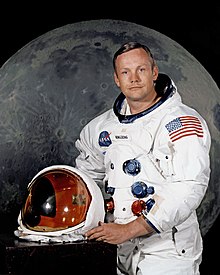
Neil Amstrong


Photo of Neil Armstrong, July 1969, in space suit with the helmet offNeil A. Armstrong, the first man to walk on the moon, was born in Wapakoneta, Ohio, on August 5, 1930.
As a research pilot at NASA’s Flight Research Center, Edwards, Calif., he was a project pilot on many pioneering high speed aircraft, including the well known, 4000-mph X-15. He has flown over 200 different models of aircraft, including jets, rockets, helicopters and gliders.
Armstrong transferred to astronaut status in 1962. He was assigned as command pilot for the Gemini 8 mission. Gemini 8 was launched on March 16, 1966, and Armstrong performed the first successful docking of two vehicles in space.
As spacecraft commander for Apollo 11, the first manned lunar landing mission, Armstrong gained the distinction of being the first man to land a craft on the moon and first to step on its surface.
Armstrong has been decorated by 17 countries. 
Neil Alden Armstrong (August 5, 1930 – August 25, 2012) was an American astronauttest pilotaerospace engineer, university professor and United States Naval Aviator. He was the first person to walk on the Moon. Before becoming an astronaut, Armstrong was a United States Navy officer and had served in the Korean War. After the war, he served as a test pilot at the National Advisory Committee for Aeronautics High-Speed Flight Station, now known as the Dryden Flight Research Center, where he logged over 900 flights. He graduated from Purdue University and the University of Southern California.
Neil Armstrong Signature.svg
A participant in the U.S. Air Force's Man In Space Soonest and X-20 Dyna-Soar human spaceflight programs, Armstrong joined the NASA Astronaut Corps in 1962. His first spaceflight was the NASA Gemini 8 mission in 1966, for which he was the command pilot, becoming one of the first U.S. civilians in space. On this mission, he performed the first manned docking of two spacecraft with pilot David Scott.

Armstrong's second and last spaceflight was as mission commander of the Apollo 11 moon landing in July 1969. On this mission, Armstrong and Buzz Aldrin descended to the lunar surface and spent 2½ hours exploring, while Michael Collins remained in orbit in the Command Module. Armstrong was awarded the Presidential Medal of Freedom by President Richard Nixon along with Collins and Aldrin, the Congressional Space Medal of Honor by President Jimmy Carter in 1978, and the Congressional Gold Medal in 2009.
On August 25, 2012, Armstrong died in Cincinnati, Ohio, at the age of 82 due to complications from blocked coronary arteries.

Friday, April 27, 2012

History of fusion

Now a video about the History of Fusion. Want to learn more? Read my post about ITER machine and fusion.


Tuesday, December 27, 2011

Kepler's Birthday

Johannes Kepler (December 27, 1571 – November 15, 1630) is not a name that most people recognize, but if you are aware of the recent discoveries of new planets, will recognize that many new planets bear his name.  Perhaps the best birthday gift we can give to this scientist is Kepler 22b, the first planet discovered in the habitable zone of a star, an earth possible planet like ours.
Kepler is best known for revealing the secrets of planetary motions. His three laws of planetary motion still apply today, and enabled Newton to give us the law of universal gravitation.
In 1596, Kepler published Mysterium Cosmographicum, where he set out arguments for the heliocentric hypothesis.
In 1609 published Astronomia Nova ... From Motibus Stellae Martis, where he presented his three laws of planetary motion that now bear his name:
  • The planets describe elliptical orbits with the sun at one focus.
  • The radius vector connecting the planet to the sun describes equal areas in equal times. (law of areas)
  • The squares of the periods of revolution (T) are proportional to the cubes of mean distances (a) from the Sun to the planets. T2 = k a3, where k is a proportionality constant.
Probably most of us will never use this information in our life, but it does well to remember that those was important intellectual achievements of Western civilization. We could even think to remember Kepler itself and its laws would be enough, but Kepler had more projects, for example, projects of the first glasses for myopia and hyperopia.

Featured Post

IBSE about Light Pollution

Here is my presentation that happened in the Discover the Cosmos Conference (Volos, Greece - 2013). The presentation was an Inquiry Base...

Popular Posts