Follow eufisica

Follow eufisica

Showing posts with label ISS. Show all posts

Tuesday, June 18, 2013

Flames in the ISS

Candle Flames in Microgravity

Microgravity experiments using drop towers and Space Shuttle Orbiters have provided scientists valuable insights on how things burn. In the typical experiment, a flammable material, such as a candle, is ignited by a hot wire. 
The picture illustrate a combustion experiment conducted at the NASA Lewis Research Center 132 Meter Drop Tower. These pictures of a candle Candle Flames in Microgravity flame. As the picture illustrate, the flame stabilized, and its shape appears to be constant throughout the remainder of the drop. Instead of the typical teardrop shape seen on Earth, the microgravity flames becomes spherical. On Earth, the flame is drawn into a tip by the rising hot gases. However, convection currents are greatly reduced in microgravity. Fresh oxygen is not being delivered to the candle by these currents. Instead, oxygen works it way slowly to the flame by the process of diffusion. Soon, the flame temperature begins to drop because the combustion is less vigorous. The lower temperature slows down the melting and vaporization of the candle wax. Candles onboard the first United States Microgravity Laboratory, launched in June 1992, burned from 45 seconds to about 1 minute before being extinguished because of the dropping temperature and reduction of wax vapor.
From: NASA


Combustion, Complex Fluids, and Fluid Physics Experiments on the ISS
Motil, Brian; Urban, David
(NASA Glenn Research Center; Cleveland, OH, United States)

Abstract

From the very first days of human spaceflight, NASA has been conducting experiments in space to understand the effect of weightlessness on physical and chemically reacting systems. NASA Glenn Research Center (GRC) in Cleveland, Ohio has been at the forefront of this research looking at both fundamental studies in microgravity as well as experiments targeted at reducing the risks to long duration human missions to the moon, Mars, and beyond. In the current International Space Station (ISS) era, we now have an orbiting laboratory that provides the highly desired condition of long-duration microgravity. This allows continuous and interactive research similar to Earth-based laboratories. Because of these capabilities, the ISS is an indispensible laboratory for low gravity research. NASA GRC has been actively involved in developing and operating facilities and experiments on the ISS since the beginning of a permanent human presence on November 2, 2000. As the lead Center both Combustion, Fluid Physics, and Acceleration Measurement GRC has led the successful implementation of an Acceleration Measurement systems, the Combustion Integrated Rack (CIR), the Fluids Integrated Rack (FIR) as well as the continued use of other facilities on the ISS. These facilities have supported combustion experiments in fundamental droplet combustion fire detection fire extinguishment soot phenomena flame liftoff and stability and material flammability. The fluids experiments have studied capillary flow magneto-rheological fluids colloidal systems extensional rheology pool and nucleate boiling phenomena. In this paper, we provide an overview of the experiments conducted on the ISS over the past 12 years. We also provide a look to the future development. Experiments presented in combustion include areas such as droplet combustion, gaseous diffusion flames, solid fuels, premixed flame studies, fire safety, and super critical oxidation processes. In fluid physics, experiments are discussed in multiphase flows, capillary phenomena, and heat pipes. Finally in complex fluids, experiments in rheology and soft condensed materials will be presented.


Saturday, April 13, 2013

ScienceCasts: A Whiff of Dark Matter on the ISS


In astronomy and cosmologydark matter is a type of matter hypothesized to account for a large part of the total mass in the universe. Dark matter cannot be seen directly with telescopes; evidently it neither emits nor absorbs light or other electromagnetic radiation at any significant level. Instead, its existence and properties are inferred from its gravitational effects on visible matter, radiation, and the large-scale structure of the universe. According to the Planck mission team, and based on the standard model of cosmology, the total mass–energy of the universe contains 4.9% ordinary matter, 26.8% dark matter and 68.3% dark energy. Thus, dark matter is estimated to constitute 84.5% of the total matter in the universe.
On 3 April 2013, NASA scientists reported that hints of dark matter may have been detected by the Alpha Magnetic Spectrometer on the International Space Station. According to the scientists, "The first results from the space-borne Alpha Magnetic Spectrometer confirm an unexplained excess of high-energy positrons in Earth-bound cosmic rays."
font: wikipedia
To know more about dark matter and dark energy follow this link: http://home.web.cern.ch/about/physics/dark-matter


Geneva 3 April 2013. The international team running the Alpha Magnetic Spectrometer (AMS) today announced the first results in its search for dark matter. The results, presented by AMS spokesperson Professor Samuel Ting (...). They report the observation of an excess of positrons in the cosmic ray flux.
The AMS results are based on some 25 billion recorded events, including 400,000 positrons with energies between 0.5 GeV and 350 GeV, recorded over a year and a half. This represents the largest collection of antimatter particles recorded in space. The positron fraction increases from 10 GeV to 250 GeV, with the data showing the slope of the increase reducing by an order of magnitude over the range 20-250 GeV. The data also show no significant variation over time, or any preferred incoming direction. These results are consistent with the positrons originating from the annihilation of dark matter particles in space, but not yet sufficiently conclusive to rule out other explanations. [...]

Tuesday, January 10, 2012

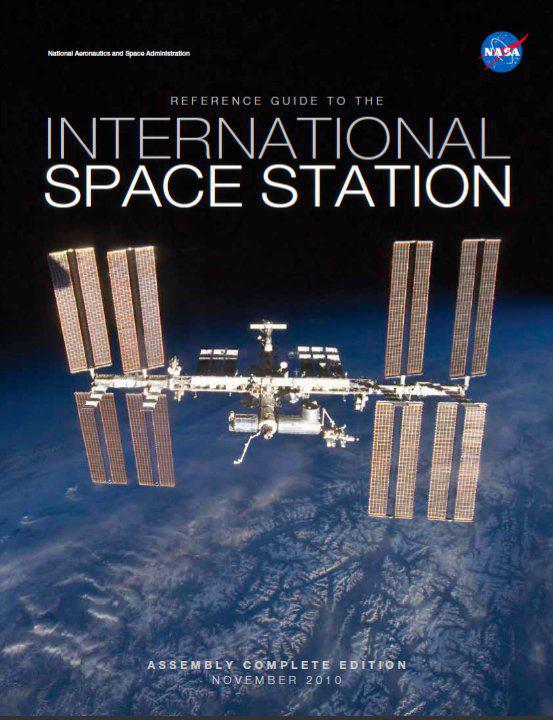
ISS Guide Reference


[EN]
Is available on NASA website the Reference Guide of International Space Station.
Highlight the page 21 where you can find the Guide to Experiments on the ISS.
To read and spread the word.

[PT]
Está disponível no sítio da NASA o Guia de Referência da Estação espacial Internacional (em Inglês).
Destaco a página 21 onde podemos encontrar o Guia das Experiências realizadas na ISS.
Para ler e divulgar.
[ES]
Está disponible en la ubicación de la NASA El Guía de referencia de la Estación Espacial Internacional (en Inglés).
Seleccione la página 21 donde se puede encontrar la Guía de experimentos en la ISS.
Para leer y difundir.


Friday, November 11, 2011

EPL paper from Space

Euro Physics Letters received its first paper from space.
Concerned with the properties of complex plasma in almost zero gravity conditions, the paper represents collaborative research of 29 individual missions performed over the last 10 years by German and Russian researchers aboard the  (ISS).

To read the full article and download (for free) the papers, visit: PhysOrg.com

Friday, February 25, 2011

Last Journey

Credits: NASA
Yesterday at the launch pad 39A at the Space Kennedy Center, the Shuttle Discovery initiated the final journey.
The STS133 mission of this shuttle to the International Space Station, it has a remarkable new: The ROBONAUT. It's the end for Discovery but the begging to Roboanut.
ROBONAUT 2 - Credits: NASA
See the launch in http://www.eufisica.com/TV/TV.html

Featured Post

IBSE about Light Pollution

Here is my presentation that happened in the Discover the Cosmos Conference (Volos, Greece - 2013). The presentation was an Inquiry Base...

Popular Posts