Follow eufisica

Follow eufisica

Showing posts with label refraction. Show all posts

Tuesday, May 13, 2014

Refraction of Light

Here is some photos taken at class to teach light's refraction.


To learn more about this topic try to find refraction in the search option.
You can also play with this PhET simulation:

Bending Light
Click to Run

Monday, March 31, 2014

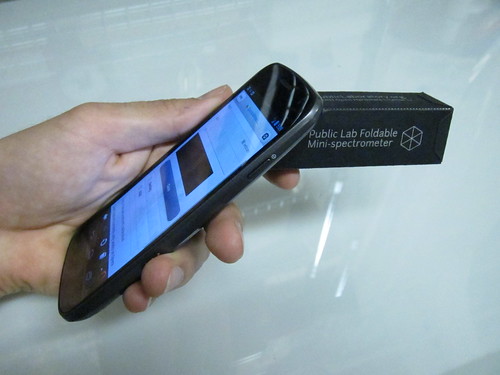
Mini-Spectrometer

Public Lab Origami Spectrometer

In a earlier post, I published how to build a spectrometer with house stuff. Now, a Physics teacher (friend of mine) show me this great website that show us how to build a mini-spectrometer. You can attach to an smartphone, laptop, or computer with a camera and submit your image to http://spectralworkbench.org/ (point your browser to the website and click "capture").

Saturday, April 28, 2012

Refraction


Snell's law (also known as the Snell–Descartes law and the law of refraction) is a formula used to describe the relationship between the angles of incidence and refraction, when referring to light or other waves passing through a boundary between two different isotropic media, such as water and glass.
Refraction of light at the interface between two media of different refractive indices, with n2 > n1. Since the velocity is lower in the second medium (v2 < v1), the angle of refraction θ2 is less than the angle of incidence θ1; that is, the ray in the higher-index medium is closer to the normal.
In optics, the law is used in ray tracing to compute the angles of incidence or refraction, and in experimental optics and gemology to find therefractive index of a material. The law is also satisfied in metamaterials, which allow light to be bent "backward" at a negative angle of refraction (negative refractive index).
Although named after Dutch astronomer Willebrord Snellius (1580–1626), the law was first accurately described by the Arab scientist Ibn Sahlat Baghdad court, when in 984 he used the law to derive lens shapes that focus light with no geometric aberrations in the manuscript On Burning Mirrors and Lenses (984).[1][2]
Snell's law states that the ratio of the sines of the angles of incidence and refraction is equivalent to the ratio of phase velocities in the two media, or equivalent to the opposite ratio of the indices of refraction:
\frac{\sin\theta_1}{\sin\theta_2} = \frac{v_1}{v_2} = \frac{n_2}{n_1}
with each \theta as the angle measured from the normal, v as the velocity of light in the respective medium (SI units are meters per second, or m/s) and n as the refractive index (which is unitless) of the respective medium.
The law follows from Fermat's principle of least time, which in turn follows from the propagation of light as waves.
Learn more about the mathematics of refraction in physicsclassrom.
Watch this video about refraction in gases (MIT):

Friday, August 7, 2009

Physics Buzz: How to Build a Spectrometer with Just Three Household Items

A PhysicsBuzz article show us how to build a spectrometer with simple stuff that we have at home!


"A CD has the very cool property of behaving like a reflective
diffraction grating. An ordinary diffraction grating is a grid of tiny,
evenly spaced opaque lines on an otherwise transparent material. Light can pass through the material but it has to bend around the lines, which are about the size of a wavelength of visible light." in PhysicsBuzz

----[Versão Portuguesa]----
Um artigo do PhysicsBuzz mostra como construir um espectrómetro com coisas simples que temos em casa!

"O CD tem a propiedade de comportar-se como uma rede de difracção por reflexão. Uma rede de difracção é como uma rede de pequenas linhas opacas, espaçadas uniformemente num material transparente. A luz pode passar através do material, mas tem que dobrar em redor das linhas, que são aproximadamente do tamanho de um comprimento de onda de a luz visível". in PhysicsBuzz
Para saber mais sobre como construir este espectrómetro, segue o endereço indicado.


---[Versión Española/Castelhana]----
Un artículo de PhysicsBuzz nos muestra cómo construir un espectrómetro con cosas simples que tenemos en casa!


"Un CD tiene la propiedad de comportarse como una red de difracción por reflexión. Una rejilla de difracción es como una red de pequeñas líneas opacas, espaciadas uniformemente, en un material transparente. La luz puede pasar a través del material, pero tiene que doblar en torno a las líneas, que son aproximadamente del tamaño de una longitud de onda de la luz visible". in PhysicsBuzz

Si quieres saber cómo construir, siga el enlace.

Featured Post

IBSE about Light Pollution

Here is my presentation that happened in the Discover the Cosmos Conference (Volos, Greece - 2013). The presentation was an Inquiry Base...

Popular Posts