TOP TEN POSTS IN 2013

Showing posts with label 2013. Show all posts
Showing posts with label 2013. Show all posts
Sunday, December 22, 2013


Gravity Visualized
 |
| Two-dimensional analogy of spacetime distortion generated by the mass of an object. Matter changes the geometry of spacetime, this (curved) geometry being interpreted as gravity. White lines do not represent the curvature of space but instead represent the coordinate system imposed on the curved spacetime, which would berectilinear in a flat spacetime. Credit: Wikipedia |
Newton's law for gravitational force is described by: F = G MA MB / r2
Where G is the gravitational constant, M is the mass of the body, and r is the vector position between the object with mass A and the other object with mass B. This force is a vector that increase with the mass of each object and decrease with the square of the distance between them.
Now you can see a great experiment about it.
I recommend the reading of this article: Why does gravity get weaker with distance?
The Sun's Magnetic Field is About to Flip.
The sun's magnetic field changes polarity approximately every 11 years. It happens at the peak of each solar cycle as the sun's inner magnetic dynamo re-organizes itself.
A reversal of the sun's magnetic field is, literally, a big event. The domain of the sun's magnetic influence (also known as the "heliosphere") extends billions of kilometers beyond Pluto. Changes to the field's polarity ripple all the way out to the Voyager probes, on the doorstep of interstellar space.

An artist's concept of the heliospheric current sheet, which becomes more wavy when the sun's magnetic field flips.
When solar physicists talk about solar field reversals, their conversation often centers on the "current sheet." The current sheet is a sprawling surface jutting outward from the sun's equator where the sun's slowly rotating magnetic field induces an electrical current. The current itself is small, only one ten-billionth of an amp per square meter (0.0000000001 amps/m2), but there’s a lot of it: the amperage flows through a region 10,000 km thick and billions of kilometers wide. Electrically speaking, the entire heliosphere is organized around this enormous sheet.
During field reversals, the current sheet becomes very wavy.
Cosmic rays are also affected. These are high-energy particles accelerated to nearly light speed by supernova explosions and other violent events in the galaxy.
"The sun's north pole has already changed sign, while the south pole is racing to catch up," Scherrer said. "Soon, however, both poles will be reversed, and the second half of solar max will be underway."
Source: NASA
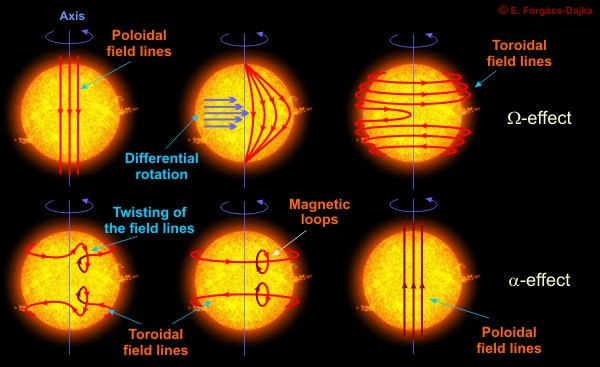
"The changing magnetic field is described by dynamo models: the rotation takes effect on the convective envelope and the result is the surface differential rotation, when the angular rotation has an equator-to-pole gradient. Differential rotation acts on the primordial poloidal field, and starts to build up a toroidal one (see the figure). Under the surface, somewhere at the bottom of the convective zone, this spin up effect streches, thus reinforces the toroidal field until it becomes an unstable state, when the buoyant force begins to act on them. Thus, the toroidal magnetic field arranged in vast flux tubes begins to emerge and reaches the solar surface. At this time, a typical magnetic feature appears: a magnetic loop, with a cool bipolar spot pair at the footpoints. The large scale meridional convection works just the opposite: somehow (that we do not understand clearly) it regenerates the poloidal field, transporting the emerging flux towards the poles. Finally, this process results in a poloidal field, similar to that we had at the beginning, but the polarity is now the opposite in sign."Source: http://www.konkoly.hu/solstart/stellar_activity.html
Tuesday, December 10, 2013
Impressions from La Silla

ESOcast 61: Chile Chill 5 - Impressions from La Silla
In this episode of Chile Chill we take a closer look at the telescopes and instruments of ESO's first observatory at La Silla in northern Chile.
Loading player...
http://www.eso.org/public/videos/esocast61a/
Thursday, November 28, 2013
Comet ISON
 |
| Credit: HST |
Right now, Comet ISON is making that journey. It began its trip from the Oort cloud region of our solar system and is now travelling toward the sun. The comet will reach its closest approach to the sun on Thanksgiving Day -- Nov. 28, 2013 -- skimming just 730,000 miles above the sun’s surface. If it comes around the sun without breaking up, the comet will be visible in the Northern Hemisphere with the naked eye, and from what we see now, ISON is predicted to be a particularly bright and beautiful comet.
font: NASA
More info: wikipedia
Wednesday, October 9, 2013
The 2013 Nobel Prize in Physics
The Nobel Prize in Physics 2013 was awarded jointly to François Englert and Peter W. Higgs "for the theoretical discovery of a mechanism that contributes to our understanding of the origin of mass of subatomic particles, and which recently was confirmed through the discovery of the predicted fundamental particle, by the ATLAS and CMS experiments at CERN's Large Hadron Collider"

Photo: Pnicolet via Wikimedia Commons
François Englert

Photo: G-M Greuel via Wikimedia Commons
Peter W. Higgs
The Scientific background paper can be found here. (font: nobelprize.org website)
You can find the complete investigation conducted at CERN in the official website.
Interview with François Englert (credit: CERN)
You can find the complete investigation conducted at CERN in the official website.
Interview with François Englert (credit: CERN)
Interview with Peter Higgs (credit: CERN)
Sunday, October 6, 2013
Astro Watch: 'Higgsogenesis'
 |
| The Globe - CERN (C) Photo by José Gonçalves (eufisica) |
"Two physicists suggest that the Higgs had a key role in the early Universe, producing the observed difference between the number of matter and antimatter particles and determining the density of the mysterious dark matter that makes up five-sixths of the matter in the Universe."- AstroWatch
Astronomy and Space News - Astro Watch: 'Higgsogenesis' Proposed to Explain Dark Matter: A key riddle in cosmology may be answered by the 2012 discovery of the Higgs boson — now a leading contender for the 2013 Nobel Prize in...
Wednesday, October 2, 2013
New Galaxy Catalog

For the catalog"Researchers publish enormous catalog of more than 300,000 nearby galaxies.More than 83,000 volunteer citizen scientists. Over 16 million galaxy classifications. Information on more than 300,000 galaxies. This is what you get when you ask the public for help in learning more about our universe.The project, named Galaxy Zoo 2, is the second phase of a crowdsourcing effort to categorize galaxies in our universe. Researchers say computers are good at automatically measuring properties such as size and color of galaxies, but more challenging characteristics, such as shape and structure, can currently only be determined by the human eye.This catalog is 10 times larger than any previous catalog of its kind. It is available online and a paper describing the project and data was published today in the Monthly Notices of the Royal Astronomical Society." +Betty Bee (on G+)
http://data.galaxyzoo.org/
Research paper
Tuesday, October 1, 2013
Strange behavior of bouncing drops

"A research team led by Yves Couder at the Université Paris Diderot recently discovered that it's possible to make a tiny fluid droplet levitate on the surface of a vibrating bath, walking or bouncing across, propelled by its own wave field. Surprisingly, these walking droplets exhibit certain features previously thought to be exclusive to the microscopic quantum realm." (PhysOrg)
Read more and watch the videos at: http://phys.org/news/2013-10-strange-behavior-pilot-wave-dynamics-action.html#jCp
Saturday, September 28, 2013
Latest news from Curiosity

Low concentration of methane in the atmosphere
The data collected by Curiosity rover revealed a poor concentration of methane in Mars. This results are interesting because they are in contradiction with the data collected by other missions in Mars' orbit.
The methane is important to scientist because it came from geological phenomena and biological process.
“This results minimized the probability of microbiological process in Mars, but there are many types of terrestrial microbes that do not generate methane.”
The Curiosity measured six times the concentration of methane in samples from the Martian atmosphere, in the period between October 2012 and June this year. In any cases, the robot has detected its presence. Due to the high sensitivity of the instrument used, the tunable laser spectrometer which follows the edge of the robot, scientists estimate that the concentration of atmospheric methane Mars should not exceed 1.3 parts per million. This value corresponds to roughly one-sixth of some previous estimates.
More info ScienceMag.

Water in the martian soil
After careful analysis, the fifth soil collection done by Curiosity rover in 'Rocknest' showed the presence of water, carbon dioxide, oxygen and sulfur. As a result of this analysis, it appears that the Martian soil is composed by 2% water, which leads scientists to project future missions to colonize the red planet.
"We know that there must be water on Mars so abundant and accessible," said Laurie Leshin, lead author of the study, concluding that "when we send people to Mars, they may collect soil from the Martian surface, heat it a little and draw water ". According to the study, we can extract about 0.47 liters of water from 0.03 cubic meter of soil.
More info in Space.com
Source: NASA
Images: NASA/JPL-Caltech/MSSS
Thursday, September 19, 2013
Friday, September 13, 2013
Voyager 1 reaches Interstellar Space

You Are Here, Voyager: This artist's concept puts huge solar system distances in perspective. The scale bar is measured in astronomical units (AU), with each set distance beyond 1 AU representing 10 times the previous distance. Each AU is equal to the distance from the sun to the Earth. It took from 1977 to 2013 for Voyager 1 to reach the edge of interstellar space.
Image Credit:
NASA/JPL-Caltech
"We have been cautious because we're dealing with one of the most important milestones in the history of exploration,” said Voyager Project Scientist Ed Stone of the California Institute of Technology in Pasadena. “Only now do we have the data -- and the analysis -- we needed."
Basically, it was needed more data on plasma, which is ionized gas, the densest and slowest moving of charged particles in space. The plasma is the most important marker and show us that Voyager 1 is inside the solar bubble, known as the heliosphere, or in the interstellar space and surrounded by material ejected by the explosion of nearby giant stars millions of years ago.
The two Voyager spacecraft were launched in 1977 and Voyager 1's plasma instrument, which measures the density, temperature and speed of plasma, stopped working in 1980. The science team detected the pressure of interstellar space on our heliosphere in 2004, they focused on the direction of the magnetic field as a proxy for source of the plasma. Since solar plasma carries the magnetic field lines emanating from the sun and interstellar plasma carries interstellar magnetic field lines, the directions of the solar and interstellar magnetic fields were expected to differ.
Then on April 9, 2013, it happened: Voyager 1's plasma wave instrument picked up local plasma oscillations. The oscillations increased in pitch through May 22 and indicated that Voyager was moving into an increasingly dense region of plasma. This plasma had the signatures of interstellar plasma, with a density more than 40 times that observed by Voyager 2 in the heliosheath.
Read the characteristics of Voyager 1 in Space.com
Thank you Lawrence Klaes for the links
Thursday, September 12, 2013
Voyager 1 left the Solar System
 |
| An artist's concept shows the Voyager spacecraft traveling through space against a field of stars. Credit: NASA/JPL-Caltech. |
University of Iowa space physicist Don Gurnett says there is solid evidence that NASA's Voyager 1 spacecraft has become the first manmade object to reach interstellar space, more than 11 billion miles distant and 36 years after it was launched.
Read more at: phys.org
After streaking through space for nearly 35 years, NASA's robotic Voyager 1 probe finally left the solar system in August 2012, a study published today (Sept. 12) in the journal Science reports.
Wednesday, September 11, 2013

The big James Webb Telescope
Nice graphic size comparison of various space telescopes.
Courtesy +Tony Darnell
 |
| Credit: Tony Darnell |
Mission Exploring the Universe from the solar neighbourhood to the most distant galaxies.
Name The James Webb Space Telescope honours NASA's second administrator, James E. Webb.
Partnership JWST is a joint project between NASA, ESA and the Canadian Space Agency (CSA).
Description JWST is a major space observatory often presented as the successor to the very successful NASA/ESA Hubble Space Telescope (HST). It has a large 6.5-metre segmented mirror that will collect almost 6 times more light than HST. It has also been designed to work with infrared light. It will address a broad variety of scientific topics ranging from detecting the first galaxies in the Universe to studying planets around other stars.
 |
| Credit: NASA |
JWST mission facts
Scientists expect JWST:
- to find out more about the origins of the Universe by observing infrared light from the first stars and galaxies;
- to study the properties of planets around other stars, including looking for the signature of water in their atmosphere;
Read more:
James Webb Telescope - A bigger and better time machine (ESA)
James Webb Factsheet (ESA)
Saturday, August 31, 2013
IBSE about Light Pollution
Here is my presentation that happened in the Discover the Cosmos Conference (Volos, Greece - 2013).
The presentation was an Inquiry Based Science Education (IBSE) scenario about Light Polution:
Light pollution from eufisica
You can download the worksheets here: http://portal.discoverthecosmos.eu/en/node/195700
Friday, August 30, 2013
Bullet Block Explained!
The question is: which will make the block of wood go higher? The bullet in the center of the block or off center?

Both achieve the same high (conservation of momentum).
There is certainly energy associated with the spinning of the block. The kinetic energy is not conserved during this collision, but the total energy is. The internal energy associated to each block is different (in each block we have thermal energy and deformation energy). So, the block 2 will have the same translational kinetic energy as block 1 by a lower change in internal energy (the bullet causes less thermal energy and deformation to the second block, and it increase in rotational kinetic energy).
Now, you can see all the info in Wired website, and watch the answer:
The Solar System -- our home in space

This cool video has a lot if information about our Solar System:
Tuesday, August 20, 2013
NASA Spinoff 2012

Subscribe to:
Posts (Atom)
Popular Posts
-
 Standard Model - Source: Wikipedia The Standard Model of particle physics is the theoretical framework that describes the fundamental bu...
 -
 Eggnaut protection created with Gemini One of the students’ favorite challenges is the Eggnaut experiment. In this activity, they use the ...
 -
Andrew Fraknoi made a catalog with Astronomy applications for your mobile and you can found it here (most applications is for iPhone...
-
 In the past, I posted about the Physics of Spiderman 3 , Superman . Today, I present in this blog a paper about Physics and Superheroes.


