
Showing posts with label collision. Show all posts
Showing posts with label collision. Show all posts
Thursday, May 31, 2012
Crash of the Titans
In this episode of the Hubblecast, scientists Jay Anderson and Roeland van der Marel show how they have used Hubble observations to predict the future of the Andromeda Galaxy and the Milky Way.

Monday, April 9, 2012
Colliding galaxies

The collision of galaxies is very common in the evolution of the universe.
Due to the extremely tenuous distribution of matter in the galaxies themselves, these collisions are not in the normal sense of the word, but gravitational interactions.
The collision may lead to fusion. This occurs when two galaxies collide and do not have enough strength to continue traveling after the collision. Instead, they attract each other, returning back and eventually merge, after several passages through, forming a single galaxy. If one of the clusters in collision is much larger than the other, it will remain intact after the fusion, that it means that the largest galaxy will look the same, while the smaller galaxy is removed and become part of the large one.
Thursday, April 5, 2012
The Standard Model of Particle Physics
LHC physics data taking gets underway at new record collision energy of 8TeV


(font CERN)At 0:38 CEST this morning, the LHC shift crew declared ‘stable beams’ as two 4 TeV proton beams were brought into collision at the LHC’s four interaction points. This signals the start of physics data taking by the LHC experiments for 2012. The collision energy of 8 TeV is a new world record, and increases the machine’s discovery potential considerably.
- Press Release: LHC physics data taking gets underway at new record collision energy of 8TeV
- Video: CERN News - Physics restarts in the LHC at new record energy
- CERN: LHC bate novo recorde mundial de energia
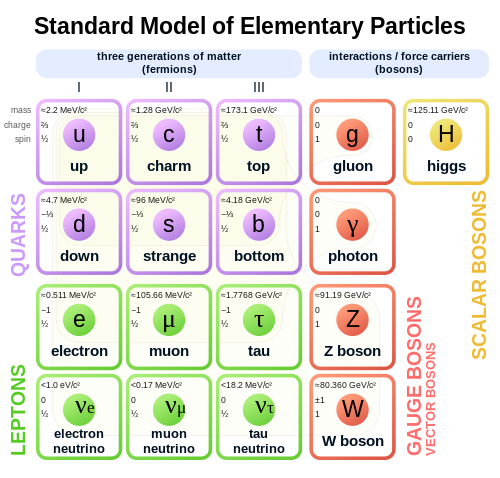
The Standard Model of particle physics is a theory concerning the electromagnetic, weak, and strong nuclear interactions, which mediate the dynamics of the known subatomic particles.
Still, the Standard Model falls short of being a complete theory of fundamental interactions because it does not incorporate the physics of dark energy nor of the full theory of gravitation as described by general relativity. The theory does not contain any viable dark matter particle that possesses all of the required properties deduced from observational cosmology. It also does not correctly account for neutrino oscillations (and their non-zero masses). Although the Standard Model is believed to be theoretically self-consistent, it has several apparently unnatural properties giving rise to puzzles like the strong CP problem and the hierarchy problem.
Nevertheless, the Standard Model is important to theoretical and experimental particle physicists alike. For theorists, the Standard Model is a paradigmatic example of a quantum field theory, which exhibits a wide range of physics including spontaneous symmetry breaking, anomalies, non-perturbative behavior, etc. It is used as a basis for building more exotic models which incorporate hypothetical particles, extra dimensions and elaborate symmetries (such as supersymmetry) in an attempt to explain experimental results at variance with the Standard Model, such as the existence of dark matter and neutrino oscillations. In turn, experimenters have incorporated the Standard Model into simulators to help search for new physics beyond the Standard Model.
Recently, the Standard Model has found applications in fields besides particle physics, such as astrophysics, cosmology, and nuclear physics.
(in Wikipedia)
You can read another posts about particles and Higgs in my blog. Now, watch this videos about Standard Model:
Tuesday, March 13, 2012
Angry Birds Space: NASA announcement

Techradar website explores velocity and distance (post 1) and stretching and collisions (post 2);
wired website explores the elastic force, acceleration and analysis.http://www.wired.com/wiredscience/2011/11/physics-of-the-yellow-angry-bird/
Angry Birds Space is coming and NASA made "the announcement":
Wednesday, January 18, 2012
CMS gaves a lot of particle collision data
 |
| Credit: CERN |
"Datasets are the currency of physics. As data accumulate, measurement uncertainty ranges shrink, increasing the potential for discoveries and making non-observations more stringent, with more far-reaching consequences. In collider experiments, the amount of data is measured by the total number of collisions observed and the rate of those collisions, called the luminosity. In 2011, the Large Hadron Collider (LHC) produced more collisions than scientists dared to expect, breaking the world record luminosity in April and then continuing to grow seven-fold. By the end of the proton collision run in November, 240 million protons were colliding each second."
in PhysOrg
CMS Particle Detector
The LHC smashes groups of protons together and very close to the speed of light: 40 million times per second and with seven times the energy of the most powerful accelerators. When the collisions happens some of its energy is turned into mass and previously unobserved, short-lived particles – which could give clues about how Nature behaves at a fundamental level - fly out and into the detector.
The Physics Results
All the Physics results can be found here.
CMS is a general-purpose experiment with sub-groups producing results for many different topics including:
- QCD Physics
- Forward Physics
- B Physics and Quarkonia
- Electroweak Physics
- Top Physics
- Higgs Physics
- Supersymmetry
- Exotica
- Heavy Ions Physics
font: http://cms.web.cern.ch
Watch the Photobook 2008:
Tuesday, January 17, 2012
Copper collisions gives more strangeness than gold
"Colliding pairs of copper ions produce significantly more strange quarks per nucleon than pairs of much larger gold atoms. That is the surprising discovery of physicists working on the Relativistic Heavy Ion Collider (RHIC) at the Brookhaven National Laboratory in the US. The finding gives further backing to the core–corona model of such high-energy collisions and could shed further light on the quark–gluon plasma – a state of matter though to have been present in the very early universe."

in PhysicsWorld
Wednesday, April 13, 2011
When Neutron Stars Collide
EN: A team of scientist made the most concise simulation about the collision of two neutron's stars.
ES: Un equipo de científicos hizo la simulación más concisa sobre la colisión de dos estrellas de neutrones.
PT: Uma equipa de cientistas realizou a mais precisa simulação da colisão de duas estrelas de neutrões até à data. Saber mais em astroPT.
Monday, March 28, 2011
The antihelium was discover

The antihelium
Physics of the Relativistic Heavy Ion Collider (RHIC) in New York claim that they created nuclei of antihelium-4 for the first time – the heaviest antimatter element ever seen on Earth.
Antimatter nuclei are made from antiprotons and antineutrons but, with all the types of combinations of two and three quarks that can appear in the particle collisions, it is rare that multiple antiprotons and antineutrons appear close enough to each other to form anti-nuclei. Although the first antiprotons and antineutrons were discovered in 1950s, the construction of heavier nuclei has been very difficult and each additional anti-nucleon makes the anti-nuclei 1000 less probable to appear in a collision of particles. Until now, the heaviest anti-nuclei observed was limited to three anti-nucleons. But with RHIC experiment and the new detectors of STAR was possible to detect such anti-nuclei.
read more in: physicsworld.com
Versão Portuguesa: em astroPT ou eufisica.com
Thursday, November 11, 2010
Tuesday, November 9, 2010
First image from lead ions' collisions
First collisions of lead ions seen by the ALICE experiment on 07.11.2010 recorded by its innermost detector, the Inner Tracking System.
The shaded structures represent a perspective view of the detector elements. The lines are the reconstructed particle trajectories and the colour scale indicates the energy of the particles.
Such collisions produce an unprecedented number of particles, reaching thousands per collision.
More images: http://aliceinfo.cern.ch/Public/en/Chapter1/fhied.html
The shaded structures represent a perspective view of the detector elements. The lines are the reconstructed particle trajectories and the colour scale indicates the energy of the particles.
Such collisions produce an unprecedented number of particles, reaching thousands per collision.
 |
| Credits: ALICE experiment, CERN |
Wednesday, September 10, 2008
LHC
LHC
LHC First Beam on 10 September 2008
Primeira experiência do LHC
Geneva, 10 de Setembro de 2008. O primeiro teste com um feixe de milhões de protões no acelerador LHC (Large Hadron Collider) do Laboratório Europeu de Física de Partículas (CERN) foi bem sucedido, percorrendo os 27 quilómetros às 10h28min desta manhã. Este evento histórico marca um momento chave na transição, com mais de duas décadas de preparação, para uma nova era de descobertas científicas.
Para saber mais visite:
First beam in the LHC - accelerating science
Geneva, 10 September 2008. The first beam test, with millions of protons, in the Large Hadron Collider (LHC) at CERN was successfully. The beam covered a distance around the full 27 kilometres at 10h28 this morning. This historic event marks a key moment in the transition to a new era of scientific discovery.
(in CERN)
Subscribe to:
Posts (Atom)
Popular Posts
-
Atomic wire made of phosphorus. It links to silicon atoms. Credit: Physics World Ohm's Law Ohm's law states that th...
-
" 'C' is for chocolate! 'c' is also the symbol used for the speed of light. Defined as being 299,792,458 meters per ...
-
Snell's law (also known as the Snell–Descartes law and the law of refraction ) is a formula used to describe the relationship be...
-
" Physicists like to think that all you have to do is say, these are the conditions, now what happens next? " Richard Feynman [...
-
Physics Buzz: Rollercoaster Roulette: Physics Edition tags: ...


