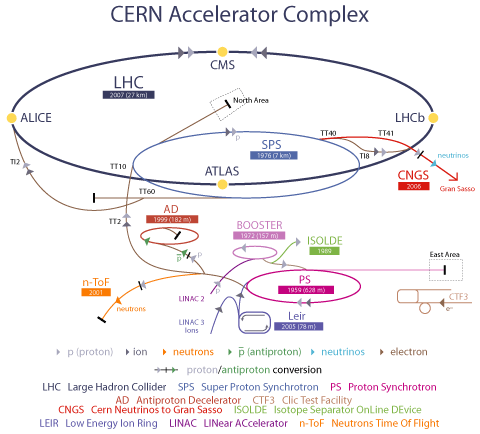
 In this day we had two lectures. One lecture was about the latest discoveries (top quark, bottom quark and tau neutrino); the second lecture was about the Principle of Uncertainty. I don't want to bored you with this stuff. So lets talk about our first visit: LINAC 2. We went to the restricted area with radiation control and watch the place where Physics started. Everything started with a tiny Hydrogen bottle. The H2 goes to a chamber where the electrons are retain and protons are "synchronized". After that the protons are injected to a linear accelerator and goes to LEIR. Look here:
Friday, July 6, 2012
HST2012, CERN - Day 6
In this day we had two lectures. One lecture was about the latest discoveries (top quark, bottom quark and tau neutrino); the second lecture was about the Principle of Uncertainty. I don't want to bored you with this stuff. So lets talk about our first visit: LINAC 2. We went to the restricted area with radiation control and watch the place where Physics started. Everything started with a tiny Hydrogen bottle. The H2 goes to a chamber where the electrons are retain and protons are "synchronized". After that the protons are injected to a linear accelerator and goes to LEIR. Look here:
Subscribe to:
Post Comments (Atom)
Popular Posts
-
O Telescópio Espacial Hubble foi levado para o espaço em 24 de Abril de 1990. Este telescópio tem cinco instrumentos científicos: uma c...
-
Time of flight difference between the speed of light and the arriving neutrinos. Observe a great difference between the two experiments. N...
-
The principle of quantum random motion in two dimensions: At a node, a light pulse can continue on its journey through a network of optica...


No comments:
Post a Comment